GitHub hosts HunyuanVideo, Tencent's open-source framework for large-scale video generation models, enabling AI-driven video creation.

LeRobot
$0.07Starting price
0Popularity
About LeRobot
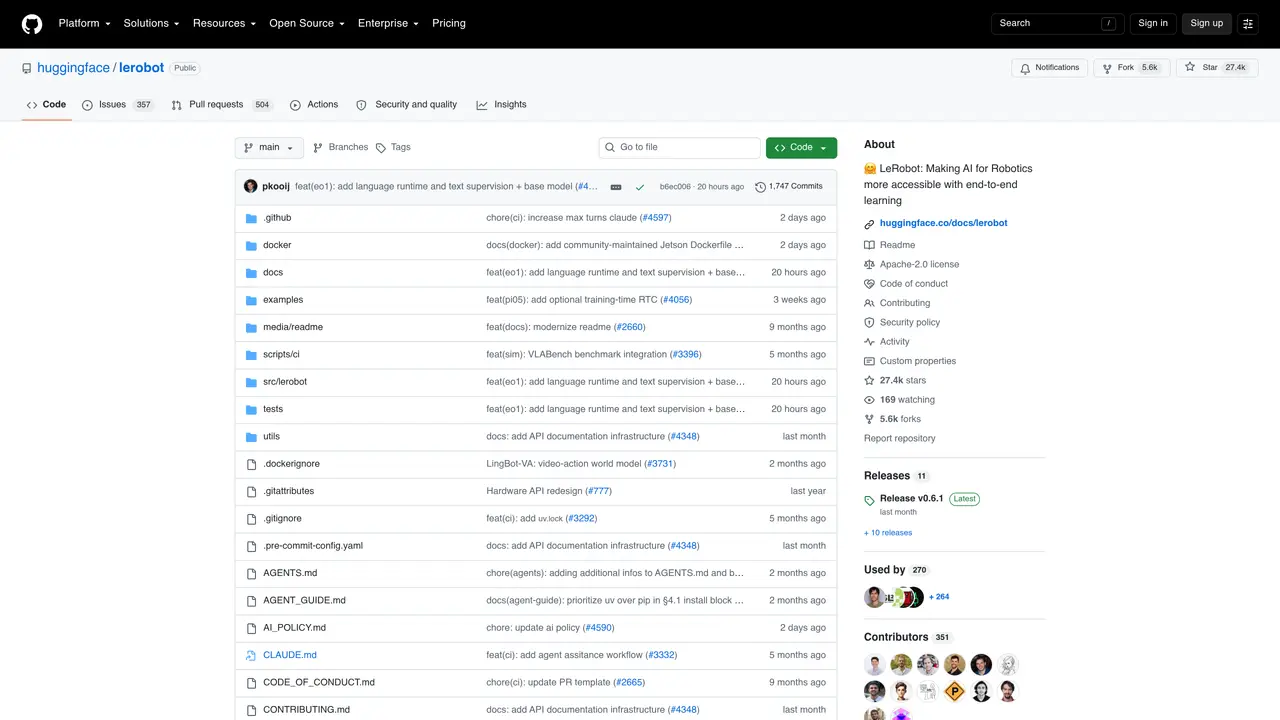
LeRobot is an open-source PyTorch library developed by Hugging Face that provides a shared foundation for end-to-end robot learning. It combines robot control interfaces, dataset standards, training scripts, and deployable policies into a unified workflow. The tool is designed to reduce friction in robot learning projects by standardizing the infrastructure layer between hardware, data collection, training, and deployment. Researchers and engineers can use LeRobot to collect synchronized robotics data, train policies through configuration-driven commands, and evaluate behavior in both simulation and real-world environments. The library supports imitation learning, reinforcement learning, and vision-language-action experiments, making it suitable for academic labs, robotics startups, and hardware teams. It also facilitates reproducibility by providing a standardized dataset format and publishing tools for sharing datasets and pretrained policies via the Hugging Face Hub. LeRobot is best suited for users with Python-based machine learning experience who need practical robotics infrastructure rather than a no-code solution or commercial fleet management system.
GitHub, Inc.
San Francisco, California, US · Founded 2008
- Founders
- Tom Preston-Werner, Chris Wanstrath, PJ Hyett, Scott Chacon
- Founded
- 2008
- Headquarters
- San Francisco, California, US
- Legal status
- Subsidiary of Microsoft (NASDAQ: MSFT)
Key features
- Unified PyTorch-based workflow for robot control, data collection, and policy training
- Standardized LeRobotDataset format for synchronized visual, state, and action data
- Configuration-driven policy training for imitation learning, reinforcement learning, and vision-language-action experiments
- Support for both simulation and real-world robot evaluation
- Robot interface for standardizing connection, observation, and action commands across hardware
- Hugging Face Hub integration for publishing and discovering datasets and pretrained policies
- Reproducible experiments and easy sharing of datasets and models
- Custom hardware support through extensible Robot interface
Use cases
- Recording teleoperated demonstrations on a low-cost robotic arm and training imitation policies for transfer to physical setups
- Prototyping robot policies in academic labs or startups using affordable hardware before scaling to specialized platforms
- Converting fragmented robotics recordings into standardized datasets for training and evaluation in research workflows
Pros
- Provides a hardware-agnostic Python interface for standardizing robot control across diverse platforms
- Includes a standardized LeRobotDataset format (Parquet + MP4/images) for efficient storage, streaming, and visualization of robotic datasets
- Offers state-of-the-art policies designed for real-world transferability and deployment
- Supports a wide range of robots and teleoperation devices natively or via extensible interfaces
- Integrates seamlessly with the Hugging Face Hub for dataset and model sharing and discovery
Cons
- Requires Python-based machine learning experience, limiting accessibility for non-technical users
- Hardware integration may still require custom implementation for unsupported devices
- Dataset and model sharing via the Hugging Face Hub depends on community adoption and maintenance
Frequently asked questions about LeRobot
What is LeRobot and what does it do?
LeRobot is an open-source PyTorch library designed to make AI for robotics more accessible by providing end-to-end learning tools, including models, datasets, and standardized interfaces for robot control, data collection, training, and deployment.
Who is LeRobot suitable for?
The tool is aimed at researchers, engineers, and hardware teams with Python-based machine learning experience who need practical robotics infrastructure, rather than no-code solutions or commercial fleet management systems.
How does LeRobot handle different types of robots?
LeRobot provides a unified Robot class interface that decouples control logic from hardware specifics, supporting a wide range of robots and teleoperation devices natively or through extensible implementations.
What is the LeRobotDataset format?
The LeRobotDataset format uses synchronized MP4 videos (or images) for vision and Parquet files for state/action data, enabling efficient storage, streaming, and visualization of robotic datasets.
Can I use LeRobot with custom hardware?
Yes, LeRobot is designed to be extensible; users can implement the Robot interface to utilize its data collection, training, and visualization tools for their own custom robots.
How do I get started with LeRobot?
LeRobot can be installed directly from PyPI using pip. Detailed installation and usage guides are available in the project's documentation and GitHub repository.