
OpenAI builds and deploys advanced AI models like GPT-4o for autonomous agents and workflows.

Pollen Robotics
323KMonthly visits
42Popularity
About Pollen Robotics
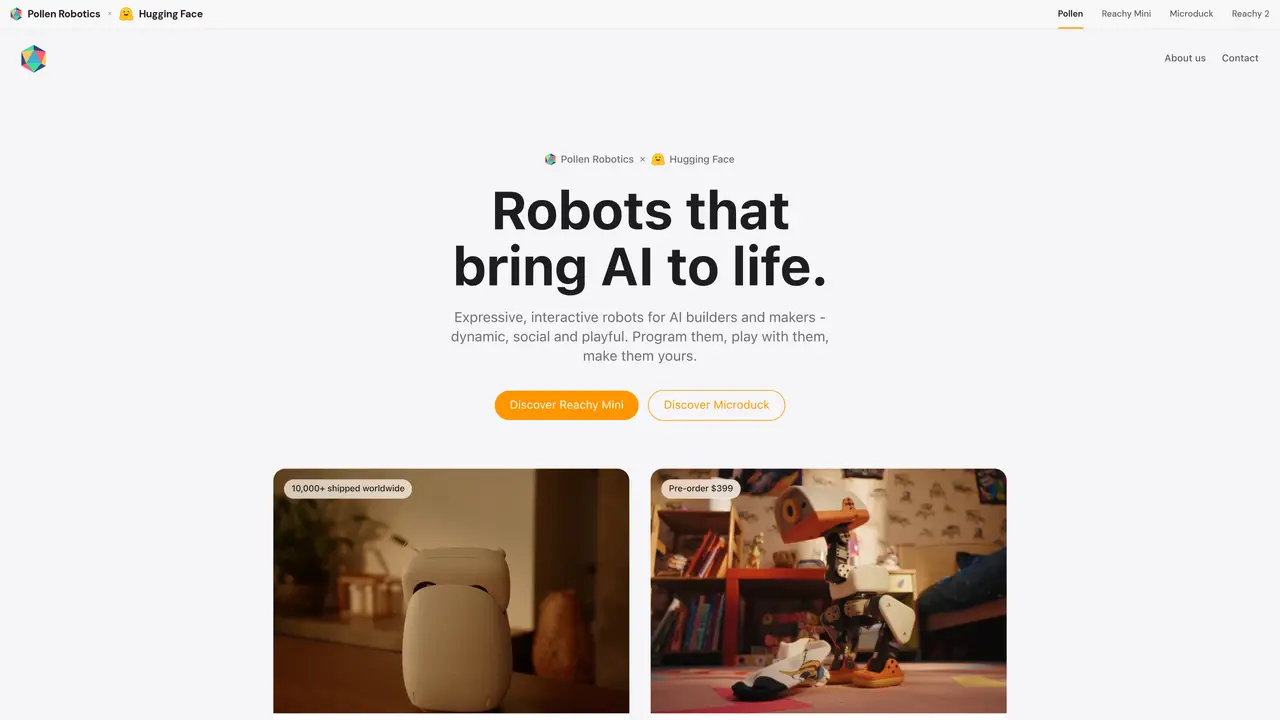
Pollen Robotics builds open-source, expressive robots designed to make embodied AI practical for researchers, educators, and makers. Reachy Mini enables social interaction and creative coding, while Microduck is a compact biped focused on locomotion and reinforcement learning. The robots support workflows from software behavior design to on-robot deployment, allowing users to evaluate policies in real environments with people. Open documentation, example apps, and community resources reduce setup time and accelerate iteration across sensing, control, and behavior layers. Designed for accessibility, the platforms feature approachable hardware, modular actuation, and transparent documentation to lower integration barriers and enable reproducible experiments. Developers can prototype embodied AI quickly, script expressive interactions, or train locomotion skills before deploying in real-world conditions. The architecture combines open hardware with documented control stacks, bridging perception to action for scripted behaviors, learned policies, and rapid evaluation with real users and environments.
Pollen Robotics
Bordeaux, France · Founded 2016
- Founded
- 2016
- Headquarters
- Bordeaux, France
Key features
- Open-source hardware with transparent documentation
- Reachy Mini for social interaction and creative coding
- Microduck for compact biped locomotion and reinforcement learning
- Modular actuation and accessible components for repairability
- Open-source SDKs and example apps for rapid prototyping
- Community resources including GitHub and Discord support
- Scripted behaviors, learned policies, and model-to-robot evaluation
- Approachable hardware designed for education and research
Use cases
- Prototyping embodied AI behaviors for social robots
- Reinforcement learning and locomotion experiments on compact bipeds
- Human-robot interaction studies and educational robotics projects
Pros
- Open-source hardware and software for full customization and transparency
- Modular actuation and documented control stacks for reproducible experiments
- Designed for accessibility with approachable hardware and transparent documentation
- Supports both scripted behaviors and reinforcement learning workflows
- Community resources and example applications reduce setup time and accelerate iteration
Cons
- Limited availability due to pre-order or shipping constraints
- Requires technical expertise for advanced AI and robotics integration
- Physical robots may have constraints in deployment environments
Frequently asked questions about Pollen Robotics
What are Pollen Robotics' robots designed for?
Pollen Robotics builds expressive, interactive robots for AI builders and makers, enabling social interaction, creative coding, and AI experimentation.
Who is Pollen Robotics suitable for?
The robots are designed for researchers, educators, and makers who want to prototype embodied AI, experiment with locomotion, or deploy interactive behaviors in real-world conditions.
How do the robots support AI development?
The robots support workflows from software behavior design to on-robot deployment, allowing users to evaluate AI policies in real environments with people.
Are the robots open-source?
Yes, Pollen Robotics provides open-source hardware and software under the Apache 2.0 license, with documentation and community resources available.
What integrations or tools work with Pollen Robotics' robots?
The robots are designed to integrate with AI frameworks and tools, including reinforcement learning libraries, and are supported by example applications and community resources.
How can I get started with Pollen Robotics' robots?
Users can begin by exploring the provided documentation, downloading example applications, and joining the community resources such as Discord and GitHub for support and collaboration.
Pollen Robotics Website Engagement
Last Update: 10 days ago
Total Monthly Visits
0
Bounce Rate
0%
Visit Duration (avg)
0.00s
Pages Per Visit
0
Country Rank
0
United States
Global Rank
0
Category Rank
#0
Computers Electronics & Technology
Monthly Traffic
Traffic Sources
Traffic Share By Country
- United States43.9%
- China7.3%
- Germany7.2%
- South Korea5.7%
- Canada5%