Meshy turns text prompts or images into fully textured 3D models in minutes.
NVIDIA Omniverse
0Popularity
About NVIDIA Omniverse
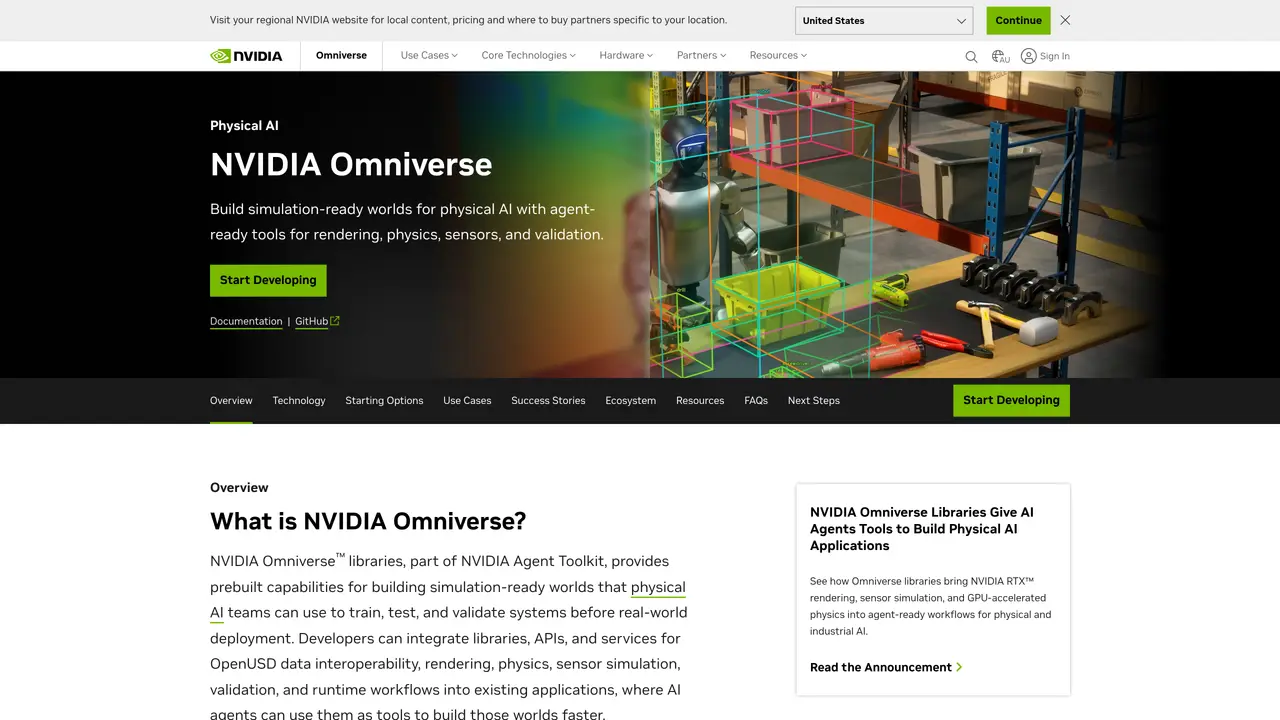
NVIDIA Omniverse provides OpenUSD-native libraries, APIs, and services to construct simulation-ready 3D environments for physical AI applications. Teams integrate RTX rendering, physics, synthetic sensors, and validation to create digital twins, robotics workflows, and scalable synthetic data pipelines within existing applications. The platform enables durable scene structure, agent-assisted preflight checks, and reproducible physics for safe deployment in robotics, autonomous vehicles, and industrial digital twins. Typical workflows begin with OpenUSD scenes assembled from design and engineering sources, followed by agent or script checks for materials, colliders, and semantics. Rendering via ovrtx and physics via ovphysx produce viewport outputs and sensor data, while validation gates ensure readiness before downstream simulation, data generation, or deployment. Omniverse supports local development on NVIDIA RTX workstations, scaling to multi-user visualization with NVIDIA OVX or bursty synthetic data generation on NVIDIA DGX Cloud. Production deployments can leverage NVIDIA Enterprise Support where applicable.
Key features
- OpenUSD-native scene assembly and interoperability across design, simulation, and robotics tools
- RTX rendering for photorealistic viewport outputs and synthetic sensor data (cameras, lidar, radar)
- GPU-accelerated physics simulation for motion, contacts, and constraints
- Agent-assisted preflight checks for materials, colliders, and semantics
- SimReady validation gates to ensure asset readiness before training or deployment
- Integration with existing applications via APIs and libraries (ovrtx, ovphysx)
- Scalable deployment options from local RTX workstations to OVX and DGX Cloud
- Support for digital twins, robotics workflows, and synthetic data pipelines
- Human-in-the-loop workflows for scene checks and issue routing
- NVIDIA Enterprise Support for production deployments
Use cases
- Building and validating digital twins for industrial facility planning and optimization
- Preparing robotics learning and evaluation environments with physics and sensor simulation
- Generating synthetic perception data for autonomous vehicle sensor setups and scenario reviews
Pros
- OpenUSD-native architecture for seamless 3D scene composition and interoperability
- Integrated RTX rendering, physics, and synthetic sensors for high-fidelity simulations
- Agent-assisted preflight checks and validation gates for reproducible workflows
- Scalable deployment options from local RTX workstations to cloud-based DGX systems
- Supports multi-user collaboration and bursty synthetic data generation pipelines
Cons
- Requires NVIDIA RTX hardware for optimal performance
- Steep learning curve due to complex OpenUSD and Physical AI workflows
- Limited accessibility for users without access to NVIDIA-certified systems
Frequently asked questions about NVIDIA Omniverse
What is NVIDIA Omniverse used for?
NVIDIA Omniverse is used to develop simulation-ready 3D environments for physical AI applications, enabling teams to create digital twins, robotics workflows, and synthetic data pipelines.
Who should use NVIDIA Omniverse?
The tool is designed for teams working in robotics, autonomous vehicles, industrial digital twins, and AI training, particularly those requiring high-fidelity simulations and OpenUSD-native workflows.
How does NVIDIA Omniverse integrate with other tools?
Omniverse supports integration with design and engineering sources via OpenUSD, and offers APIs for extending functionality within existing applications and workflows.
What hardware is required to run NVIDIA Omniverse?
Optimal performance requires NVIDIA RTX workstations or certified systems, with scaling options available on NVIDIA OVX or DGX Cloud for larger workloads.
Can NVIDIA Omniverse be used for synthetic data generation?
Yes, Omniverse supports scalable synthetic data generation pipelines, particularly for training AI models in robotics and autonomous systems.
How do I get started with NVIDIA Omniverse?
Users can begin with the Omniverse Libraries and OpenUSD documentation, followed by exploring use cases like digital twins or robotics simulations.