Meshy turns text prompts or images into fully textured 3D models in minutes.

RNDRS
$19Starting price
0Popularity
About RNDRS
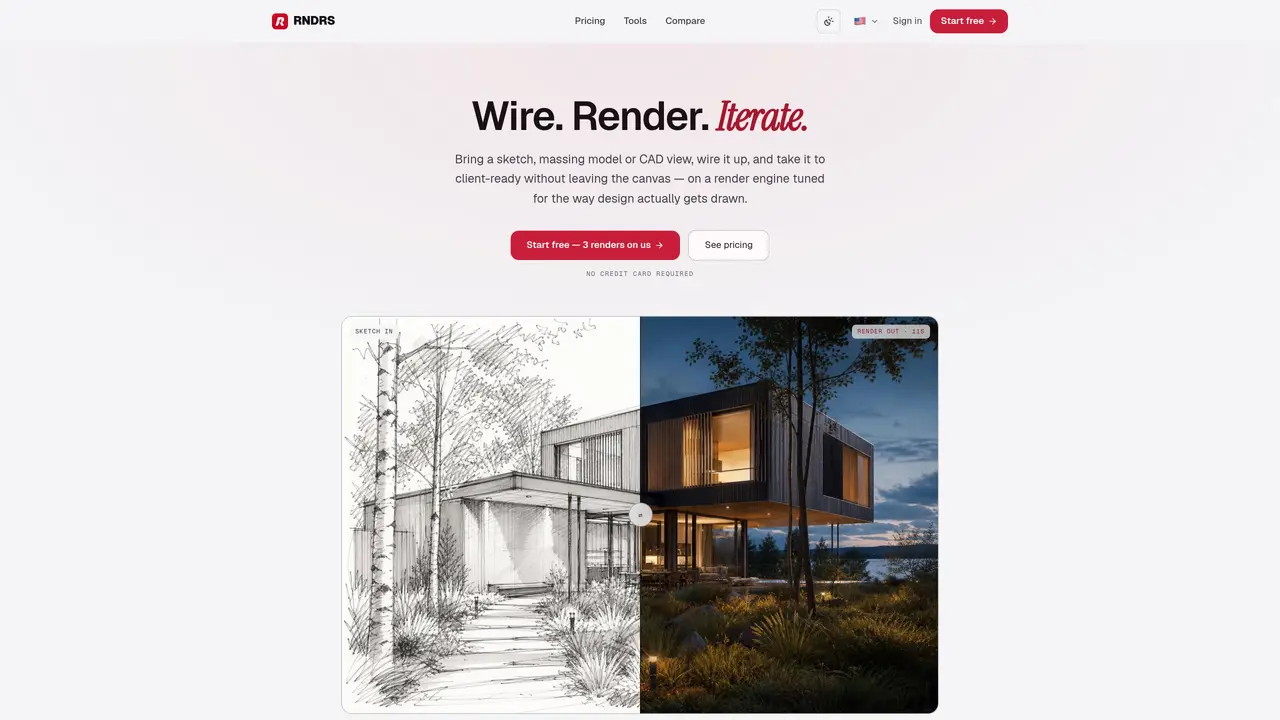
RNDRS is a node-based AI render studio for architects, interior designers, landscape architects, and masterplanners. It turns sketches, massing models, CAD exports, or site photos into client-ready images on a single visual canvas. Instead of bouncing between image tools, upscalers, and video apps, design teams wire prompts and operations as nodes, then iterate from first sketch to 4K visualization and short camera-move videos in one place. Key Features: Node-Based Canvas Workflows: Every project is a canvas where users connect Upload, Prompt, Render, and post-processing nodes, then save graphs as reusable workflows. Architecture-Tuned Render Engine: RNDRS uses its own engine focused on geometry preservation, material realism, and believable light so openings, massing, and proportions survive the render. Eraser and Cleanup Tools: An Eraser node removes cars, cranes, scaffolding, and clutter from scenes while rebuilding plausible backgrounds. Image Extender and 4K Upscaler: Designers can extend tight crops into full hero shots and upgrade outputs to print-grade 4K with recovered texture and crisp edges. Image to Video: A still render can become a short cinematic camera move, enabling golden-hour flythroughs and simple motion paths without traditional animation setups. Integrations with Design Software: Integrations listed for SketchUp, Revit, Rhino, Archicad, and Blender help connect existing 3D workflows to the RNDRS canvas.
Key features
- Node-Based Canvas Workflows
- Architecture-Tuned Render Engine
- Eraser and Cleanup Tools
- Image Extender and 4K Upscaler
- Image to Video
- Integrations with Design Software
Use cases
- Architects turn massing studies or SketchUp/Rhino/Revit viewports into client-ready exteriors and interiors in a few node hops.
- Interior designers swap materials, moods, and lighting from basic CAD elevations or site photos without remodeling 3D geometry.
- Landscape architects visualize planting, terrain, and site character from diagrams or photos so plans read as living places.
Pros
- Node-based canvas workflows for visual, iterative project pipelines
- Architecture-tuned render engine preserving geometry, materials, and proportions
- Built-in tools for erasing clutter, extending images, upscaling to 4K, and converting stills to videos
- Direct integrations with SketchUp, Revit, Rhino, Archicad, AutoCAD, and Blender via image exports
- Browser-based with no plugin or software installation required
Cons
- Pricing model relies on credits, which may require budgeting for frequent or high-volume use
- Output resolution and advanced features are limited on lower-tier plans
- Requires exporting 3D models or sketches as images, which may add steps to existing workflows
Frequently asked questions about RNDRS
What inputs work best with RNDRS?
RNDRS accepts visual inputs such as hand sketches, SketchUp or Rhino screenshots, clay renders, CAD elevations, site photos, or photos of physical models. Users upload an image, wire it to a Render node, describe the desired mood, and generate a visualization.
Do I need to install a plugin or special software to use RNDRS?
No plugin or installation is required. RNDRS operates entirely in the browser and works with any design software that can export an image, including SketchUp, Rhino, Revit, Archicad, AutoCAD, and Blender.
Who is RNDRS designed for?
RNDRS is built specifically for architects, interior designers, landscape architects, and masterplanners. Its engine is tuned to preserve massing, openings, and proportions, aligning with real design workflows rather than generic image generation.
How is RNDRS different from a generic AI image tool?
RNDRS uses its own AI render engine, developed exclusively for design work, rather than relying on a general-purpose image model. The node-based editor organizes iterations per project, results are chainable, and workflows are reusable across projects.
What powers the renders in RNDRS?
RNDRS uses an in-house AI-powered render engine focused on geometry preservation, material realism, and believable lighting. This ensures massing, openings, and proportions remain accurate in the final output.
Can I use RNDRS for print and client presentations?
Yes. RNDRS supports renders up to 4K resolution, and the 4K upscaler enhances outputs for print-grade quality. Studio and Firm plans include 4K resolution and image-to-video capabilities for polished deliverables.