Meshy turns text prompts or images into fully textured 3D models in minutes.

Shap-e
$0.07Starting price
0Popularity
About Shap-e
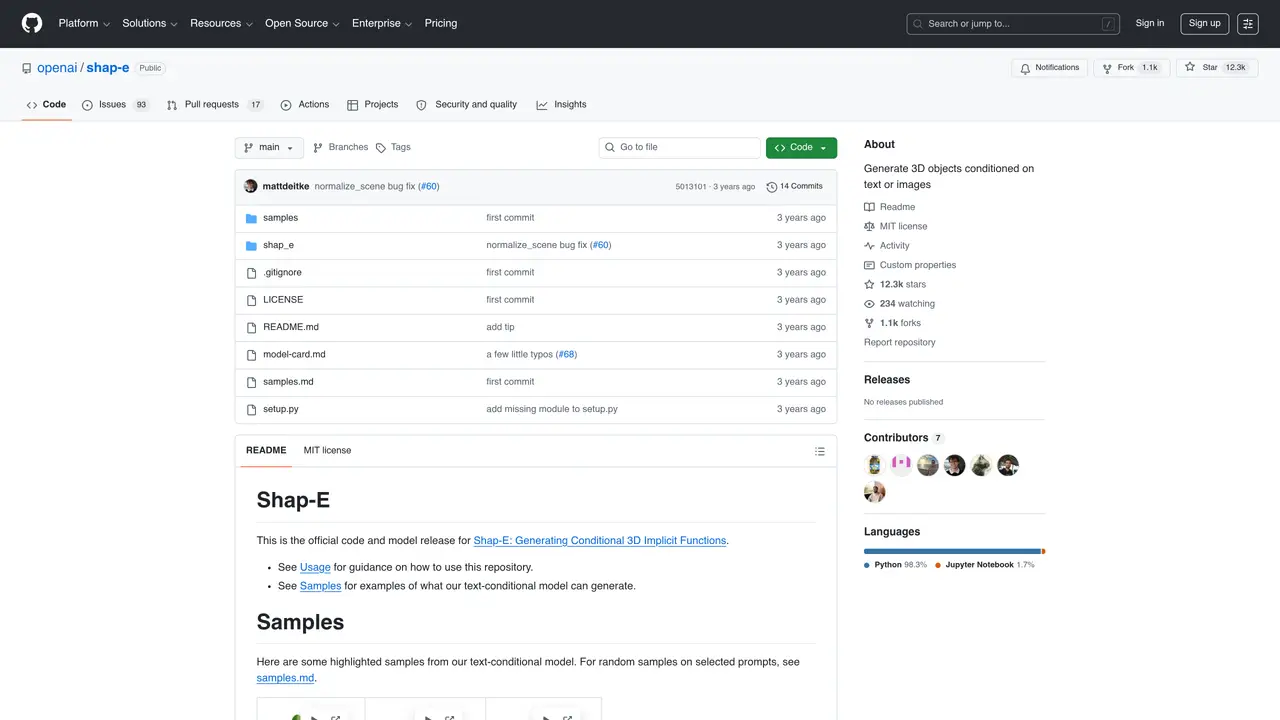
Shap-e is an open-source AI model developed by OpenAI that generates 3D objects from text or image inputs. The tool leverages diffusion-based generative models to produce high-quality 3D assets, including textured meshes and NeRF-style representations, which can be directly used in 3D modeling software or game engines. Shap-e is designed for developers, researchers, and creators who need to automate 3D content creation workflows without requiring advanced modeling skills. The model supports conditional generation, allowing users to specify desired attributes or styles through prompts, and it can be fine-tuned or extended for specialized applications. It integrates seamlessly with existing 3D pipelines, enabling users to export generated assets in common formats such as OBJ or glTF for further editing or rendering. Shap-e is particularly useful for prototyping, concept art, virtual environments, and educational projects where rapid iteration and customization are essential. The open-source nature of the project encourages community contributions, fostering continuous improvement and innovation in 3D generative AI. Users can access the model via GitHub, where documentation, code examples, and pre-trained weights are provided to facilitate adoption and experimentation.
GitHub, Inc.
San Francisco, California, US · Founded 2008
- Founders
- Tom Preston-Werner, Chris Wanstrath, PJ Hyett, Scott Chacon
- Founded
- 2008
- Headquarters
- San Francisco, California, US
- Legal status
- Subsidiary of Microsoft (NASDAQ: MSFT)
Key features
- Create 3D objects from text and images in just a few clicks
- Automate development workflows and manage packages
- Use AI to find vulnerabilities and write better code
- Available on GitHub for open-source contribution
- Instant development environments creation
- AI-driven tool for 3D object creation
Use cases
- Create 3D objects for product design or virtual reality
- Automate development workflows to increase productivity
- Find vulnerabilities in code using AI-powered tools
Pros
- Generates 3D objects from text or image inputs using conditional implicit functions
- Open-source and publicly available on GitHub for community contributions
- Provides sample notebooks for text-to-3D and image-to-3D generation workflows
- Supports encoding and decoding 3D models or point clouds into latent representations
- Includes pre-trained models for immediate use without extensive setup
Cons
- Requires technical knowledge to install and configure, including dependencies like Blender
- Output quality depends heavily on input prompts or image preprocessing
- Limited built-in user interface, primarily designed for developers and researchers
Frequently asked questions about Shap-e
What is Shap-E?
Shap-E is an open-source AI model developed by OpenAI that generates 3D objects conditioned on text or images. It creates 3D implicit functions from prompts, allowing users to produce 3D models with minimal input.
Who should use Shap-E?
Shap-E is designed for developers, designers, and researchers interested in 3D modeling and generation. It is particularly useful for those who need to automate 3D object creation or integrate 3D generation into their workflows.
How do I get started with Shap-E?
To get started, install Shap-E using pip and follow the provided notebooks for text-to-3D or image-to-3D generation. For image-to-3D, ensure the input image has a removed background for best results.
What are the key features of Shap-E?
Shap-E supports text and image conditioning for 3D object generation. It includes tools for encoding 3D models into latent representations and rendering them back. The model is open-source and available on GitHub.
Does Shap-E require specific software for image-to-3D generation?
Yes, for image-to-3D generation, Shap-E requires Blender version 3.3.1 or higher. Users must set the environment variable BLENDER_PATH to the path of the Blender executable before running the encoding process.
Is Shap-E free to use?
Yes, Shap-E is an open-source project released under the MIT license, making it freely available for use and modification. Users can access the code, contribute to development, and use it for personal or commercial projects.