

Generate content, correct spelling, suggest synonyms to enhance writing.
173M visits/mo+0.1%#1 Productivity & Office
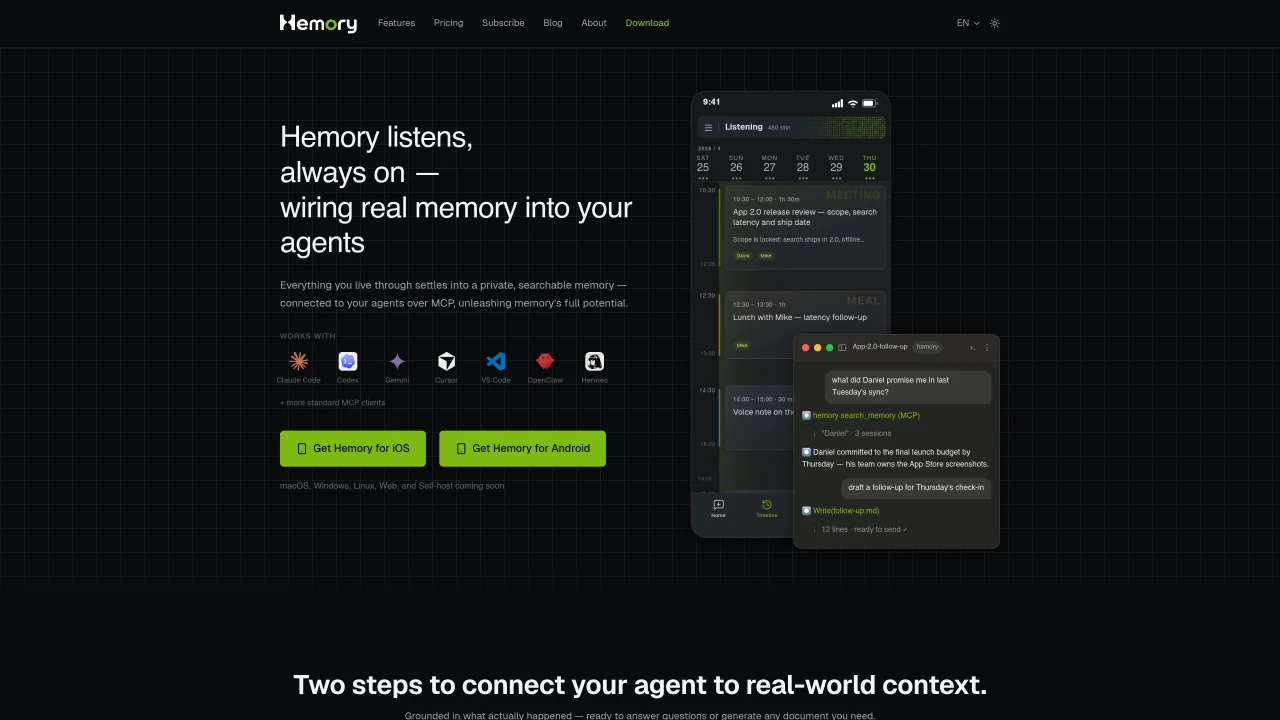
Hemory records conversations and meetings in real time, converting speech into searchable, private memory that AI agents can query via MCP. Users can listen manually or schedule automatic capture during set hours, with voice-activity detection ensuring only spoken segments count against usage limits. The captured audio is processed locally and never stored in the cloud, with raw files kept only on the user’s device. Once connected to an AI agent, Hemory enables generation of documents, summaries, or reports directly from the recorded sessions. The tool supports multiple platforms including iOS, Android, and desktop, with upcoming support for macOS, Windows, Linux, and self-hosted deployment. It integrates with mainstream agents like Claude Code, Codex, and Cursor, allowing users to ask questions or draft follow-ups based on past conversations. Transcription is available in over 100 languages, with features like speaker recognition, auto activity segmentation, and type-aware summaries. A built-in Q&A agent and Apple Watch listening are also included.
Hemory is a tool that records conversations and meetings in real time, converting speech into searchable, private memory that AI agents can query via MCP. It captures audio locally, processes it on-device, and enables users to generate documents, summaries, or reports from recorded sessions.
Hemory is designed for professionals, teams, and individuals who need to capture, organize, and leverage real-world conversations for tasks like drafting follow-ups, generating reports, or creating PRDs. It suits users who rely on AI agents for productivity and documentation.
Hemory processes audio locally and does not store raw files in the cloud. Audio is kept only on the user’s device, and the tool offers a self-hosted option for users who prefer to run it on their own infrastructure.
Hemory supports iOS, Android, and desktop platforms, with upcoming support for macOS, Windows, Linux, and self-hosted deployment. It also includes features like Apple Watch listening for convenience.
Hemory connects to AI agents like Claude Code, Codex, and Cursor via MCP, allowing users to query recorded conversations or generate documents directly from the memory. This integration enables seamless workflows for tasks like drafting follow-ups or creating reports.
Hemory supports transcription in over 100 languages, with features like speaker recognition, auto activity segmentation, and type-aware summaries to enhance usability.
hemory.com · third-party estimates from Similarweb
Share of visits by channel
No measurable traffic from Social, Paid Referrals or Search.
Productivity & Office · Sep 2026
Traffic figures are third-party estimates, good for scale and trends; they can differ from a company's own numbers. Updated monthly.
We use essential cookies to run Aitoolnavio, and optional cookies to analyze traffic and measure our marketing. You choose what we use — optional cookies stay off unless you turn them on. See our Privacy Policy.
One short email a week: fresh tools worth trying, honest takes and the updates that actually matter. No spam, unsubscribe any time.
Generate content, correct spelling, suggest synonyms to enhance writing.
Unify customer data, automate workflows, and scale experiences with Einstein AI, Copilot, and Data Cloud in one CRM platform.
Create customizable tables, databases, and spreadsheets, share data securely with team members.
Cloud accounting software that automates bookkeeping, invoicing, and financial reporting for small and growing businesses.
Transforms thoughts into actions, enhancing productivity and efficiency.
AI assistant for safe, reliable productivity with code, collaboration, and integrations.
Automate code, research, and documents using agents.
Record lectures, create tutorials, and securely share videos with teams.
Revolutionize travel with AI-driven personalized itinerary planning.
Easy-to-use CRM platform that automates lead capturing, prioritizes tasks, and provides sales pipeline analytics for businesses of all sizes.
All-in-one team productivity platform combining chat, docs, video meetings, workflows, and AI tools in one place.
AI travel planner that builds personalized itineraries from your preferences, travel dates, and reservations for vacations, road trips, and more.
Matched on what this tool does — grouped by the job you would be replacing.
matches Always-on or scheduled listening modes · Voice-activity detection (VAD) for efficient usage · 100-language transcription
AI voice note-taker that records, transcribes, and organizes spoken thoughts, ideas, and conversations in over 50 languages.
An AI note-taking app for Apple devices that records, transcribes, and summarizes audio or video into searchable notes and action items.
Voice notes that transcribe, tag, summarize and file into searchable notes
Local speech-to-text transcription for macOS with privacy-focused features
matches Auto activity segmentation and type-aware summaries · Speaker recognition by voice
Automatically transcribe meetings, create summaries, and securely store audio files in a searchable format.
Automatically turn meetings into searchable notes and tasks.
AI note taker for online calls.
Automated meeting notes, summaries, and action items from calls