
AI-powered medical search engine that delivers synthesized, cited answers from peer-reviewed research for clinicians.

InternLM
$0.03Starting price
0Popularity
About InternLM
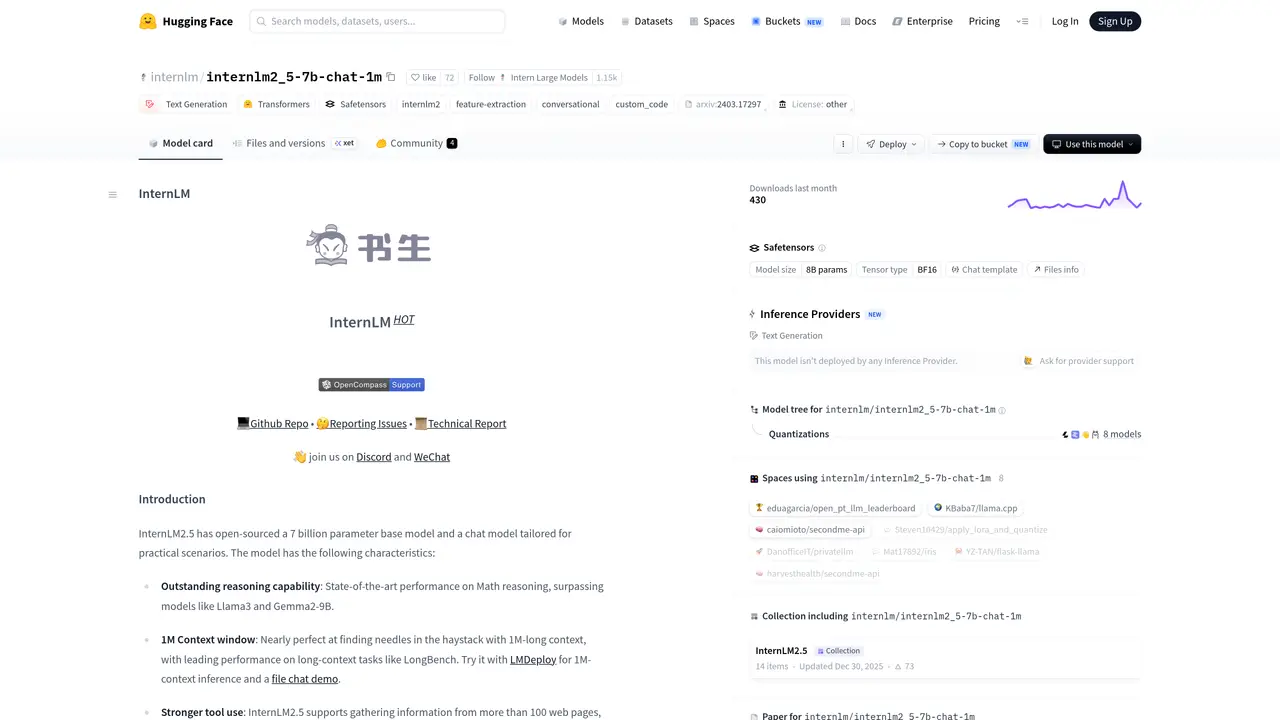
InternLM2.5-7B-Chat-1M is a 7-billion parameter conversational AI model developed by Hugging Face, designed for practical scenarios requiring advanced reasoning and long-form content generation. It excels in math reasoning and supports an exceptional 1-million-token context window, enabling it to process and analyze extensive documents or conversations without losing coherence. The model is built to handle complex tool usage, such as gathering and synthesizing information from numerous web pages for deeper analysis and inference. It is particularly suited for building sophisticated AI agents capable of engaging in detailed, multi-turn dialogues while maintaining reliability and contextual understanding. Its applications span customer service, virtual assistance, research, and other domains where deep natural language understanding and generation are critical. The model’s architecture prioritizes both performance and practicality, making it accessible for developers and researchers aiming to deploy advanced conversational systems.
Key features
- 7 billion parameters for robust conversational ability
- Superior math reasoning capabilities
- 1-million-token context window for long-form tasks
- Multi-turn tool interaction support
- Information gathering and synthesis from web sources
- Deep natural language understanding and generation
- Designed for practical, real-world scenarios
- Open-source availability
- High reliability in complex reasoning tasks
- Optimized for AI agent development
Use cases
- Building advanced customer service AI agents
- Developing virtual assistants for research and analysis
- Creating long-form content generation systems
Pros
- Supports an exceptional 1-million-token context window for processing extensive documents or conversations
- Excels in mathematical reasoning and complex tool usage for information synthesis
- Designed for multi-turn dialogues with strong contextual understanding and reliability
- Built on the Transformers library with compatibility for local and cloud deployment
- Offers flexibility through integration with inference providers like vLLM and SGLang
Cons
- Requires technical expertise to deploy and optimize for specific use cases
- Large context window may increase computational resource requirements
- Performance heavily depends on hardware configuration and model quantization
Frequently asked questions about InternLM
What is InternLM2.5-7B-Chat-1M and what can it do?
InternLM2.5-7B-Chat-1M is a 7-billion parameter conversational AI model designed for advanced reasoning and long-form content generation. It supports a 1-million-token context window, excels in math reasoning, and can process and synthesize information from extensive documents or multi-turn conversations.
Who should use InternLM2.5-7B-Chat-1M?
The model is suited for developers, researchers, and organizations building sophisticated AI agents, customer service systems, virtual assistants, or research tools that require deep natural language understanding and generation capabilities.
How do I get started with InternLM2.5-7B-Chat-1M?
Users can get started by loading the model directly via the Transformers library, using inference providers like vLLM or SGLang, or deploying it locally with Docker. The Hugging Face model card provides detailed instructions for each method.
What libraries and tools are compatible with InternLM2.5-7B-Chat-1M?
The model is compatible with the Transformers library and supports integration with inference providers such as vLLM and SGLang. It can also be deployed locally using Docker for flexible usage.
Does InternLM2.5-7B-Chat-1M require special hardware?
While the model can run on standard hardware, its large context window and parameter size may benefit from high-performance GPUs or optimized inference frameworks to ensure efficient operation.
Can InternLM2.5-7B-Chat-1M be used for non-English languages?
The model is primarily designed for English-language tasks, as indicated by its documentation and example use cases. Its performance in other languages may vary and is not explicitly supported.