
AI-powered medical search engine that delivers synthesized, cited answers from peer-reviewed research for clinicians.

TESRAC
FreeStarting price
0Popularity
About TESRAC
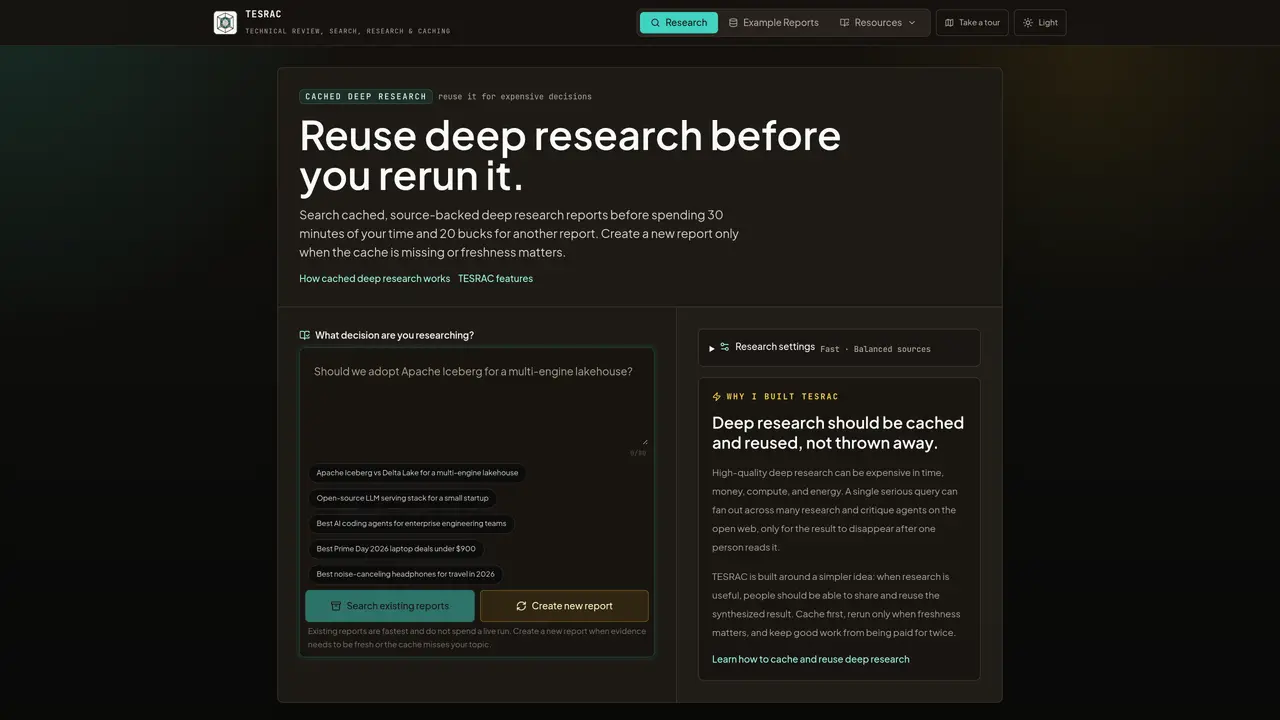
TESRAC is a research caching and reuse platform designed to help users avoid duplicating costly deep research efforts. It enables individuals and teams to search, save, and repurpose previously conducted research reports across technical, product, market, procurement, civic, and scientific domains. The platform aggregates high-quality, source-verified research into a centralized cache, allowing users to quickly retrieve relevant insights instead of starting investigations from scratch. By leveraging cached reports, users can compare engineering architecture choices, evaluate software and vendor trade-offs, review consumer buying decisions, or analyze market categories with greater efficiency and reduced risk. TESRAC offers multiple research modes, including Economy, Standard, and Deep, to balance cost, time, and decision-making confidence, ensuring flexibility for different use cases. The tool also provides query autocomplete and cached report suggestions to streamline discovery, while specialized prompts guide users toward tailored research strategies. Whether for technical reviews, procurement decisions, or market analysis, TESRAC helps users make informed choices by building on existing, verified research rather than reinventing the wheel.
Key features
- Search existing cached deep research reports
- Reuse source-backed work as decision records
- Query autocomplete for faster discovery
- Three research modes (Economy, Standard, Deep)
- Three source strategies (balanced, verified, fresh)
- Specialized research prompts for technical, buying, civic, business, science, and general questions
- Cached report suggestions for reuse
- Browser-based application
Use cases
- Comparing engineering architecture choices
- Evaluating software and vendor trade-offs
- Reviewing consumer buying decisions
Pros
- Caches deep research reports for reuse
- Supports multiple research modes (Economy, Standard, Deep)
- Provides specialized prompts for different inquiry types
- Includes query autocomplete and cached report suggestions
- Allows switching between source strategies (balanced, verified, fresh)
Cons
- Requires JavaScript-enabled browsers
- Public example research themes exclude private artifacts and workspace data
Frequently asked questions about TESRAC
What does TESRAC do?
TESRAC enables users to search, save, and reuse previously conducted deep research reports across technical, product, market, procurement, civic, and scientific domains. It helps avoid rerunning high-cost investigations for common questions by providing cached research with source-quality controls.
Who is TESRAC for?
TESRAC suits professionals and organizations that rely on thorough research for decision-making, such as engineers, product managers, procurement teams, civic analysts, and scientists. It is designed for those who need to compare technical choices, evaluate vendors, or review market categories efficiently.
How does TESRAC work?
Users can search existing cached deep research reports before initiating new live investigations. The tool offers Economy, Standard, or Deep modes to balance cost, time, and decision risk, along with query autocomplete and cached report suggestions to accelerate discovery.
Can I use TESRAC for fresh research?
Yes, TESRAC allows running fresh AI deep research when needed, while also enabling users to switch between balanced, verified, or fresh research strategies based on their requirements. Specialized prompts are available for different inquiry types.
Does TESRAC support different research strategies?
TESRAC provides options to choose between Economy, Standard, or Deep modes depending on cost, time, and decision risk. Users can also switch source strategies between balanced, verified, and fresh research needs.
How do I get started with TESRAC?
To get started, users can access the interactive TESRAC app in a browser with JavaScript enabled. The tool guides users through caching and reusing deep research, with features like query autocomplete and cached report suggestions to streamline the process.