
Unleash creativity: edit photos, videos, and designs with AI-enhanced tools.

Qencode MCP server
$0.01Starting price
0Popularity
About Qencode MCP server
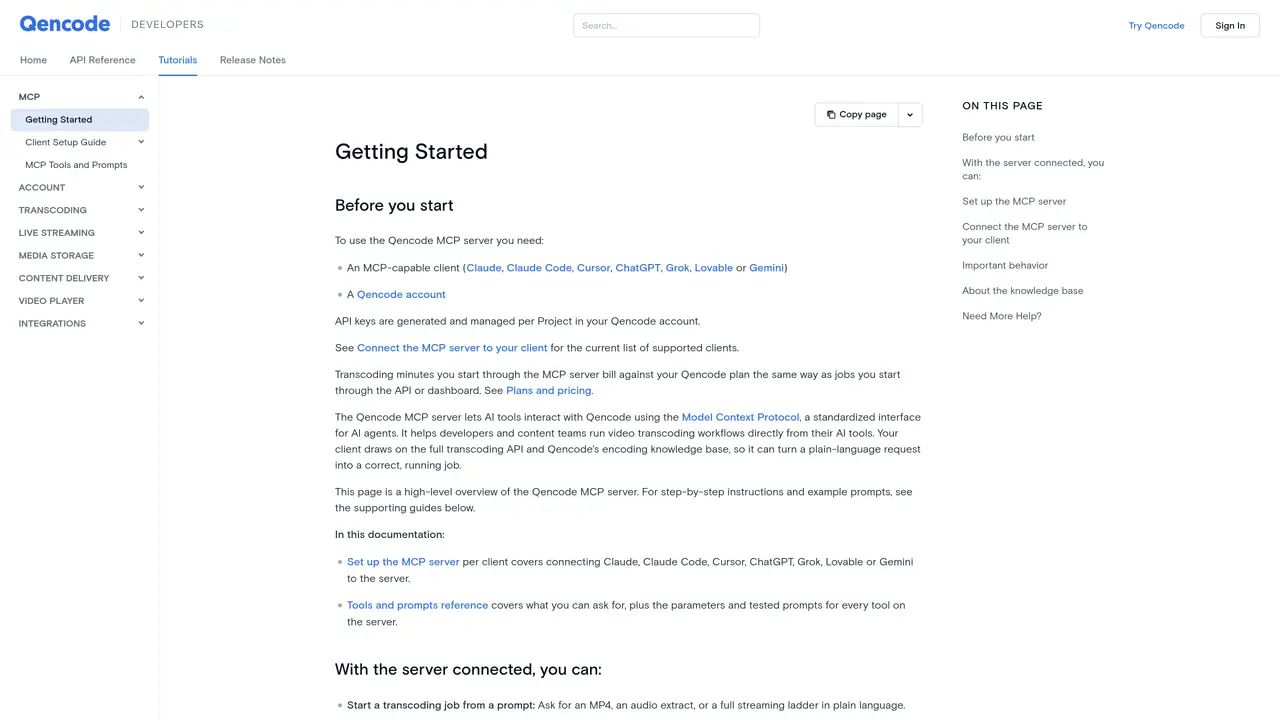
The Qencode MCP server enables AI tools to interact with Qencode’s transcoding and media services using the Model Context Protocol. It allows developers and content teams to run video transcoding workflows directly from AI clients such as Claude, Claude Code, Cursor, ChatGPT, Grok, Lovable, or Gemini. The server exposes Qencode’s full transcoding API and encoding knowledge base, enabling AI agents to process plain-language requests into executable transcoding jobs. Users can start transcoding jobs, generate adaptive bitrate streaming playlists, create subtitles and transcripts, produce thumbnails, stitch or clip videos, and manage media storage buckets. The server also supports querying Qencode’s documentation and tracking job progress within the AI client interface. Authentication is handled via Qencode API keys, which are billed against the user’s transcoding plan. No local installation is required beyond an MCP-compatible client, and setup varies by client with some offering one-click connectors.
Key features
- Start transcoding jobs from plain-language prompts
- Generate adaptive bitrate streaming playlists (HLS and DASH)
- Create subtitles, transcripts, and translations in SRT, VTT, or JSON
- Produce thumbnails, smart thumbnails, and sprite sheets
- Stitch and clip source videos for compilations or edits
- Query Qencode’s documentation from within AI client
- Manage media storage buckets and file transfers
- Track job progress with completion percentage and output URLs
Use cases
- Automated video transcoding workflows from AI tools
- Generating streaming-ready adaptive bitrate playlists
- Extracting subtitles or transcripts from video content
Pros
- Supports multiple AI clients including Claude, Cursor, ChatGPT, and others
- Exposes full Qencode transcoding API and encoding knowledge base
- No local installation required beyond an MCP-compatible client
- Enables plain-language video processing requests
- Tracks job progress and provides output URLs within AI client
Cons
- Requires a Qencode account and API key for authentication
- Limited to clients supporting Model Context Protocol
- Transcoding minutes billed against user’s Qencode plan
Frequently asked questions about Qencode MCP server
What is the Qencode MCP server?
The Qencode MCP server enables AI tools to interact with Qencode’s transcoding and media services using the Model Context Protocol. It allows users to run video transcoding workflows directly from AI clients such as Claude, ChatGPT, Grok, or Gemini.
Who should use the Qencode MCP server?
The tool is designed for developers and content teams who want to automate video transcoding workflows within their AI clients. It is suitable for those managing media storage, generating subtitles, or creating adaptive bitrate streaming playlists.
How does authentication work with the Qencode MCP server?
Authentication is handled via Qencode API keys, which are generated and managed per project in the user’s Qencode account. These keys authorize transcoding jobs and are billed against the user’s transcoding plan.
What AI clients are compatible with the Qencode MCP server?
The server supports MCP-compatible clients including Claude, Claude Code, Cursor, ChatGPT, Grok, Lovable, and Gemini. Some clients offer one-click connectors for easier setup.
What can I do with the Qencode MCP server?
Users can start transcoding jobs, generate adaptive bitrate streaming playlists, create subtitles and transcripts, produce thumbnails, stitch or clip videos, manage media storage buckets, and query Qencode’s documentation.
Is local installation required to use the Qencode MCP server?
No local installation is required beyond an MCP-compatible client. The server is accessed via a hosted endpoint, and setup varies by client with some offering one-click connectors.