Generate AI images, discover unique prompts, and save favorite images for quick reference.
Skryblr
0Popularity
About Skryblr
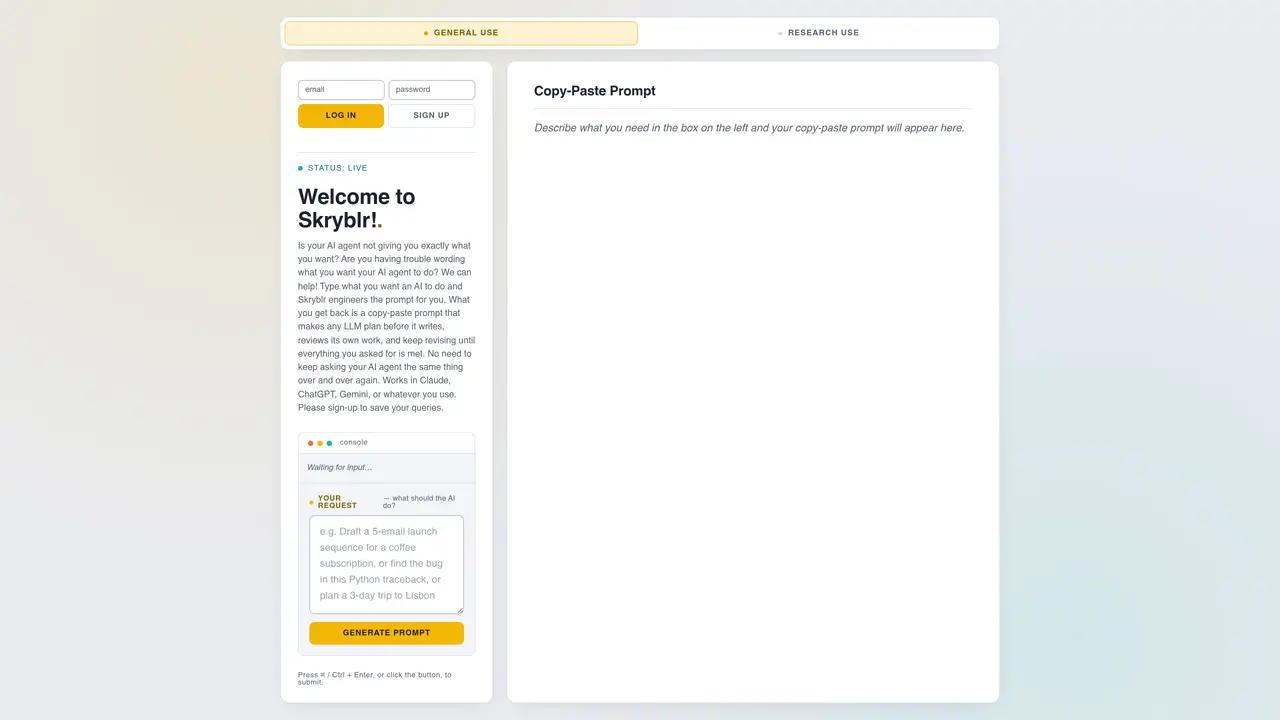
Skryblr produces copy-paste prompts for large language models that guide the model to plan its response, review its own work, and iteratively revise until all requested elements are included. Users describe a task or topic, and Skryblr returns a structured prompt tailored for models such as ChatGPT, Claude, or Google Gemini. The prompts are designed to reduce repeated prompting by embedding explicit instructions for iterative self-checking and refinement. Skryblr supports general use cases like refining AI outputs and academic writing, where it can generate prompts for producing peer-review-grade scientific papers with in-text citations and reference lists. For scientific writing, users must provide methods and results files, which the AI uses to complete manuscript sections. The tool emphasizes saving queries and maintaining a history for returning users.
Key features
- Prompt generation for general AI tasks
- Academic paper prompt creation with citations
- Iterative self-review and revision instructions
- Query history and saved entries
- Direct links to open prompts in ChatGPT, Claude, or Google Gemini
- Copy-paste prompt delivery with clipboard support
- Supports multiple LLM platforms
- Peer-review-grade output guidance
Use cases
- Refining AI responses to reduce repeated prompting
- Generating peer-review-grade scientific papers with citations
- Creating structured prompts for iterative AI self-review
Pros
- Generates reusable prompts for multiple LLMs
- Forces iterative self-review and revision in AI outputs
- Supports academic writing with citation and reference generation
- Saves query history for returning users
- Provides direct links to open prompts in supported platforms
Cons
- Requires sign-up to save queries and access history
- Scientific paper prompts need methods and results files to function
- Limited to platforms with browsing capabilities
Frequently asked questions about Skryblr
What does Skryblr do?
Skryblr generates copy-paste prompts for large language models that guide the model to plan, review its own work, and iteratively revise until all requested elements are included. Users describe a task or topic, and Skryblr returns a structured prompt tailored for models such as ChatGPT, Claude, or Google Gemini.
Who is Skryblr suitable for?
Skryblr suits users who struggle to craft precise prompts for AI models, including researchers, academics, and professionals needing structured outputs. It is particularly useful for refining AI responses and producing peer-review-grade scientific papers.
How does Skryblr work for scientific writing?
For scientific writing, users provide a topic or working title and attach methods and results files. Skryblr generates a prompt that forces the AI to iteratively check its work, ensuring correct information and legitimate sources, and then drafts manuscript sections.
Can Skryblr save my prompts for later use?
Yes, Skryblr allows users to sign up and save their queries, maintaining a history of prompts for future reference and reuse.
Which AI models does Skryblr support?
Skryblr supports models such as ChatGPT, Claude, and Google Gemini, providing copy-paste prompts that work across these platforms.
What files are required for generating a scientific paper prompt?
To generate a full manuscript prompt, users must provide methods and results files, which the AI uses to complete the corresponding manuscript sections.