OpenAI builds and deploys advanced AI models like GPT-4o for autonomous agents and workflows.

AgentDeck
$10Starting price
0Popularity
About AgentDeck
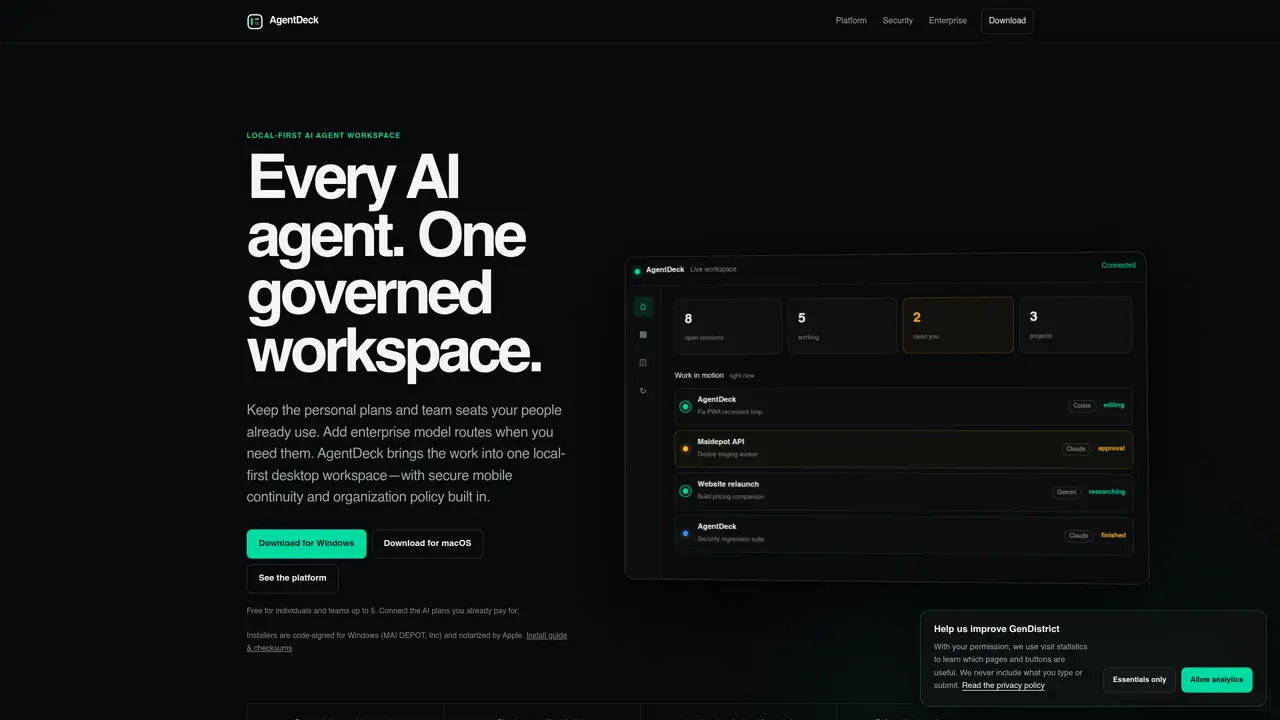
AgentDeck provides a local-first desktop workspace that consolidates multiple AI agents, subscriptions, and company AI servers into a single governed environment. The tool integrates with existing personal and team AI plans while allowing local model execution and private network deployment. Users can connect their signed-in browser via an extension, enabling AI agents to operate within familiar Chrome environments while maintaining approval controls. The platform offers a unified view of AI usage across providers, accounts, devices, and teams, including cost estimates and session tracking. Mobile continuity allows secure remote control of AI workflows from paired phones, with device-to-device encryption protecting connections. Projects are organized into folders with sessions, tools, and approval workflows, supporting both individual and team collaboration up to five members for free. Enterprise features include scoped guest access, audit logging, and time-limited invitations with role-based permissions.
Key features
- Local model execution via GGUF
- Browser extension for Chrome integration
- Project-based organization with sessions and tools
- Scoped guest access with time limits
- Audit logging for all actions
- Cross-provider usage tracking
- Mobile continuity for remote control
- Policy enforcement without reading conversations
Use cases
- Managing AI agents across multiple subscriptions in one workspace
- Delegating tasks to contractors with scoped, time-limited access
- Tracking AI usage and costs across teams and devices
Pros
- Local-first architecture with optional cloud integration
- Unified workspace for multiple AI providers and subscriptions
- Secure mobile control with device-to-device encryption
- Built-in policy controls and audit logging
- Free tier for individuals and teams up to five members
Cons
- Desktop-only application with no web version
- Requires code-signed installers for Windows and Apple notarization
- Limited to 5 team members in free tier
- Mobile control dependent on paired device
Frequently asked questions about AgentDeck
What is AgentDeck and who is it designed for?
AgentDeck is a local-first desktop workspace that consolidates multiple AI agents, subscriptions, and company AI servers into a single governed environment. It is designed for individuals, teams, and enterprises who want to manage AI workflows across providers, accounts, and devices while maintaining control and security.
How does AgentDeck integrate with existing AI subscriptions and tools?
AgentDeck allows users to connect their existing personal and team AI plans, including subscriptions and company AI servers, into one unified workspace. It supports local model execution and private network deployment while maintaining the original terms and usage limits of each provider.
Can AgentDeck be used for team collaboration?
Yes, AgentDeck supports team collaboration with features like shared AI usage tracking, role-based permissions, audit logging, and time-limited invitations. Teams of up to five members can collaborate for free, with enterprise features available for larger groups.
How does AgentDeck ensure security and control over AI workflows?
AgentDeck provides secure mobile continuity, device-to-device encryption, and approval workflows for AI actions. It also includes audit logging, scoped guest access, and time-limited invitations to ensure that only authorized users can interact with specific sessions or projects.
What platforms and devices does AgentDeck support?
AgentDeck is available as a downloadable desktop application for Windows and macOS. It also supports secure mobile control via paired phones, allowing users to manage AI workflows remotely while maintaining encrypted connections.
How do I get started with AgentDeck?
To get started, download the AgentDeck installer for your operating system from the official website, install the application, and follow the setup guide. Connect your existing AI subscriptions or local models, and begin organizing projects, sessions, and approval workflows within the workspace.