
Cloud accounting software that automates bookkeeping, invoicing, and financial reporting for small and growing businesses.
36M visits/mo+0.9%#5 Business & Marketing

Tracks and attributes AI costs across multiple LLM providers with budget controls
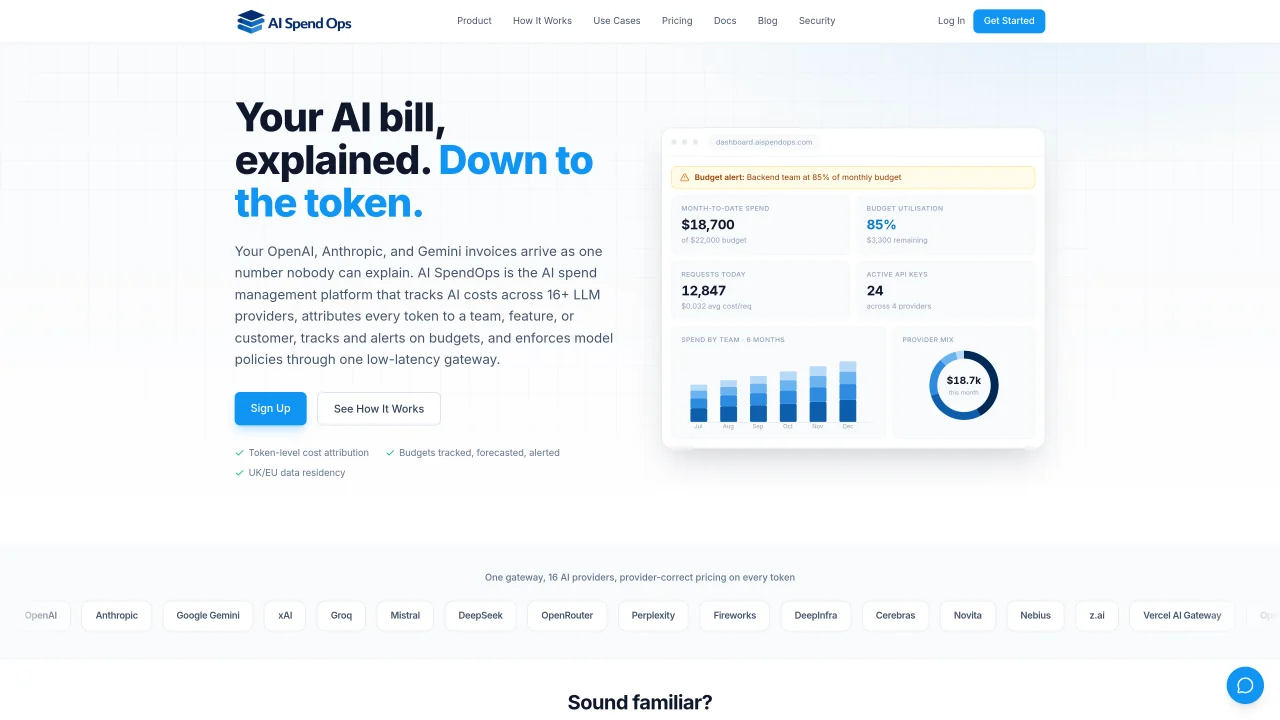
AI SpendOps is a platform that provides visibility and governance for AI spending across multiple large language model providers. It tracks token-level costs and attributes usage to teams, features, or customers, enabling detailed cost breakdowns that are typically unavailable from standard invoices. The tool supports over 16 LLM providers and enforces budget controls with configurable alerts and forecasts to prevent overruns. It operates as a low-latency gateway that routes AI requests while logging every transaction for compliance and audit purposes. The platform is designed for both engineering and finance teams, offering real-time dashboards, model leaderboards, and customizable dimensions for cost allocation. It aims to transform AI spending from an unpredictable cost center into a controlled, auditable platform with quick time-to-value.
AI SpendOps provides visibility and governance for AI spending across multiple large language model providers. It tracks token-level costs, attributes usage to teams or customers, and enforces budget controls with configurable alerts and forecasts.
The platform is designed for both engineering and finance teams, offering real-time dashboards, model leaderboards, and customizable dimensions for cost allocation to support decision-making.
It operates as a low-latency gateway that routes AI requests while logging every transaction for compliance and audit purposes, enabling detailed cost breakdowns that are typically unavailable from standard invoices.
Yes, it supports over 16 LLM providers, including OpenAI, Anthropic, Google, Mistral, and others, with provider-correct pricing on every token.
Yes, it tracks and alerts on budgets with configurable thresholds and forecasts overrun risk before month-end to help prevent unexpected costs.
Users can sign up and start tracking AI spend in minutes by deploying the AI SpendOps gateway and routing traffic through it to attribute token usage and spend.
aispendops.com · third-party estimates from Similarweb
Last 4 months · grows by one month every month
Share of visits by channel
No measurable traffic from Social, Paid Referrals or Search.
Share of visits · estimated visits
How people reach this site from other AI tools
1 a month
Business & Marketing · Sep 2026
Traffic figures are third-party estimates, good for scale and trends; they can differ from a company's own numbers. Updated monthly.
We use essential cookies to run Aitoolnavio, and optional cookies to analyze traffic and measure our marketing. You choose what we use — optional cookies stay off unless you turn them on. See our Privacy Policy.
One short email a week: fresh tools worth trying, honest takes and the updates that actually matter. No spam, unsubscribe any time.
Cloud accounting software that automates bookkeeping, invoicing, and financial reporting for small and growing businesses.
AI-powered budgeting companion that auto-categorizes spending, forecasts expenses, and offers conversational guidance within YNAB’s trusted zero-based system.
A bookkeeping automation platform that captures receipts, invoices, and statements, extracts data, and syncs to accounting software for SMBs and accounting firms.
AI-powered real estate platform for finding deals, analyzing properties, and building investor workflows with nationwide data and predictive analytics.
Send money globally, track payments, and save with competitive rates and low fees.
AI market intelligence platform that turns natural-language queries into analyst-grade insights with real-time monitoring and AI-generated summaries.
Revolutionize planning: Connect, model, and forecast across all business areas.
AI-powered terminal for researching global stocks with financial data, AI summaries, KPIs, filings, and portfolio dashboards.
Trendspider is a sophisticated all-in-one market research and trading software designed to enhance the trading strategies of investors and traders.
Develop, backtest, and analyze trading strategies with drag-and-drop builder, extensive data sources, and real-time market data.
Stock market data API delivering real-time prices, fundamentals, and news for financial modeling and trading applications.
Zocks is an AI assistant for financial advisors that automates meeting notes, client emails, forms, and CRM updates.
Matched on what this tool does — grouped by the job you would be replacing.
matches Token-level cost attribution · Budget tracking and forecasting · Multi-provider support (16+ LLM providers)
Centralizes tracking and optimization of AI service spending across multiple platforms through a single dashboard.
Tracks and alerts on AI provider spend across models and projects
Shared AI workspace with per-project budgets and cost allocation for client-billing firms
Enterprise platform for governing AI spend, access and security in one console
matches Multi-provider support (16+ LLM providers) · Real-time dashboards and audit trails · Configurable policy enforcement
matches Multi-provider support (16+ LLM providers) · Real-time dashboards and audit trails · Configurable policy enforcement
Single endpoint routing LLM API calls to minimize inference costs
Intelligent routing layer for AI inference requests across multiple providers
Unified API to access hundreds of AI models from multiple providers
Self-hosted gateway that routes LLM requests to cost-efficient models based on policy
Centralized AI governance and runtime enforcement platform for mid-sized companies
Runtime control and observability for production AI agents
AI agent control plane and LLM gateway for policy enforcement and audit
LLM observability and cost tracking tool for engineering and product teams