
OpenAI builds and deploys advanced AI models like GPT-4o for autonomous agents and workflows.

agentOS
$20Starting price
0Popularity
About agentOS
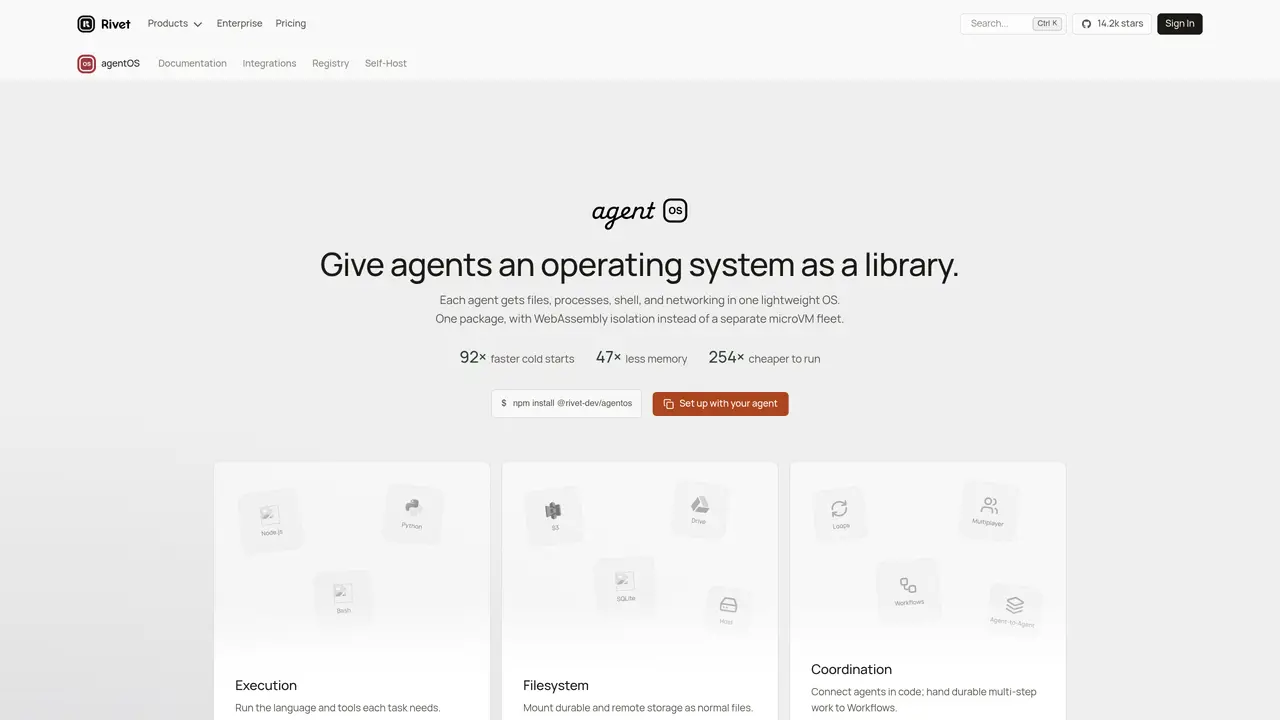
agentOS provides each AI agent with an isolated operating system that includes files, processes, shell and networking. It runs as a single lightweight library inside the host process rather than as separate microVMs, using WebAssembly and V8 isolates for isolation. The system supports running code in Bash, Node.js and Python, mounting remote storage such as S3 or Google Drive as normal filesystems, and coordinating agents through durable workflows and multiplayer loops. agentOS is designed for building and deploying AI agents that require persistent state, multi-step operations and secure access to backend functions without exposing raw credentials. It emphasizes fast cold starts, low memory footprint and cost efficiency by sharing host resources across many agents. The platform targets developers who need to deploy AI-generated applications, automate workflows and manage agent-to-agent coordination at scale.
Key features
- WebAssembly and V8 isolate-based isolation
- POSIX-compatible filesystem and shell
- Multi-language execution (Bash, Node.js, Python)
- Remote storage mounting (S3, Google Drive)
- Durable workflows and multiplayer loops
- Dynamic app deployment for users
- Typed backend bindings without credential exposure
- Built-in type checking for agent-generated code
Use cases
- Deploying AI-generated applications for end users
- Automating multi-step agent workflows that survive restarts
- Coordinating multiple agents in shared sessions
Pros
- Lightweight WebAssembly-based isolation instead of microVMs
- Supports POSIX files, processes and networking per agent
- Fast cold starts and low memory usage compared to sandbox alternatives
- Allows mounting remote storage as local filesystems
- Enables durable multi-step workflows and agent coordination
Cons
- Requires Node.js environment for installation
- No explicit free tier beyond Rivet Cloud's limited free plan
- Metrics and comparisons reference specific sandbox providers
- Enterprise features require on-prem deployment or custom pricing
Frequently asked questions about agentOS
What is agentOS and what does it do?
agentOS provides each AI agent with an isolated operating system that includes files, processes, shell, and networking. It runs as a lightweight library inside the host process using WebAssembly and V8 isolates, enabling persistent state, multi-step operations, and secure access to backend functions without exposing raw credentials.
Who should use agentOS?
agentOS is designed for developers who need to deploy AI-generated applications, automate workflows, and manage agent-to-agent coordination at scale. It suits teams building multi-agent systems, dynamic apps, or workflows requiring durable state and secure backend access.
How does agentOS handle isolation and security?
agentOS uses WebAssembly and V8 isolates for isolation, running in-process without separate microVMs. It provides scoped access to backend functions without exposing raw credentials, ensuring secure execution environments for agents.
What programming languages and tools does agentOS support?
agentOS supports running code in Bash, Node.js, and Python. It also allows mounting remote storage like S3 or Google Drive as normal filesystems and provides access to POSIX files, processes, and networking within the isolated environment.
How does agentOS improve performance and cost efficiency?
agentOS achieves faster cold starts, lower memory footprint, and reduced costs by running in-process with shared host resources. It avoids the overhead of booting separate VMs, resulting in significantly better performance and cost metrics compared to traditional sandboxing approaches.
Can agentOS be integrated with existing agent frameworks?
Yes, agentOS can integrate with existing agent frameworks like Pi, Claude Code, Codex, OpenCode, Eve, and Flue. It provides native coordination and integrations, allowing agents built with different frameworks to operate within the same virtual operating system.