Unify customer data, automate workflows, and scale experiences with Einstein AI, Copilot, and Data Cloud in one CRM platform.
110M visits/mo+1.1%#1 Business & Marketing

Local-first AI agent operating system with 21 sovereign agents and 28 micro-tools
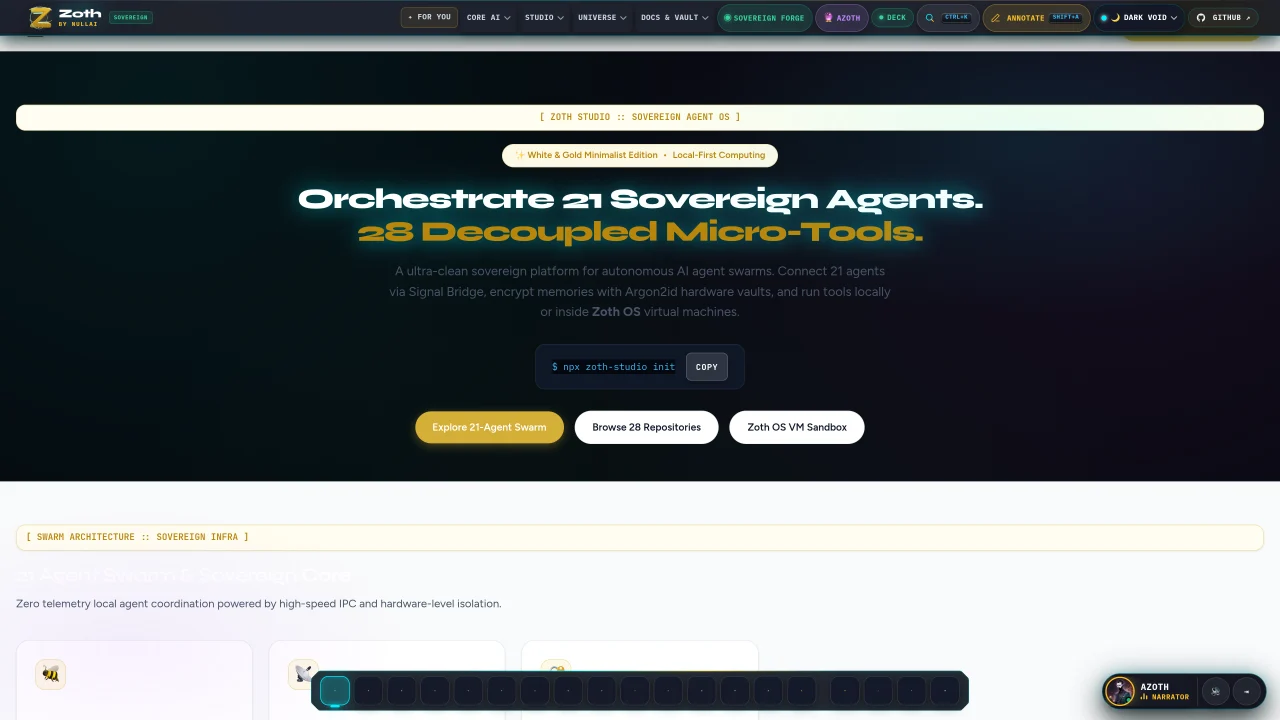
Zoth Studio is a local-first operating system designed for autonomous AI agent swarms. It orchestrates 21 sovereign agents that coordinate through a high-speed local IPC bus and Signal Bridge for encrypted communication. The system uses Argon2id hardware vaults for zero-knowledge secret storage and runs tools either locally or within isolated Zoth OS virtual machines. Each of the 28 micro-tool repositories operates as a standalone unit, enabling integration into agent pipelines or local execution. The platform includes a dedicated Agent VM with a dedicated virtual filesystem, isolated compute sandbox, and encrypted SQLite memory daemon. Zoth OS can be deployed via bootable USB images or QEMU/KVM virtual machines, providing a hardware-isolated environment for agent execution. The ecosystem also preserves cyberpunk heritage through animated mascots and comic series.
Zoth Studio is a zero-egress, air-gapped development environment designed for orchestrating autonomous AI agent pantheons, local LLMs, and biomorphic synaptic memory matrices. It ensures all LLM queries, vector embeddings, and memory retention remain strictly local, with no outbound telemetry.
Zoth Studio is built for developers and researchers working with autonomous AI agents who require hardware-isolated, sovereign intelligence environments. It suits those prioritizing privacy, zero-cloud dependency, and decentralized agent communication.
Zoth Studio uses a decentralized peer-to-peer simplex agent communication bus called the Sovereign Agent Bridge, which employs Byzantine AST consensus verification for secure and reliable agent interactions.
Yes, Zoth Studio is designed as a zero-egress system, meaning all operations—including LLM queries and memory retention—occur strictly within a local loopback environment, requiring no internet access.
Zoth Studio requires hardware capable of running WebGPU WASM engines for client-side tensor operations and GPU-accelerated neural inference. It can be deployed via bootable USB images or QEMU/KVM virtual machines for hardware isolation.
Users can start by running commands like 'npx zoth up' to initiate offline daemons (memory, bridge, vault, studio), 'npx zoth status' to check hardware readiness, and 'npx zoth clone' to scaffold open-source templates and agent cadres.
We use essential cookies to run Aitoolnavio, and optional cookies to analyze traffic and measure our marketing. You choose what we use — optional cookies stay off unless you turn them on. See our Privacy Policy.
One short email a week: fresh tools worth trying, honest takes and the updates that actually matter. No spam, unsubscribe any time.
Unify customer data, automate workflows, and scale experiences with Einstein AI, Copilot, and Data Cloud in one CRM platform.
Build conversational forms, capture rich responses, and automate follow-ups with AI-powered surveys and workflows.
Transforms thoughts into actions, enhancing productivity and efficiency.
Automate code, research, and documents using agents.
All-in-one team productivity platform combining chat, docs, video meetings, workflows, and AI tools in one place.
Automate workflow, optimize operations, and detect potential issues with this efficient AI-driven solution.
AI-powered IDE for autonomous coding tasks and agentic development workflows
AI Recruitment engine to hire top global talent
Automate tailored conversations, analyze customer behavior, and automate lead gen, customer service, and sales.
AI job search copilot that matches roles to skills, optimizes resumes for ATS, generates cover letters, and autofills applications with real-time insights.
Source, match, and manage talent with predictive analytics for effortless recruiting.
Personal assistant that coordinates tasks across apps and devices via text or call
Matched on what this tool does — grouped by the job you would be replacing.
matches 21-agent swarm coordination · Local IPC bus for high-speed agent communication · Zoth OS virtual machine for agent isolation
End-to-end AI agent orchestration for coding, design, media and research tasks
Local-first personal AI system for coding, media creation and skill growth
Operating system for AI agents with POSIX files, processes and networking
Spatial IDE for orchestrating multiple AI coding agents on a shared canvas
matches Argon2id hardware vault for credential storage · Signal Bridge for encrypted peer communication
matches Socratic code debate and consensus mechanisms
Run AI agents automating systems with secrets locked.
Self-hosted agent gateway that connects AI assistants to personal data sources without sharing passwords
Secure workspace for AI agents to manage secrets, memory and chats without exposing credentials
Local-first vault and tools for managing API keys and AI agents on macOS
Desktop AI workspace with isolated agents for local document analysis and code editing
Local collaboration workspace for models and ACP agents to share work and complete tasks