
OpenAI builds and deploys advanced AI models like GPT-4o for autonomous agents and workflows.

Brain Memory
FreeStarting price
0Popularity
About Brain Memory
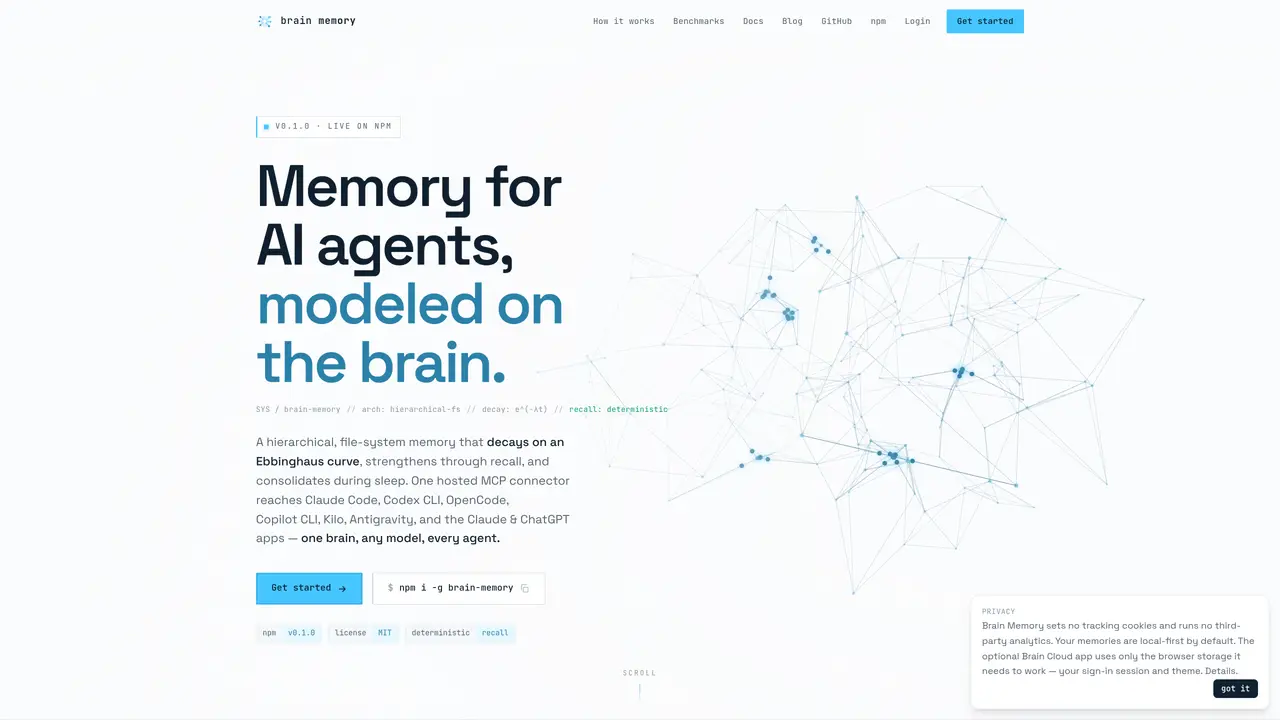
Brain Memory provides a hierarchical file-system memory for AI agents modeled on biological memory systems. It stores agent decisions, learnings, and preferences as Markdown files with YAML frontmatter, organizing them in a directory tree that serves as semantic structure. Memories decay along an exponential forgetting curve based on the Ebbinghaus model, with episodic memories fading faster than procedural ones. Strength is restored through recall, which also reinforces memory links via spaced reinforcement intervals. The system uses an associative network with weighted edges to connect related memories, enabling spreading activation where recalling one memory activates its neighbors. A nine-phase nightly sleep cycle handles consolidation, pruning, reorganization, and REM-style recombination. Deterministic recall scoring combines TF-IDF, decayed strength, spreading activation, and context matching to ensure identical results across different agents and models. The memory store is cross-agent compatible, supporting Claude Code, Codex CLI, OpenCode, Copilot CLI, Kilo, Antigravity, and the Claude and ChatGPT apps through a hosted MCP connector.
Key features
- Hierarchical memory storage in directory tree
- Exponential decay with type-specific rates
- Spreading activation through associative network
- Spaced reinforcement for durable memory boosts
- Nine-phase sleep cycle for consolidation
- Deterministic recall scoring (TF-IDF × decayed-strength + spreading-activation)
- Cross-agent memory sharing via MCP connector
- Plain file storage with cloud sync options
Use cases
- Long-term agent memory with noise resistance
- Multi-session continuity for complex tasks
- Skill management with progressive disclosure
Pros
- Hierarchical file-system structure with semantic organization
- Decay-based forgetting modeled on Ebbinghaus curve
- Deterministic recall scoring for consistent results
- Cross-agent compatibility via MCP connector
- Plain file storage enabling sync with cloud services or git
Cons
- No free tier or open-source server component
- Requires installation via npm
- Limited to Markdown/YAML memory format
- Sleep cycle requires nightly maintenance
Frequently asked questions about Brain Memory
What is Brain Memory and what does it do?
Brain Memory provides a hierarchical file-system memory for AI agents modeled on biological memory systems. It stores agent decisions, learnings, and preferences as Markdown files with YAML frontmatter, organizing them in a directory tree that serves as semantic structure.
Who is Brain Memory designed for?
Brain Memory is designed for AI agents, including those using Claude Code, Codex CLI, OpenCode, Copilot CLI, Kilo, Antigravity, and the Claude and ChatGPT apps. It supports any LLM underneath these agents.
How does Brain Memory handle memory decay and reinforcement?
Memories decay along an exponential forgetting curve based on the Ebbinghaus model, with episodic memories fading faster than procedural ones. Strength is restored through recall, which also reinforces memory links via spaced reinforcement intervals.
What is the sleep cycle in Brain Memory and what does it do?
Brain Memory includes a nine-phase nightly sleep cycle that handles consolidation, pruning, reorganization, and REM-style recombination to maintain and optimize the memory store.
How does Brain Memory ensure cross-agent compatibility?
Brain Memory uses a hosted MCP connector to reach multiple agents and apps, allowing one memory store to be shared across different models and agents without lock-in.
How can I get started with Brain Memory?
To get started with Brain Memory, install it via npm using the command 'npm i -g brain-memory'. The system uses plain files in a folder, which can be synced via Google Drive, Dropbox, iCloud, git, or encrypted export.