
OpenAI builds and deploys advanced AI models like GPT-4o for autonomous agents and workflows.

Google GLaM
Build, deploy, and monitor in-context learning models rapidly with Google GLaM's intuitive platform.
$1Starting price
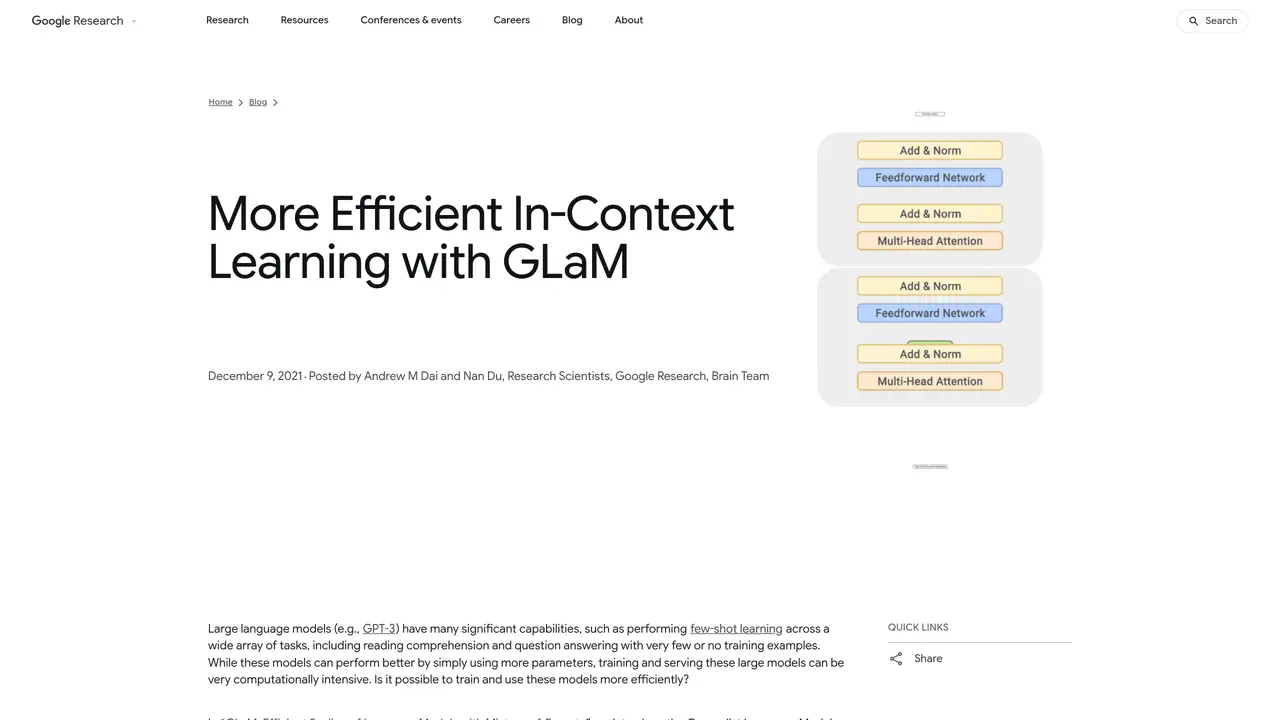
About Google GLaM
Google GLaM is an AI platform that enables developers to build, deploy, and monitor machine learning models tailored for specific applications using in-context learning. The platform leverages the latest advances in artificial intelligence to provide developers with tools that streamline the creation, testing, and deployment of sophisticated models. By reducing manual effort, Google GLaM allows users to quickly construct complex models that better align with their application needs. Its intuitive user interface simplifies the process of developing, testing, and deploying models in significantly less time compared to traditional methods. The platform also includes monitoring capabilities to track model performance over time, enabling users to make necessary adjustments to maintain accuracy and efficiency. Google GLaM is designed for developers seeking to accelerate model development while ensuring adaptability and precision in their applications.
Key features
- Rapid model building with in-context learning
- Intuitive user interface for easy development
- Quick testing and deployment of models
- Performance monitoring over time
- Adjustments for model accuracy and efficiency
- Tailored models for specific applications
- Reduced manual effort in model creation
- Sophisticated model capabilities
Use cases
- Developing custom machine learning models for niche applications
- Deploying models for real-time use in production environments
- Monitoring and refining model performance in live applications
Pros
- Leverages sparsity via Mixture-of-Experts (MoE) architecture to reduce computational and energy costs during training and inference
- Achieves competitive performance on few-shot learning tasks compared to dense models like GPT-3
- Dynamically routes input tokens to specialized expert networks, improving efficiency without sacrificing accuracy
- Trained on a high-quality 1.6 trillion token dataset filtered for relevance and quality
- Supports a wide range of NLP tasks including language completion, open-domain question answering, and natural language inference
Cons
- Requires significant computational resources for training and deployment due to its large-scale architecture
- Complexity of the MoE architecture may pose challenges for integration and maintenance in some development environments
- Performance heavily depends on the quality and diversity of the training dataset
Frequently asked questions about Google GLaM
What is Google GLaM?
Google GLaM is a Generalist Language Model that uses a Mixture-of-Experts architecture to enable efficient training and inference for large-scale natural language processing tasks.
Who is Google GLaM designed for?
GLaM is designed for researchers and developers working on large-scale NLP applications who require efficient few-shot learning capabilities and competitive performance.
How does Google GLaM improve efficiency?
GLaM improves efficiency by using sparsity in its MoE architecture, where only a subset of parameters (experts) are activated per input token, reducing computational and energy demands.
What types of tasks can Google GLaM handle?
GLaM can handle tasks such as language completion, open-domain question answering, and natural language inference with few-shot learning capabilities.
Does Google GLaM require labeled data for training?
No, GLaM is trained on an unlabeled corpus but uses a quality filter to ensure high-quality training data from diverse sources like web pages, books, and Wikipedia.
How can I get started with Google GLaM?
To get started, users can explore the research publication and model details provided by Google Research, which may include open-source implementations or further documentation.