
OpenAI builds and deploys advanced AI models like GPT-4o for autonomous agents and workflows.

GPT Researcher
$0.07Starting price
0Popularity
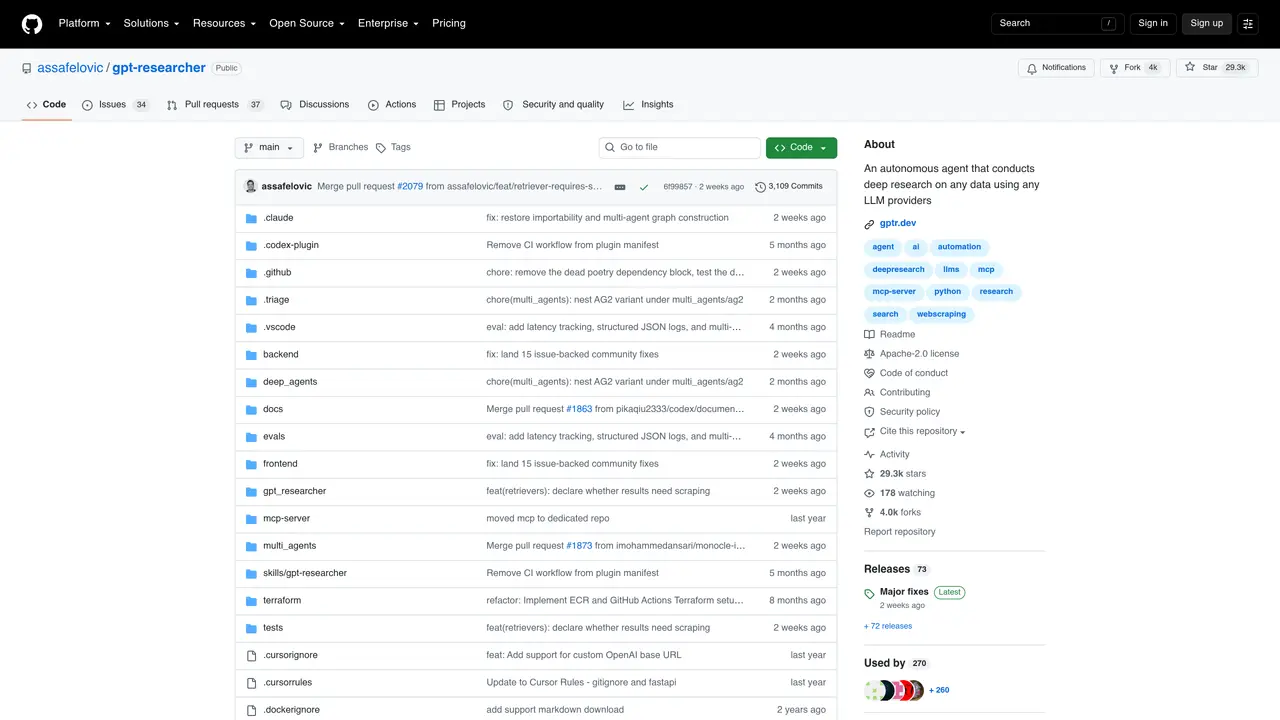
About GPT Researcher
GPT Researcher is an open-source autonomous agent designed to conduct deep research on any given task, supporting both web and local data sources. It generates detailed, factual, and unbiased research reports with proper citations, addressing common issues such as misinformation and hallucinations through a structured plan-and-solve approach. The tool leverages planner and execution agents to decompose research tasks into targeted questions, gather relevant information, and synthesize findings into a comprehensive report. Users can customize agents for domain-specific needs, ensuring tailored research outputs. Inspired by recent advancements in AI research, GPT Researcher emphasizes reliability, speed, and determinism by parallelizing agent workflows. It is particularly useful for individuals and organizations requiring thorough, evidence-based research without manual effort, such as market analysis, academic research, or competitive intelligence gathering. The system also offers integration options, including deployment as a Claude Skill for seamless use within conversations.
GitHub, Inc.
San Francisco, California, US · Founded 2008
- Founders
- Tom Preston-Werner, Chris Wanstrath, PJ Hyett, Scott Chacon
- Founded
- 2008
- Headquarters
- San Francisco, California, US
- Legal status
- Subsidiary of Microsoft (NASDAQ: MSFT)
Key features
- Autonomous research agent with GPT-4 integration
- Generates research questions automatically
- Deploys crawler agents to scrape online resources
- Summarizes and filters collected information
- Aggregates data from multiple sources
- Produces structured research reports
- Web-based interface for task management
- PDF export functionality for reports
- Open-source codebase available on GitHub
Use cases
- Conducting market research for business decisions
- Generating academic literature reviews
- Performing competitive intelligence analysis
Pros
- Autonomous agent that conducts deep research on both web and local data sources
- Produces detailed, factual, and unbiased research reports with citations
- Supports customization for domain-specific research agents
- Addresses misinformation and hallucinations through structured planning and execution
- Parallelized agent workflows for increased speed and stable performance
Cons
- Requires technical setup for local deployment or integration with LLM providers
- Dependent on the quality and availability of online sources for research
- May face limitations with highly specialized or niche research topics
GPT Researcher videos
Frequently asked questions about GPT Researcher
What does GPT Researcher do?
GPT Researcher is an autonomous agent that conducts deep research on any given task by generating targeted research questions, deploying crawler agents to gather information, summarizing sources, and producing structured research reports with citations.
Who is GPT Researcher designed for?
The tool is designed for individuals and organizations that require thorough, evidence-based research without manual effort, such as researchers, analysts, journalists, and businesses conducting market or competitive analysis.
How does GPT Researcher ensure the accuracy of its reports?
It addresses misinformation and hallucinations by using a plan-and-solve approach, parallelized agent workflows, and sourcing information from diverse online resources, while providing citations for all findings.
Can GPT Researcher be customized for specific research needs?
Yes, the tool offers full customization options to create tailor-made, domain-specific research agents based on user-defined tasks and requirements.
What integrations does GPT Researcher support?
GPT Researcher can be installed as a Claude Skill to extend Claude's deep research capabilities, and it supports integration with various LLM providers for research tasks.
How do I get started with GPT Researcher?
Users can install GPT Researcher as a Claude Skill using a provided command or deploy it locally by following the setup instructions in the project's repository, including configuring LLM providers and research parameters.