
OpenAI builds and deploys advanced AI models like GPT-4o for autonomous agents and workflows.

RAGFlow
$0.07Starting price
0Popularity
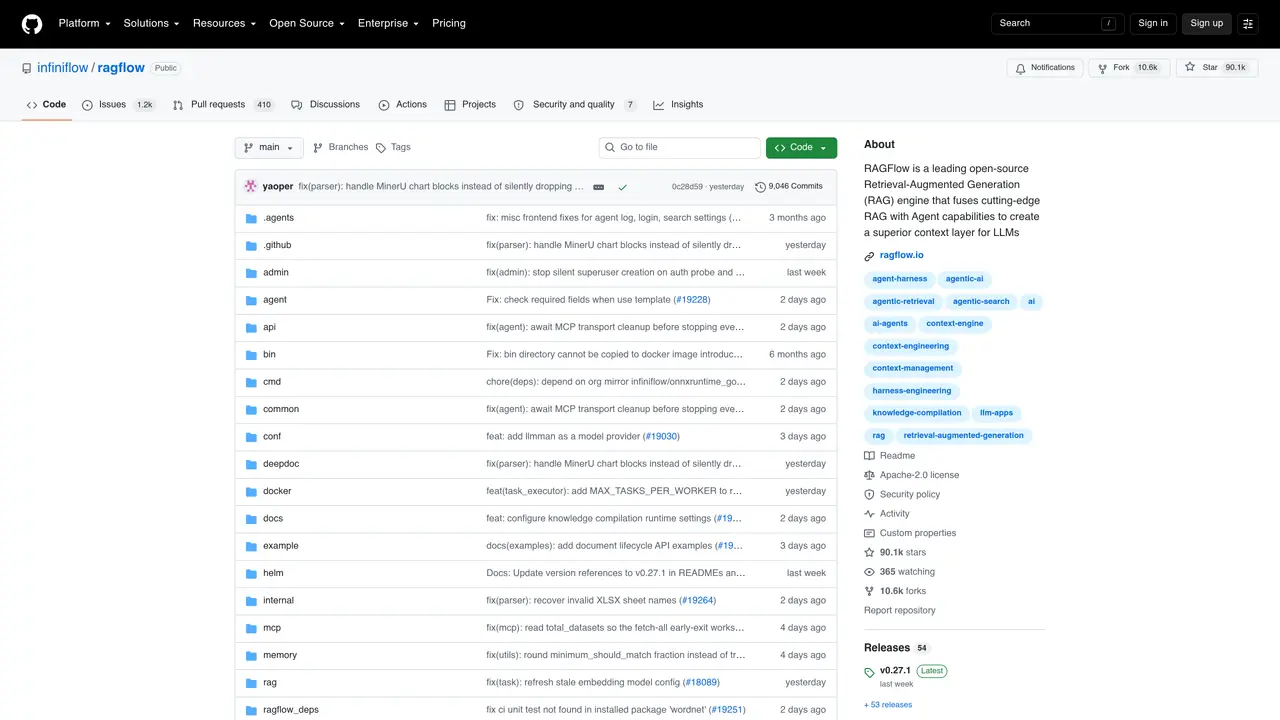
About RAGFlow
RAGFlow is an open-source Retrieval-Augmented Generation (RAG) engine designed to create a context layer for large language models. It combines advanced RAG with agentic capabilities to extract accurate, traceable knowledge from heterogeneous sources such as PDFs, Word documents, slides, images, Notion, Confluence, and cloud storage like S3. The tool leverages AI-powered deep document understanding, configurable LLMs and embedding models, and template-based chunking to process diverse file formats efficiently. Multi-recall with fused re-ranking ensures high retrieval precision, while grounded citations and optional sandboxed code execution reduce hallucinations in generated outputs. Developers and enterprises use RAGFlow to build production-grade chatbots, knowledge bases, and agentic workflows more rapidly. It supports multimodal and cross-language processing, scalable ingestion, and deployment tools, making it suitable for both technical and non-technical users seeking reliable, traceable AI-driven insights from documents.
GitHub, Inc.
San Francisco, California, US · Founded 2008
- Founders
- Tom Preston-Werner, Chris Wanstrath, PJ Hyett, Scott Chacon
- Founded
- 2008
- Headquarters
- San Francisco, California, US
- Legal status
- Subsidiary of Microsoft (NASDAQ: MSFT)
Key features
- Open-source RAG engine with agentic capabilities
- AI-powered deep document understanding
- Configurable LLMs and embedding models
- Template-based chunking for structured processing
- Multi-recall with fused re-ranking for precision
- Grounded citations to reduce hallucinations
- Optional sandboxed code execution for extraction
- Multimodal and cross-language support
- Scalable ingestion and deployment tools
- Pre-built agent templates for faster development
Use cases
- Building production-grade chatbots from documents
- Creating traceable knowledge bases from heterogeneous sources
- Developing agentic workflows with reduced hallucinations
Pros
- Open-source and freely available for modification and deployment
- Supports multimodal document processing including PDFs, Word files, slides, and images
- Integrates agentic workflows and MCP for advanced automation and tool use
- Offers configurable LLMs and embedding models for flexible customization
- Provides grounded citations and sandboxed code execution to reduce hallucinations
Cons
- Requires technical expertise for self-hosting and configuration
- Documentation and community support are primarily available through GitHub
- Scalability and performance depend heavily on local infrastructure setup
Frequently asked questions about RAGFlow
What is RAGFlow?
RAGFlow is an open-source Retrieval-Augmented Generation (RAG) engine that combines advanced RAG with agentic capabilities to create a context layer for large language models. It processes diverse document formats and supports multimodal and cross-language workflows.
Who should use RAGFlow?
RAGFlow is designed for developers and enterprises seeking to build production-grade chatbots, knowledge bases, and agentic workflows. It suits users who require traceable, high-precision AI-driven insights from documents.
How does RAGFlow work?
RAGFlow ingests documents, applies AI-powered deep understanding, and uses configurable LLMs and embedding models to generate accurate responses. It leverages multi-recall with fused re-ranking for high retrieval precision and supports sandboxed code execution to minimize hallucinations.
What integrations does RAGFlow support?
RAGFlow supports integrations with cloud storage services like S3, collaboration tools such as Notion and Confluence, and messaging platforms including Feishu, Discord, and Telegram. It also supports MCP for external tool integration.
Can RAGFlow be self-hosted?
Yes, RAGFlow can be self-hosted using Docker or launched from source for development. It provides tools and configurations for deployment, including Helm charts for Kubernetes environments.
How do I get started with RAGFlow?
Users can start by visiting the GitHub repository for documentation and setup instructions. A cloud service is also available at https://cloud.ragflow.io for immediate testing and use.