OpenAI builds and deploys advanced AI models like GPT-4o for autonomous agents and workflows.

Kanwas
$1Starting price
484Monthly visits
0Popularity
About Kanwas
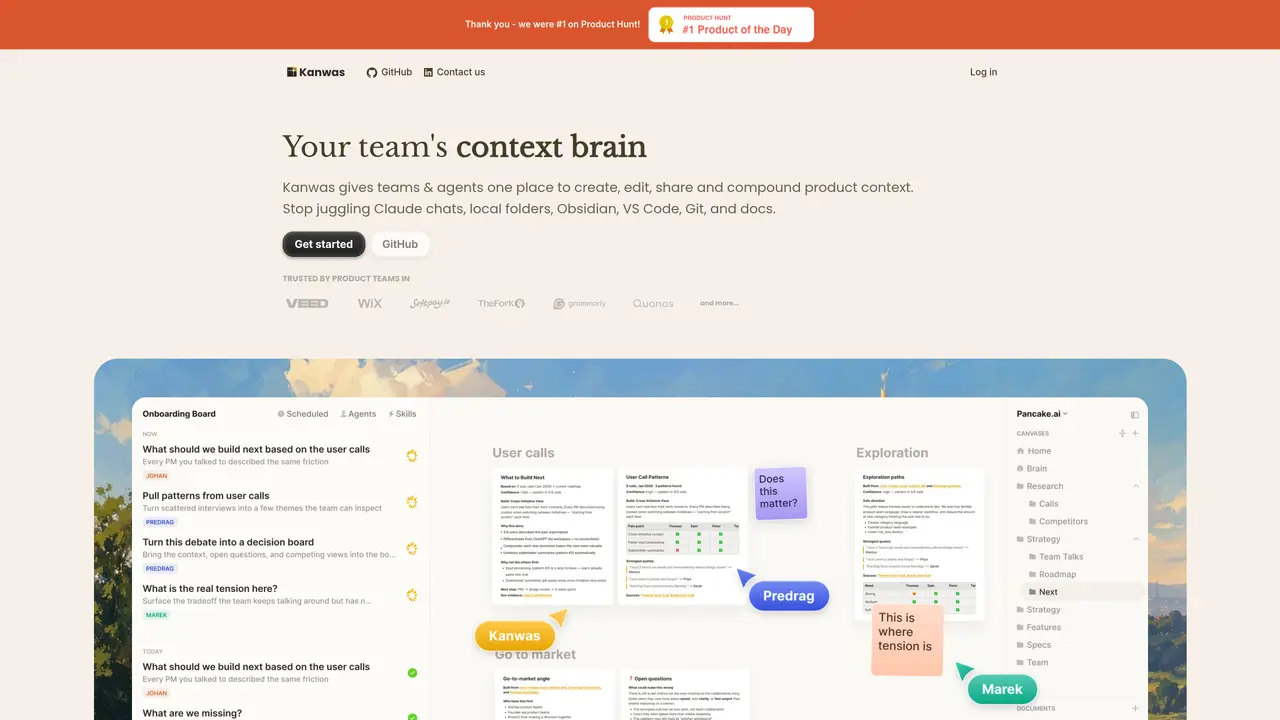
Kanwas is a context-first AI workspace that acts as a shared brain for product teams and agents. It combines a spatial canvas, a compounding knowledge graph, and model-agnostic AI agents that learn a team’s rules, workflows, and history. Instead of scattered chats, static docs, and forgotten whiteboards, Kanwas pulls code, tasks, research, conversations, and decisions into one Git-backed space where humans and agents reason over the same context. It targets product managers, founders, and cross-functional product teams that want sharper strategies, PRDs, and roadmaps without losing the human taste that makes those decisions distinct. Key Features: Context-aware AI agents, Canvas for real work, Compounding context graph, Model-agnostic stack, Git-backed markdown storage, Real-time collaboration, 1,000+ connections and CLI. Kanwas is a good fit for PM workflows, mirrors how experienced PMs combine evidence, trade offs, and execution details in one living decision space.
Key features
- Context-aware AI agents
- Canvas for real work
- Compounding context graph
- Model-agnostic stack
- Git-backed markdown storage
- Real-time collaboration
- 1,000+ connections and CLI
Use cases
- Product Managers and Product Leads: Centralizing discovery notes, PRDs, decision logs, and metrics while AI agents keep specs and roadmaps current.
- Startup Founders and Leadership Teams: Turning investor feedback, customer calls, and strategy memos into a living context brain for the company.
- Design and UX Research Teams: Connecting research artifacts, insights, and design explorations so AI can surface relevant evidence during key product decisions.
Pros
- Combines team context, decisions, and deliverables in a single Git-backed workspace
- Uses a compounding knowledge graph that improves with each decision and iteration
- Supports real-time collaboration with teammates and model-agnostic AI agents
- Enables structured, execution-ready deliverables for product strategy and roadmaps
- Provides a spatial canvas for thinking, reasoning, and working alongside AI
Cons
- Requires teams to migrate and centralize existing workflows into a new system
- May involve a learning curve for teams accustomed to traditional document and chat tools
Kanwas videos
Frequently asked questions about Kanwas
What is Kanwas and who is it designed for?
Kanwas is a shared context board for teams and AI agents that consolidates product context into one Git-backed space. It is designed for product managers, founders, and cross-functional teams who need to align on decisions, collaborate in real time, and generate structured deliverables without losing the nuance of human judgment.
How does Kanwas help teams collaborate with AI agents?
Kanwas provides a spatial canvas where teams and agents work over the same context, learning the team’s rules, workflows, and history. Agents can be instructed with custom rules and workflows, enabling them to assist in reasoning and decision-making while maintaining transparency and alignment.
What kind of deliverables can be created in Kanwas?
Kanwas helps generate structured, execution-ready deliverables such as pitch decks, PRDs, roadmaps, and strategy documents. These are built collaboratively and improve over time as the team’s shared context compounds with each decision and outcome.
Does Kanwas integrate with other tools?
Yes, Kanwas offers over 1,000 connections and a CLI tool to pull context from existing tools like code repositories, documentation platforms, and communication apps. This ensures teams can centralize their workflow without switching between multiple systems.
How does Kanwas handle data ownership and versioning?
Kanwas stores every document as a Git-backed markdown file, providing full version history and transparent filesystem access. This ensures data ownership remains with the team, avoiding vendor lock-in and enabling seamless collaboration.
Can teams use their preferred AI models with Kanwas?
Yes, Kanwas is model-agnostic, allowing teams to use any AI model they prefer, such as Claude, GPT, or Gemini. This flexibility ensures the tool adapts to the team’s existing workflows rather than imposing a specific model.
Kanwas Website Engagement
Last Update: 9 days ago
Total Monthly Visits
0
Bounce Rate
0%
Visit Duration (avg)
0.00s
Pages Per Visit
0
Country Rank
—
Unknown
Global Rank
0