
Generate captions, optimize content, and enhance with custom images for maximum engagement.
46M visits/mo-10%#3 Image & Design
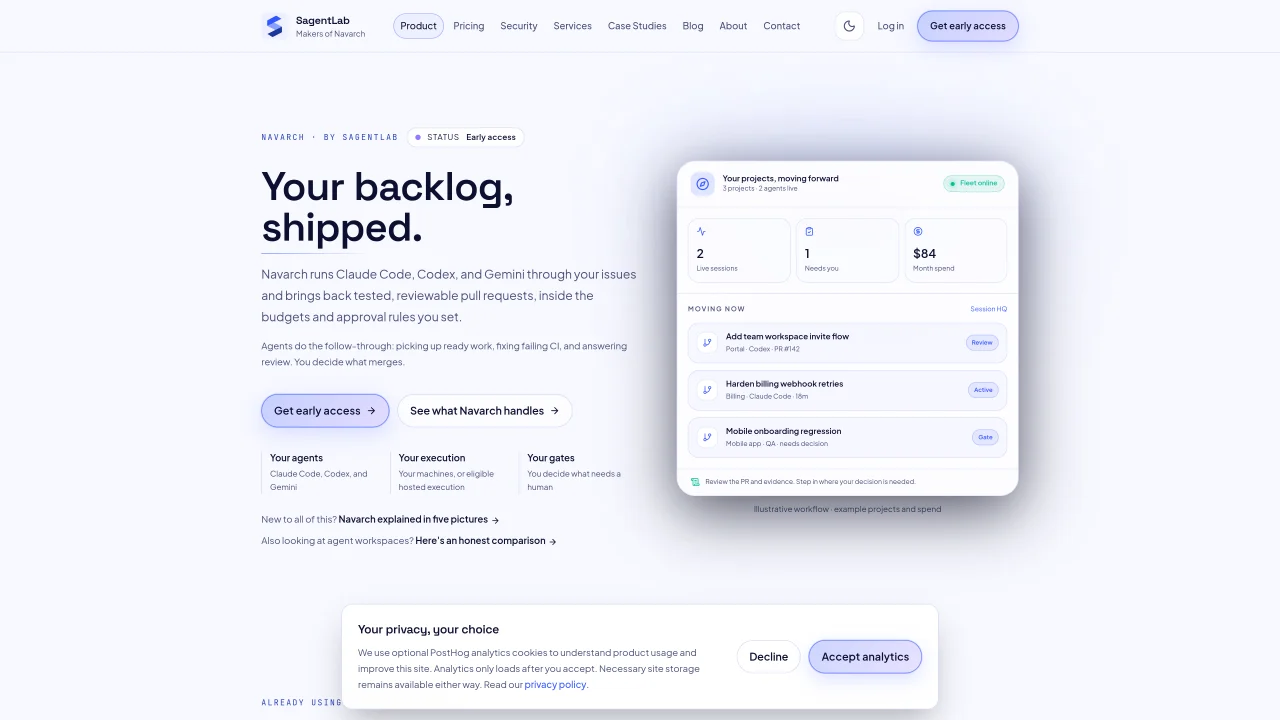
Navarch coordinates coding agents such as Claude Code, Codex, and Gemini to execute tasks from a backlog and return tested, reviewable pull requests. It handles follow-through actions like picking up ready work, fixing failing CI, and responding to reviews, while enforcing budgets and approval rules set by the user. The tool integrates with existing workflows by dispatching work to either user-provided machines or hosted execution environments, ensuring flexibility in execution location. Navarch provides a centralized project board that displays active work, review requests, blockers, and spending, allowing teams to steer multiple projects from one interface. It supports engineering workflows such as bug fixes, product QA, and release delivery by capturing evidence, managing milestones, and coordinating documentation and demos. The system records session history, approvals, and costs, with alerts surfacing exceptions to keep teams informed without constant monitoring. Designed for agencies and small engineering teams, Navarch emphasizes human oversight by letting users decide what merges and when to intervene.
Navarch coordinates coding agents such as Claude Code, Codex, and Gemini to execute tasks from a backlog and return tested, reviewable pull requests.
Navarch is designed for agencies and small engineering teams maintaining several products, emphasizing human oversight and coordination of coding agents.
Navarch integrates by dispatching work to either user-provided machines or hosted execution environments, ensuring flexibility in execution location.
Yes, Navarch handles follow-through actions such as picking up ready work, fixing failing CI, and responding to reviews while enforcing user-set budgets and approval rules.
Navarch provides a centralized project board that displays active work, review requests, blockers, and spending, allowing teams to steer multiple projects from one interface.
Navarch supports workflows such as capturing evidence for bug fixes, managing milestones, coordinating documentation and demos, and running browser checks for product QA.
We use essential cookies to run aitoolnavio™, and optional cookies to analyze traffic and measure our marketing. You choose what we use — optional cookies stay off unless you turn them on. See our Privacy Policy.
One short email a week: fresh tools worth trying, honest takes and the updates that actually matter. No spam, unsubscribe any time.
Generate captions, optimize content, and enhance with custom images for maximum engagement.
Build conversational forms, capture rich responses, and automate follow-ups with AI-powered surveys and workflows.
Automate code, research, and documents using agents.
AI-powered IDE for autonomous coding tasks and agentic development workflows
Source, match, and manage talent with predictive analytics for effortless recruiting.
Automate workflow, optimize operations, and detect potential issues with this efficient AI-driven solution.
Transforms thoughts into actions, enhancing productivity and efficiency.
AI Recruitment engine to hire top global talent
All-in-one team productivity platform combining chat, docs, video meetings, workflows, and AI tools in one place.
Personal assistant that coordinates tasks across apps and devices via text or call
AI automation and agent-building platform with 3,000+ app integrations
AI job search copilot that matches roles to skills, optimizes resumes for ATS, generates cover letters, and autofills applications with real-time insights.
Matched on what this tool does — grouped by the job you would be replacing.
matches Coordinates Claude Code, Codex, and Gemini agents · Hosted or self-hosted execution environments · Centralized project board with health, priority, and spend tracking
GitHub Marketplace coding agent that turns GitHub issues into code changes and unit-tested pull requests for engineering teams.
Autonomous software delivery agent that turns tickets into reviewed pull requests
Runs coding-agent workloads as isolated, observable jobs on self-hosted infrastructure
Self-hosted agent that proposes, reviews and publishes code changes as GitHub pull requests
matches Pull request creation with attached evidence and test results · Approval rules and governance controls per project
An AI-powered code review tool that automates GitHub and GitLab pull request reviews with inline comments, PR summaries, and custom rules for software teams.
AI-powered code review tool that fixes issues and validates against CI pipelines