
OpenAI builds and deploys advanced AI models like GPT-4o for autonomous agents and workflows.

SWE-agent
$0.07Starting price
0Popularity
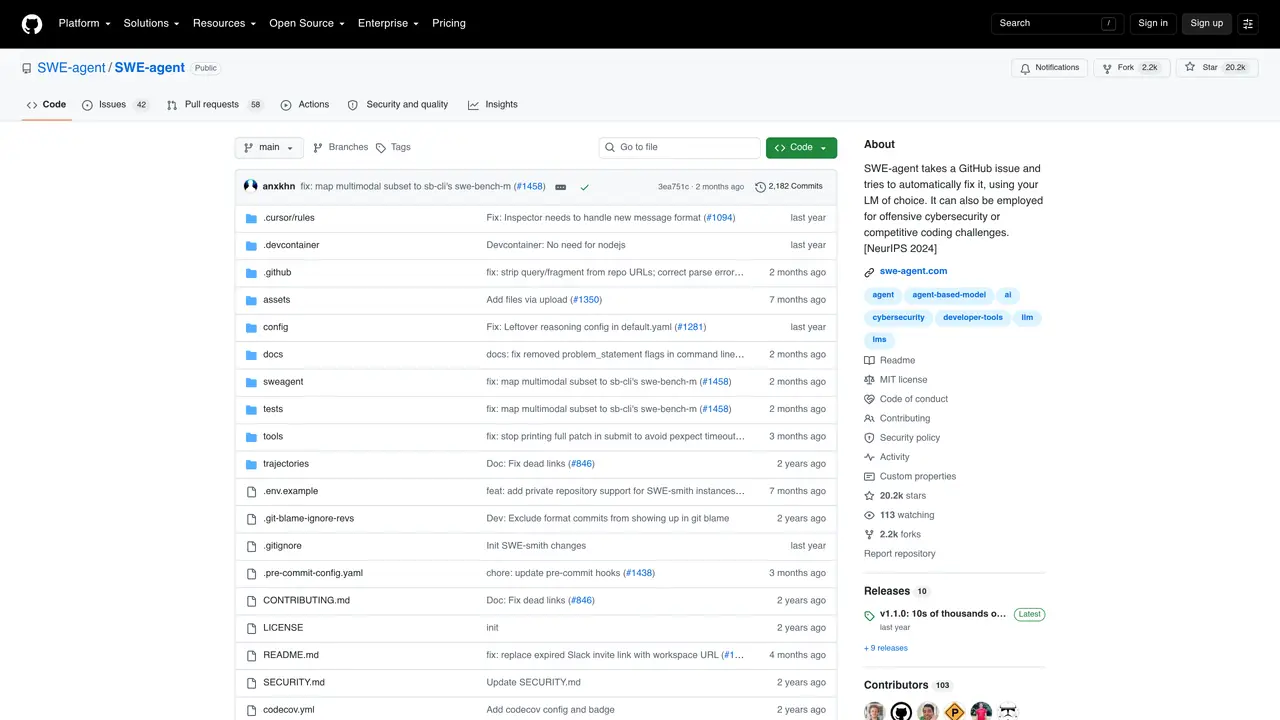
About SWE-agent
SWE-agent is a software engineering tool that leverages language models, such as GPT-4, to autonomously identify and resolve bugs within real GitHub repositories. It operates through an Agent-Computer Interface (ACI) that enables the model to interact directly with the repository’s codebase, allowing it to browse, view, edit, and execute files efficiently. By automating the debugging process, SWE-agent helps developers reduce the time spent on manual bug fixes while improving overall productivity. The tool is designed for developers seeking to integrate AI-driven problem-solving into their workflows, particularly for addressing issues in active software projects. Its state-of-the-art performance in issue resolution makes it a practical solution for streamlining software development tasks. Users can deploy SWE-agent to handle repetitive debugging challenges, freeing up time for higher-level development work.
GitHub, Inc.
San Francisco, California, US · Founded 2008
- Founders
- Tom Preston-Werner, Chris Wanstrath, PJ Hyett, Scott Chacon
- Founded
- 2008
- Headquarters
- San Francisco, California, US
- Legal status
- Subsidiary of Microsoft (NASDAQ: MSFT)
Key features
- Autonomous bug resolution in GitHub repositories
- Agent-Computer Interface (ACI) for direct codebase interaction
- Browsing, viewing, editing, and executing files
- Integration with language models like GPT-4
- State-of-the-art performance on issue resolution
- Reduces manual debugging time
- Open-source and available on GitHub
- Enhances developer productivity
Use cases
- Automating bug fixes in open-source projects
- Streamlining debugging workflows for development teams
- Integrating AI-driven issue resolution into CI/CD pipelines
Pros
- State-of-the-art performance on SWE-bench benchmarks among open-source projects
- Free-flowing and generalizable, maximizing agency for language models
- Configurable and fully documented via a single YAML configuration file
- Designed for research with a simple and hackable architecture
- Supports multiple tasks including bug fixing, cybersecurity, and competitive coding
Cons
- Most development effort is now focused on mini-SWE-agent, which is recommended over SWE-agent
- Requires setup and configuration, which may involve a learning curve for new users
- Performance depends on the capabilities of the chosen language model
SWE-agent videos
Frequently asked questions about SWE-agent
What does SWE-agent do?
SWE-agent enables a language model to autonomously fix issues in real GitHub repositories, find cybersecurity vulnerabilities, or perform custom tasks by interacting with the codebase through an Agent-Computer Interface.
Who is SWE-agent designed for?
It is designed for developers, researchers, and teams looking to integrate AI-driven problem-solving into their software development workflows, particularly for debugging and issue resolution.
How does SWE-agent work?
SWE-agent uses an Agent-Computer Interface to allow the language model to browse, view, edit, and execute files directly within a GitHub repository, automating the debugging and resolution process.
What language models does SWE-agent support?
SWE-agent supports language models such as GPT-4o, Claude Sonnet 4, and other compatible models, depending on user configuration.
Can SWE-agent be used for tasks other than bug fixing?
Yes, SWE-agent can also be employed for offensive cybersecurity challenges or competitive coding tasks, demonstrating its versatility beyond traditional debugging.
How do I get started with SWE-agent?
Users can start by installing SWE-agent, configuring it via a YAML file, and running it on a GitHub repository or task. Documentation and examples are available to guide the setup process.