
OpenAI builds and deploys advanced AI models like GPT-4o for autonomous agents and workflows.

Ralph Wiggum
$0.07Starting price
0Popularity
About Ralph Wiggum
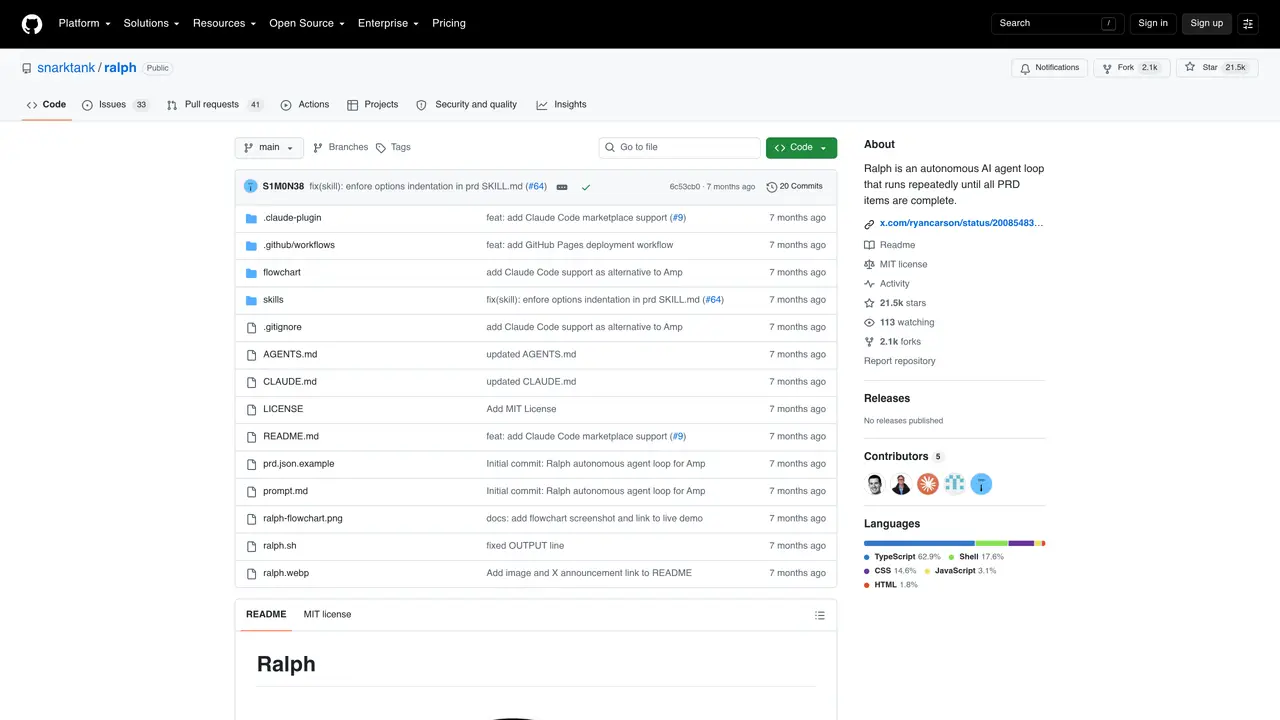
Ralph Wiggum is a minimal, iterative technique for running AI coding agents autonomously. It wraps an AI tool, such as Claude Code, in a simple loop (often a bash script) that feeds the same prompt repeatedly. Each iteration refines the code based on prior outputs or git history until a stop condition is met, such as passing tests or a successful build. The approach is named after the Simpsons character for its stubborn, repetitive persistence. It is designed for well-defined coding jobs where success can be verified automatically, allowing the AI to handle repetitive, manual work without human intervention. Users can run overnight execution of development backlogs, refactor legacy codebases, or implement microfeatures sequentially without constant oversight. The technique shifts the AI from a chatty helper into an independent coder that grinds through tasks until completion. It supports any AI model and requires minimal setup, making it accessible to developers, architects, and engineering leaders seeking hands-free automation for routine coding tasks.
GitHub, Inc.
San Francisco, California, US · Founded 2008
- Founders
- Tom Preston-Werner, Chris Wanstrath, PJ Hyett, Scott Chacon
- Founded
- 2008
- Headquarters
- San Francisco, California, US
- Legal status
- Subsidiary of Microsoft (NASDAQ: MSFT)
Key features
- Simple iterative loop for autonomous AI coding
- Works with any AI model or coding agent
- Minimal setup via bash script or plugin
- Stop conditions based on tests, builds, or git history
- Hands-free overnight execution of development tasks
- Supports refactoring, feature implementation, and regression fixes
- Open-source and free to use
- Plugin available for Claude Code (/ralph-loop or /yolo-ralph)
- Persistent refinement until task completion
Use cases
- Automate full feature implementation from a to-do list
- Refactor legacy codebases overnight without manual intervention
- Run hands-free regression fixes based on automated success criteria
Pros
- Runs AI coding agents autonomously in a loop until all PRD items are complete
- Supports multiple AI coding tools like Amp or Claude Code with minimal setup
- Persists memory and progress via git history, progress.txt, and prd.json files
- Designed for well-defined coding tasks with automatic success verification
- Enables hands-free automation for routine coding tasks, reducing manual oversight
Cons
- Requires a git repository and specific AI coding tools (Amp or Claude Code) to function
- Each iteration starts with a fresh instance, which may limit contextual continuity
- Setup involves copying files or configuring skills, adding initial complexity
- May struggle with tasks that exceed a single context window without auto-handoff configuration
Frequently asked questions about Ralph Wiggum
What is Ralph Wiggum and how does it work?
Ralph Wiggum is an autonomous AI agent loop that repeatedly runs AI coding tools until all Product Requirements Document (PRD) items are completed. Each iteration operates as a fresh instance with clean context, while memory persists through git history, progress.txt, and prd.json.
Who should use Ralph Wiggum?
Ralph Wiggum is designed for developers, architects, and engineering leaders seeking hands-free automation for routine coding tasks. It suits teams looking to automate well-defined coding jobs with verifiable success criteria.
What AI coding tools does Ralph Wiggum support?
Ralph Wiggum supports AI coding tools such as Amp CLI and Claude Code. Users can select their preferred tool during setup and execution.
How do I set up Ralph Wiggum?
Setup involves copying the Ralph files into your project or installing skills globally. Prerequisites include an AI coding tool (Amp or Claude Code), jq, and a git repository. Detailed setup instructions are provided in the README.
Can Ralph Wiggum handle large stories that exceed context limits?
Yes, Ralph Wiggum supports Amp's auto-handoff feature, which enables automatic context management when stories exceed a single context window. This allows Ralph to handle large tasks without manual intervention.
What files are used to track progress in Ralph Wiggum?
Progress is tracked using prd.json for structured user stories, progress.txt for logging learnings, and git history for maintaining memory between iterations. These files ensure continuity and verification of completed tasks.