
OpenAI builds and deploys advanced AI models like GPT-4o for autonomous agents and workflows.

Vultrino
0Popularity
About Vultrino
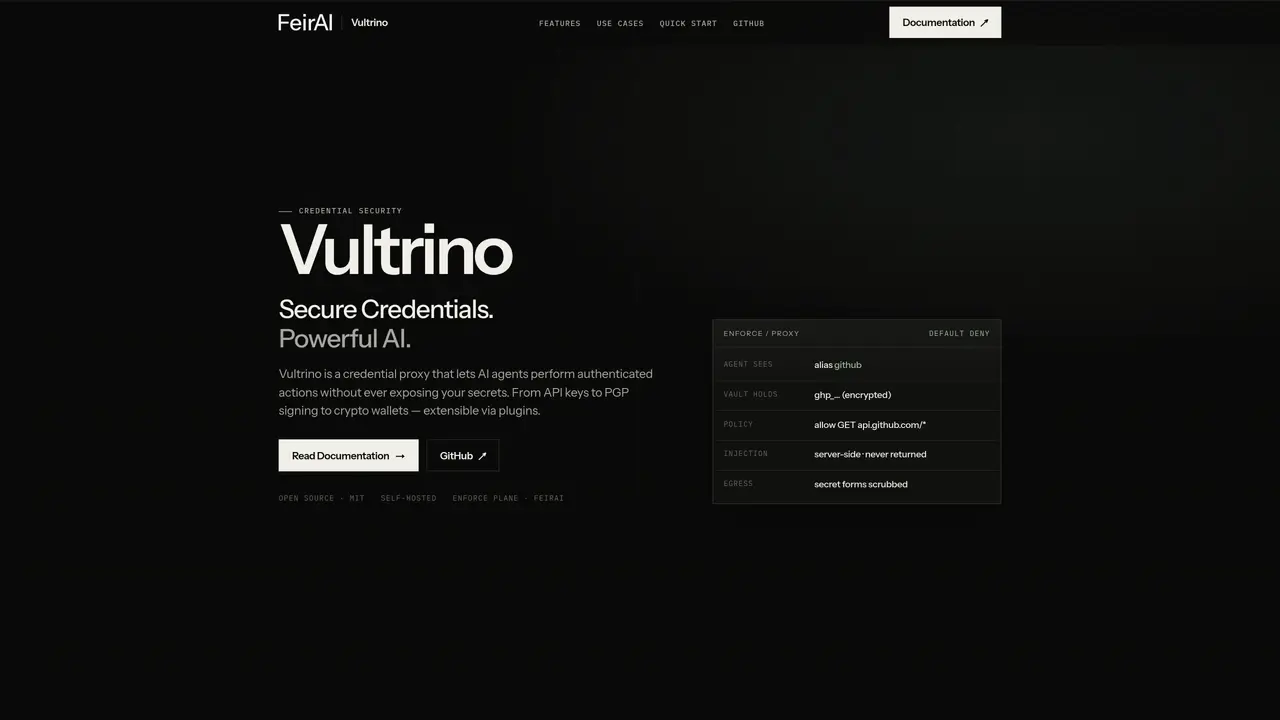
Vultrino acts as a credential proxy for AI agents, enabling authenticated actions without revealing actual secrets. It supports API keys, PGP signing, cryptocurrency wallets, SSH keys, and other credential types through extensible WebAssembly plugins. All credentials are encrypted at rest using AES-256-GCM with Argon2 key derivation, ensuring protection even if storage is compromised. The tool enforces fine-grained access control via a policy engine that restricts URL patterns, methods, and rate limits, while role-based permissions limit agent or application access. Vultrino operates as a self-hosted service, allowing users to manage credentials, roles, and permissions through a web dashboard or terminal commands. It integrates natively with the Model Context Protocol for use with LLMs like Claude and GPT.
Key features
- Credential isolation for AI agents
- AES-256-GCM encryption at rest
- WebAssembly plugin system for extensibility
- Fine-grained policy engine for access control
- Role-based permission management
- Model Context Protocol integration
- Web dashboard for credential administration
- Terminal commands for quick setup
Use cases
- Securing API keys for AI agents interacting with services like GitHub or OpenAI
- Signing PGP commits or documents without exposing private keys
- Managing cryptocurrency wallet transactions via AI agents
Pros
- Encrypts credentials at rest with AES-256-GCM and Argon2 key derivation
- Supports extensible credential types via WebAssembly plugins
- Enforces fine-grained access control with policy engine and role-based permissions
- Self-hosted deployment with web dashboard and terminal interface
- Native Model Context Protocol integration for LLM compatibility
Cons
- No mention of free tier or pricing tiers
- Limited to self-hosted deployment with no cloud-hosted option
- Documentation and setup may require technical expertise
- No explicit support for mobile or non-desktop environments
Frequently asked questions about Vultrino
What is Vultrino and what does it do?
Vultrino is a credential proxy designed for AI agents, enabling them to perform authenticated actions without exposing actual secrets. It acts as an intermediary that handles sensitive operations server-side while agents interact with aliases or scoped credentials.
Who should use Vultrino?
Vultrino is suitable for developers, organizations, and AI teams that need to securely delegate authenticated actions to AI agents without risking exposure of credentials like API keys, cryptographic keys, or tokens.
How does Vultrino secure credentials?
Vultrino encrypts all credentials at rest using AES-256-GCM with Argon2 key derivation. It enforces fine-grained access control through a policy engine and role-based permissions, ensuring credentials remain protected even if storage is compromised.
Does Vultrino support different types of credentials?
Yes, Vultrino supports a wide range of credential types including API keys, PGP signing keys, cryptocurrency wallets, SSH keys, and OAuth tokens. It achieves this through extensible WebAssembly plugins that can be added as needed.
How do I get started with Vultrino?
Getting started with Vultrino involves initializing the service, adding credentials via aliases, and starting the server. Users can then create scoped API keys or roles and begin using the proxy to manage authenticated actions for AI agents.
Can Vultrino integrate with AI models or agents?
Yes, Vultrino natively supports the Model Context Protocol (MCP), allowing integration with AI models like Claude and GPT. Agents can securely interact with APIs or services through Vultrino without ever accessing the underlying credentials.