
OpenAI builds and deploys advanced AI models like GPT-4o for autonomous agents and workflows.

Zep
FreeStarting price
68KMonthly visits
31Popularity
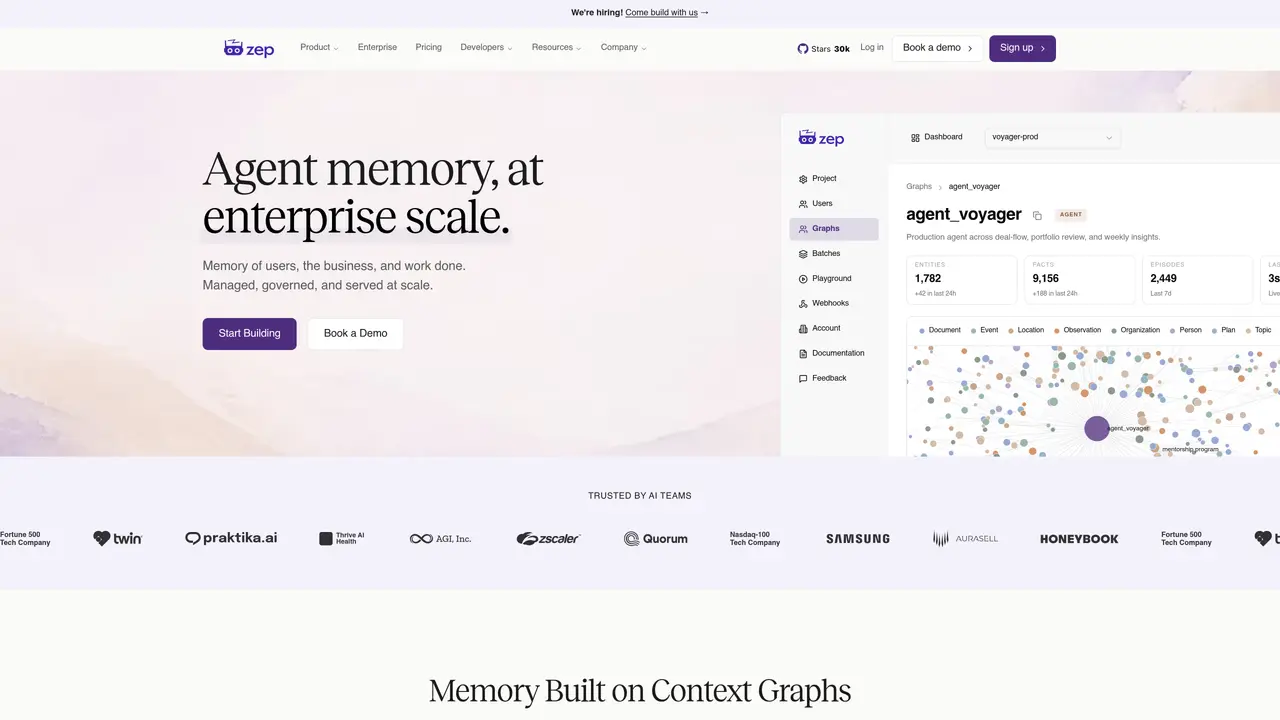
About Zep
Zep is an API and web-based context engineering and agent memory platform designed for AI development teams and enterprises building production AI agents and assistants. It constructs temporal knowledge graphs that track entities, relationships, and facts over time, enabling fact invalidation to prevent stale context from influencing responses. The platform unifies context from multiple sources—including chat history, JSON business data, documents, CRM systems, and application events—into token-efficient context blocks optimized for LLM prompts. Zep supports real-time agents with graph RAG retrieval that combines semantic, keyword, and graph-based search, achieving sub-200ms (P95) context retrieval and assembly. It offers Context Templates and custom ontologies for domain-specific filtering and reproducible evaluations. The platform integrates with major LLM providers such as OpenAI, Azure OpenAI, Google Gemini, and Anthropic, and provides an MCP server for compatibility with clients like Claude and Cursor. Zep is notable for its temporal knowledge graph approach, powered by the open-source Graphiti engine with Neo4j support, and publishes benchmark results demonstrating strong performance in agent memory evaluations.
Key features
- Temporal knowledge graph memory with fact invalidation
- Unified context assembly from chat, documents, CRM, and app events
- Graph RAG retrieval combining semantic, keyword, and graph-based search
- Sub-200ms (P95) context retrieval and assembly for real-time agents
- Context Templates and custom ontologies for domain-specific filtering
- MCP server for integration with Claude, Cursor, and other MCP-compatible clients
- Support for multiple LLM providers including OpenAI, Azure OpenAI, Google Gemini, and Anthropic
- Published benchmark results for agent memory evaluations
- Graphiti engine with Neo4j support
- Token-efficient context block formatting for LLM prompts
Use cases
- Building production AI agents and assistants
- Training AI models with structured temporal context
- Enhancing chatbots with long-term memory and context
Pros
- Temporal knowledge graphs track entities, relationships, and facts over time with automated fact invalidation to ensure up-to-date context
- Sub-200ms (P95) context retrieval and assembly, maintaining performance regardless of graph size or count
- Unified context ingestion from diverse sources including chat history, business data, documents, CRM systems, and application events
- Provenance-preserving memory with audit trails that trace facts back to their source episodes for transparency
- Enterprise-scale memory infrastructure with access control, retention policies, and audit capabilities built into the substrate
Cons
- Complexity in setup and management due to the temporal knowledge graph architecture and enterprise-scale features
- Potential latency in initial graph construction when ingesting large volumes of historical data
- Dependency on proprietary Context Graph Engine may limit flexibility for custom implementations
Frequently asked questions about Zep
What does Zep do?
Zep provides persistent memory for AI agents through temporal context graphs that track entities, relationships, and facts over time, enabling fact invalidation and token-efficient context retrieval.
Who is Zep designed for?
Zep is designed for AI development teams and enterprises building production AI agents and assistants that require scalable, governed memory infrastructure.
How does Zep handle memory updates and contradictions?
Zep invalidates old facts when new information contradicts existing data, ensuring agents reason with the latest decisions, traits, and behaviors while preserving historical context.
What integrations does Zep support?
Zep integrates with major LLM providers such as OpenAI, Azure OpenAI, Google Gemini, and Anthropic, and offers an MCP server for compatibility with clients like Claude and Cursor.
How do I get started with Zep?
Zep provides a quickstart guide with code examples in Python, TypeScript, and Go, allowing users to add memory to their agents in minutes with minimal setup.
Does Zep support enterprise-scale deployments?
Yes, Zep is built for enterprise-scale memory infrastructure, offering features like access control, retention policies, provenance tracking, and audit capabilities across millions of context graphs.
Zep Website Engagement
Last Update: 9 days ago
Total Monthly Visits
0
Bounce Rate
0%
Visit Duration (avg)
0.00s
Pages Per Visit
0
Country Rank
0
United States
Global Rank
0
Category Rank
#0
Programming & Developer Software
Monthly Traffic
Traffic Sources
Traffic Share By Country
- United States33.1%
- Vietnam11.7%
- India9.5%
- Germany6.1%
- Brazil5.3%