
OpenAI builds and deploys advanced AI models like GPT-4o for autonomous agents and workflows.

Hebbrix
FreeStarting price
0Popularity
About Hebbrix
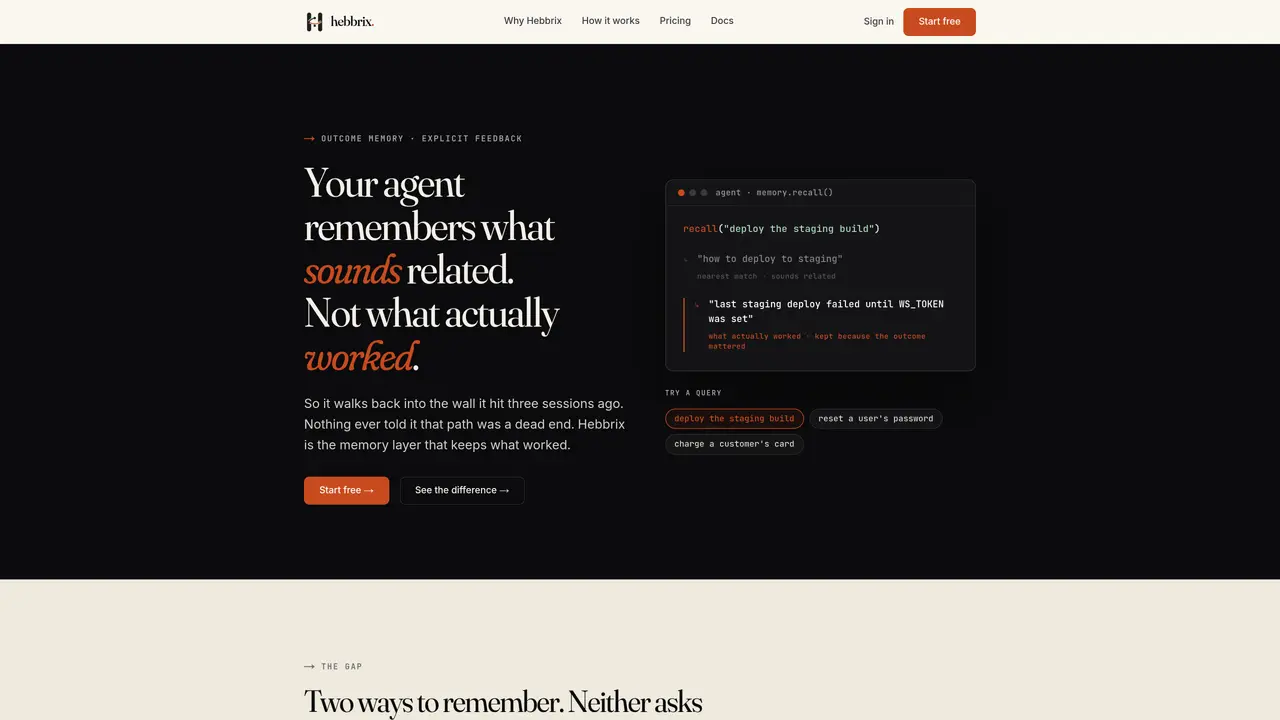
Hebbrix is a persistent memory platform designed for AI agents and applications that require long-term, queryable context. It implements a 3-tier memory architecture—short, mid, and long-term—paired with a 5-layer hybrid search system combining vector similarity, BM25, knowledge-graph traversal, time-decay, and ONNX reranking. The platform includes a knowledge graph for temporal reasoning and contradiction detection, delivering sub-50ms retrieval speeds. Hebbrix exposes OpenAI-compatible APIs, supports streaming responses, and automates context injection and fact/profile extraction from documents, audio, video, and conversations. This allows developers to integrate memory capabilities into any LLM stack without building custom state-management or memory systems. The tool is intended for teams building chatbots, agents, or AI applications that need to remember user interactions, preferences, and contextual details over extended periods. By offloading memory management to Hebbrix, users can focus on core functionality while ensuring consistent, personalized, and context-aware interactions across sessions.
Key features
- 3-tier memory architecture (short/mid/long-term)
- 5-layer hybrid search (vector similarity, BM25, knowledge-graph traversal, time-decay, ONNX reranking)
- Knowledge graph for temporal reasoning and contradiction detection
- Sub-50ms retrieval latency
- OpenAI-compatible APIs
- Streaming responses
- Automatic context injection
- Automated fact/profile extraction from documents, audio, video, and conversations
Use cases
- Building AI chatbots that remember user history and preferences
- Enabling agents to maintain long-term context across sessions
- Personalizing AI applications without custom state management
Pros
- Implements outcome-weighted recall to prioritize what actually worked over mere similarity
- Offers a 5-layer hybrid search system combining vector, lexical, graph, temporal, and feedback signals
- Provides sub-50ms retrieval speeds with a 3-tier memory architecture
- Exposes OpenAI-compatible APIs for seamless integration with existing LLM stacks
- Includes a knowledge graph for temporal reasoning and contradiction detection
Cons
- May require adjustments to existing workflows to report outcomes for optimal performance
- Free tier has limited credits, which may restrict usage for larger projects
Frequently asked questions about Hebbrix
What exactly counts as a credit?
Credits are normalized usage units that measure memory operations such as writes, reads, and profile extractions. Managed-model calls also track token and estimated-cost usage, with detailed impact shown in the dashboard.
What happens if I go over my plan's credit limit?
On Free and Starter plans, memory writes pause until the next billing cycle while reads continue to work. Pro and Scale plans allow enabling overage billing to continue operations.
How does Hebbrix differ from traditional memory systems?
Hebbrix focuses on retaining what worked based on reported outcomes rather than just retrieving similar or recent information, addressing the common issue of agents repeating failed approaches.
Can I use Hebbrix with any LLM model?
Yes, Hebbrix is designed as a drop-in replacement for OpenAI-compatible APIs, allowing you to switch models without losing stored memory or requiring rewrites.
Who should use Hebbrix?
Hebbrix is intended for teams building AI agents, chatbots, or applications that require persistent, queryable memory to remember interactions, preferences, and contextual details over time.
How do I get started with Hebbrix?
You can start with a free account offering 1,000 credits per month. Integration involves changing one line in your existing OpenAI client to point to Hebbrix's API endpoint.