An AI-driven experience management platform for enterprises to collect multi-channel feedback, analyze structured and unstructured data, and deliver actionable insights.

Diffgram
$0.07Starting price
0Popularity
About Diffgram
Diffgram is a powerful and user-friendly web-based tool designed to make data analysis faster, easier, and more accurate. It provides users with the ability to query and manipulate data from multiple sources in one place. With Diffgram, users can quickly uncover insights and identify trends in their data, allowing them to make smarter business decisions and drive better outcomes. Diffgram is ideal for teams and organizations looking to maximize their data analysis capabilities. It offers features such as visualizations, interactive dashboards, and automated workflows, all of which are designed to make data analysis simpler and more intuitive. Diffgram also provides powerful data integration tools, giving users the ability to quickly and easily combine data from multiple sources. For those looking to optimize their data analysis processes, Diffgram is an invaluable resource. It enables users to quickly and easily query, manipulate, and visualize data in a single platform, allowing them to make better-informed decisions and drive more meaningful outcomes.
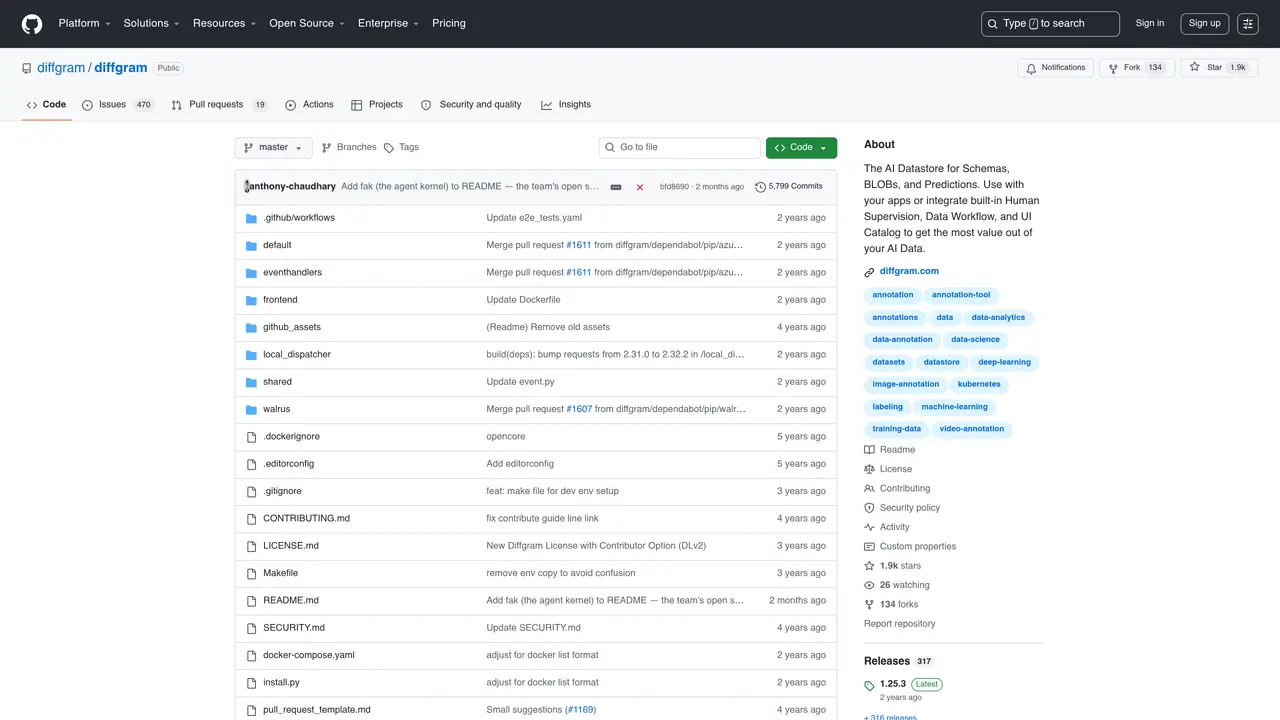
GitHub, Inc.
San Francisco, California, US · Founded 2008
- Founders
- Tom Preston-Werner, Chris Wanstrath, PJ Hyett, Scott Chacon
- Founded
- 2008
- Headquarters
- San Francisco, California, US
- Legal status
- Subsidiary of Microsoft (NASDAQ: MSFT)
Key features
- Create interactive dashboards
- Automate data analysis workflows
- Integrate data from multiple sources
- Visualize data with powerful tools
- Query and manipulate data easily
- Combine data from various sources
Use cases
- Create interactive dashboards to quickly uncover insights in data.
- Automate data analysis workflows to save time and resources.
- Integrate data from multiple sources to make better decisions.
Pros
- Open-source AI datastore for schemas, BLOBs, and predictions
- Supports human supervision and data labeling for AI workflows
- Integrates with AI applications for compliant data management
- Offers visual exploration of AI data through a UI catalog
- Provides workflow automation for moving data between AI applications
Cons
- Requires technical setup and maintenance for self-hosted deployment
- Limited documentation clarity for non-technical users
- Some advanced features (e.g., agent governance) are still in early stages
Diffgram videos
Frequently asked questions about Diffgram
What is Diffgram and what does it do?
Diffgram is an open-source AI datastore designed for managing schemas, BLOBs, and predictions. It enables users to integrate human supervision, data workflows, and UI catalogs to maximize the value of AI data, particularly for labeling, workflow automation, and data exploration.
Who should use Diffgram?
Diffgram is suitable for teams and organizations working with AI data, including developers, data scientists, and AI engineers who need to manage, label, and process large volumes of media types such as images, videos, text, and 3D data.
How does Diffgram handle data privacy and compliance?
Diffgram is installed by users, giving them full control over their data. It supports compliant handling of PII and is designed to work with AI applications that require secure and privacy-conscious data management.
What types of media does Diffgram support for labeling?
Diffgram supports a variety of media types for human supervision, including images, videos, 3D data, text, audio, geospatial data, and documents. Additional formats like HTML and DICOM are planned for future releases.
Can Diffgram integrate with other AI tools or workflows?
Yes, Diffgram is designed to integrate with AI applications and workflows, allowing users to move data between their AI tools and control AI processes through a user-friendly interface.
How do I get started with Diffgram?
Users can get started by watching the video explainer, reviewing the commercial open-source license, and installing Diffgram. Additional resources, such as joining the Slack community or contributing to the project, are also available.