
Real-time customer support with personalized service, accessible through a mobile app.

GPT4All
$0.07Starting price
0Popularity
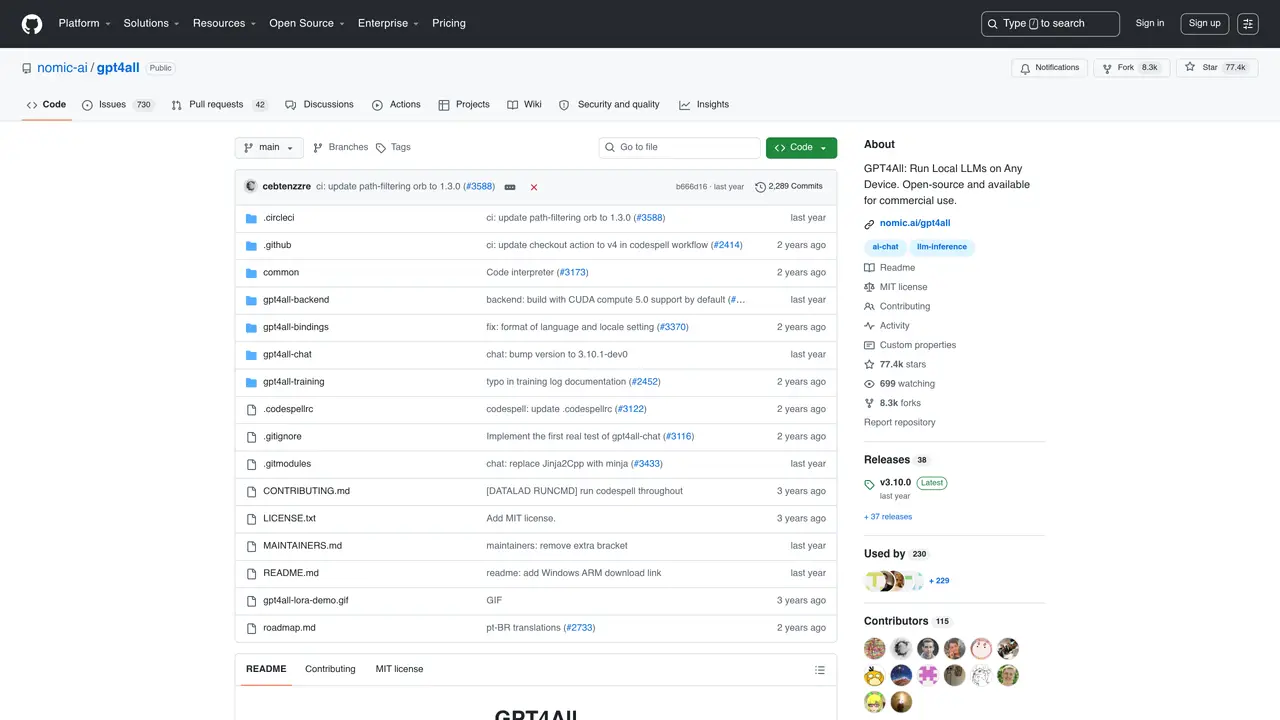
About GPT4All
GPT4All is an open-source ecosystem that enables users to create, customize, and deploy large language models (LLMs) locally on consumer-grade hardware without requiring coding expertise. The platform provides a user-friendly interface and pre-trained models that can be fine-tuned for specific tasks such as chatbots, text generation, or question answering. Users can interact with models through a chat interface or integrate them into applications via APIs, making it accessible for both non-technical users and developers. The tool is designed to prioritize privacy and offline functionality, allowing models to run entirely on local machines without sending data to external servers. GPT4All supports a variety of models, including those fine-tuned for particular domains or languages, and offers tools for model evaluation and comparison. It is particularly suited for individuals, researchers, and organizations seeking to experiment with LLMs without relying on cloud-based services or incurring usage costs.
GitHub, Inc.
San Francisco, California, US · Founded 2008
- Founders
- Tom Preston-Werner, Chris Wanstrath, PJ Hyett, Scott Chacon
- Founded
- 2008
- Headquarters
- San Francisco, California, US
- Legal status
- Subsidiary of Microsoft (NASDAQ: MSFT)
Key features
- Create automated customer support bots
- Generate natural language search queries
- Develop accurate NLG models with deep learning
- No coding experience required
- Simple and intuitive interface
- Supports a wide range of applications
Use cases
- Automating customer support for businesses
- Generating search queries for e-commerce websites
- Developing NLG models for chatbots and virtual assistants
Pros
- Enables running large language models (LLMs) locally on everyday devices without requiring GPUs or API calls
- Open-source and available for commercial use, allowing full customization and integration
- Supports a wide range of hardware, including Intel, AMD, Apple Silicon, and ARM processors
- Provides a user-friendly interface for interacting with LLMs, making it accessible to non-technical users
- Offers Python client access for developers to integrate LLMs into applications
Cons
- Requires significant local storage for model downloads, which can be impractical for devices with limited space
- Performance may vary depending on hardware specifications, particularly for larger models
- Limited to offline use, which restricts access to cloud-based features or real-time updates
Frequently asked questions about GPT4All
What is GPT4All and what does it do?
GPT4All is an open-source platform that enables users to run large language models (LLMs) locally on everyday devices like desktops and laptops without requiring API calls or GPUs. It provides a chat application and Python client to interact with LLMs privately and offline.
Who is GPT4All designed for?
GPT4All is designed for developers, businesses, and professionals who want to deploy LLMs locally for tasks such as chatbots, data analysis, or code generation without relying on cloud services or specialized hardware.
How do I get started with GPT4All?
Users can download the GPT4All application for their operating system (Windows, macOS, Ubuntu, or via Flathub) and install it directly. Alternatively, they can use the Python client by installing the gpt4all package and loading a supported model.
Does GPT4All support integrations with other tools?
Yes, GPT4All supports integrations with LangChain, Weaviate Vector Database, and OpenLIT for monitoring. It also offers an OpenAI-compatible HTTP endpoint via a Docker-based API server for inference.
Can GPT4All run on different hardware configurations?
GPT4All supports a range of hardware, including Intel Core i3 2nd Gen or better, AMD Bulldozer, Apple Silicon M-series processors, and Qualcomm Snapdragon for Windows ARM builds. Linux builds are x86-64 only, and macOS requires Monterey 12.6 or newer.
Is GPT4All suitable for commercial use?
Yes, GPT4All is open-source and available for commercial use, allowing businesses to deploy LLMs locally without licensing restrictions.