

Runtime platform for deploying AI workloads, databases and services across clouds or on-premises
303K visits/mo-18%#159 Coding & Development
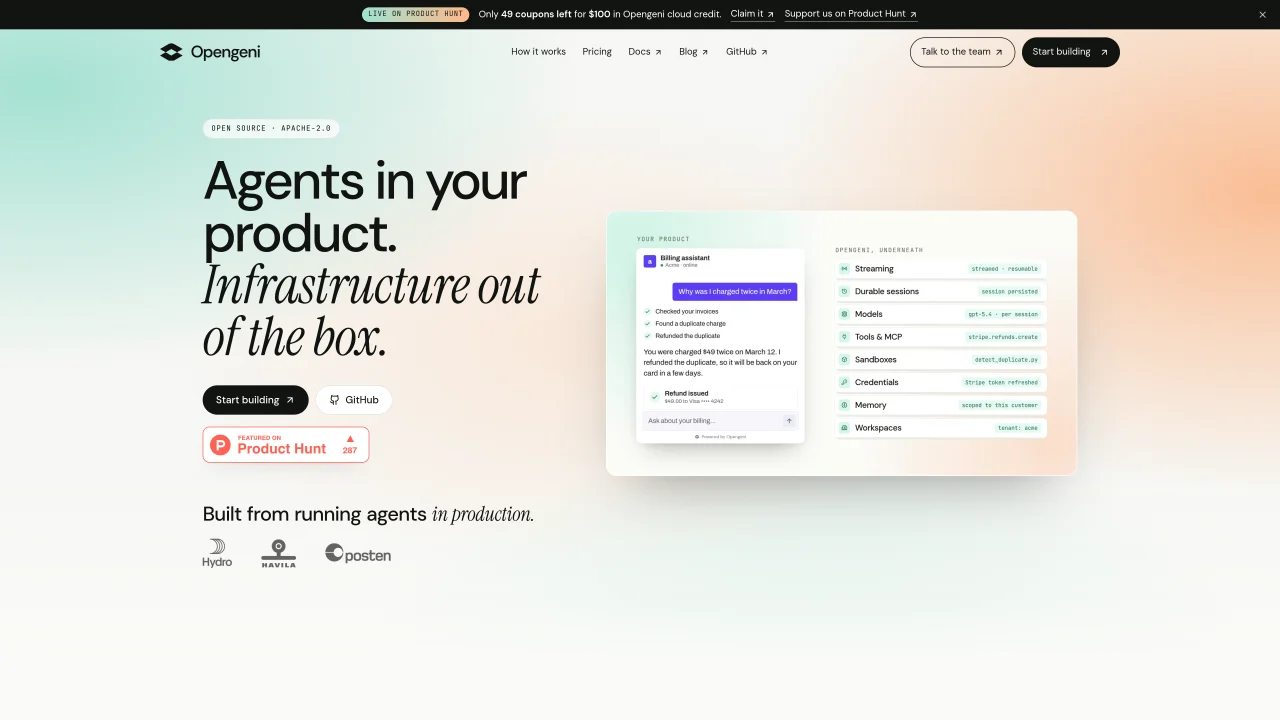
Opengeni provides a framework for integrating AI agents into software products with prebuilt infrastructure components. It supports durable sessions that survive failures, isolated sandboxes for agent execution, and scoped short-lived credentials for secure API access. The system handles OAuth tokens, tool wiring, and memory persistence so agents retain context across sessions. Multi-tenancy features keep customer data separate, and row-level security controls access within shared workspaces. Users can swap between model providers including OpenAI, Azure OpenAI, OpenRouter, or custom endpoints without rewriting agent logic. The platform offers both a managed cloud version and self-hosting options via Helm charts on Kubernetes with Terraform for major cloud providers. Integration is done through a backend API key proxy and React components that can be restyled to match product branding.
Opengeni provides a framework for integrating AI agents into software products with prebuilt infrastructure components. It enables durable agent sessions, isolated sandboxes, secure credential management, and memory persistence so agents retain context across interactions.
Opengeni is designed for developers and product teams building AI-powered features into their applications. It suits businesses that need scalable, secure, and customizable agent infrastructure without building it from scratch.
Opengeni allows users to swap between model providers such as OpenAI, Azure OpenAI, OpenRouter, or custom endpoints without rewriting agent logic. This flexibility ensures compatibility with evolving AI model options.
Opengeni provides both a managed cloud version and self-hosting options via Helm charts on Kubernetes with Terraform for major cloud providers like AWS, Azure, and GCP.
Opengeni uses scoped, short-lived credentials for secure API access, handles OAuth tokens, and enforces row-level security to control access within shared workspaces. It also isolates agent execution in sandboxes to protect sensitive data.
Users can start building with Opengeni by signing up for the cloud version or cloning the open-source repository for self-hosting. The platform offers documentation, integration guides, and React components to streamline setup.
opengeni.ai · third-party estimates from Similarweb
Last 2 months · grows by one month every month
Share of visits by channel
No measurable traffic from Social, Paid Referrals or Search.
Share of visits · estimated visits
Coding & Development · Sep 2026
Traffic figures are third-party estimates, good for scale and trends; they can differ from a company's own numbers. Updated monthly.
We use essential cookies to run Aitoolnavio, and optional cookies to analyze traffic and measure our marketing. You choose what we use — optional cookies stay off unless you turn them on. See our Privacy Policy.
One short email a week: fresh tools worth trying, honest takes and the updates that actually matter. No spam, unsubscribe any time.
Runtime platform for deploying AI workloads, databases and services across clouds or on-premises
Hardware and software stack for high-performance AI inference workloads
Cloud platform providing on-demand and reserved GPU clusters for AI training, fine-tuning and inference
Enterprise AI platform for autonomous agent orchestration and real-time data pipelines
Virtual servers with dedicated NVIDIA GPU acceleration for AI workloads
Unified API gateway for routing, comparing, and operating across 200+ AI models via a single
Tracks and attributes AI costs across multiple LLM providers with budget controls
End-to-end platform for building and operating AI vision applications without model training
Peer-to-peer AI inference marketplace for running and monetizing models
Marketplace for AI agent tools using the Model Context Protocol standard
Managed deployment platform that turns git pushes into live web apps with databases and storage
Enterprise backend platform for AI teams
Matched on what this tool does — grouped by the job you would be replacing.
matches Durable sessions that survive failures · Isolated sandboxes for agent execution · Scoped short-lived credentials
Open-source platform that lets AI agents securely connect to third-party apps via OAuth, webhooks, and MCP without building infrastructure.
Deploy AI agents as TypeScript functions on isolated Linux microVM sandboxes with hardware-level security.
Deploys managed AI agents with durable sessions and permanent URLs without infrastructure setup
matches Scoped short-lived credentials · Automatic OAuth token handling · Model provider flexibility
Credential broker issuing short-lived tokens to AI agents with policy checks and audit trails
Open-source identity and trust layer for autonomous AI agents