
OpenAI builds and deploys advanced AI models like GPT-4o for autonomous agents and workflows.
HaaS
0Popularity
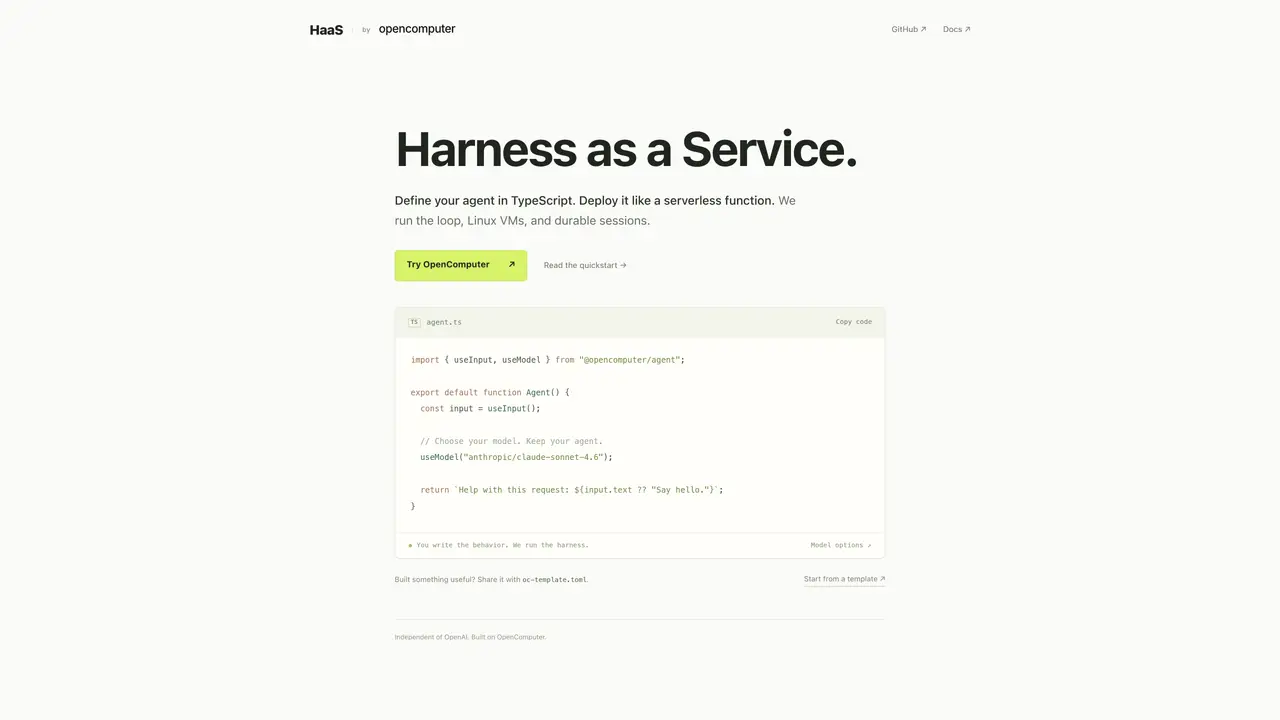
About HaaS
HaaS provides a platform for defining AI agents using TypeScript and deploying them as serverless functions. The service manages the execution loop, Linux VMs, and durable sessions, allowing developers to focus on agent behavior rather than infrastructure. Agents are configured by specifying input handling and model selection, with support for multiple model providers. Deployment is handled automatically, abstracting away server management. The system is designed to be independent of specific model providers, offering flexibility in model choices. Templates are available to accelerate development, and agents can be shared via a configuration file.
Key features
- TypeScript agent definition
- Managed execution loop
- Durable sessions
- Multiple model provider support
- Serverless deployment
- Template-based development
- Configuration file for sharing agents
Use cases
- Building custom AI assistants
- Automating workflows with AI agents
- Prototyping agent-based applications
Pros
- TypeScript-based agent definition
- Managed execution environments
- Support for multiple model providers
- Serverless deployment model
- Template-based development acceleration
Cons
- No explicit free tier mentioned
- Limited to TypeScript for agent definition
- Requires Linux VMs for execution
Frequently asked questions about HaaS
What is HaaS?
HaaS, or Harness as a Service, is a platform that allows developers to define AI agents using TypeScript and deploy them as serverless functions. It manages the execution loop, Linux VMs, and durable sessions, enabling users to focus on agent behavior rather than infrastructure.
Who is HaaS designed for?
HaaS is designed for developers who want to build and deploy AI agents without managing underlying infrastructure. It suits those comfortable with TypeScript and interested in serverless deployment models.
How do I get started with HaaS?
To get started, write an agent in TypeScript using the provided framework, define its behavior and model selection, and deploy it via the platform. The quickstart guide and templates are available to accelerate the process.
Can I use models from providers other than OpenAI?
Yes, HaaS is independent of specific model providers. It supports multiple model providers, allowing users to choose the models that best fit their needs.
How are agents shared using HaaS?
Agents can be shared via a configuration file named oc-template.toml, which allows others to replicate or build upon the agent's setup.
Does HaaS handle the execution loop and infrastructure?
Yes, HaaS manages the execution loop, Linux VMs, and durable sessions, abstracting away server management so developers can focus solely on agent behavior.