GitHub hosts HunyuanVideo, Tencent's open-source framework for large-scale video generation models, enabling AI-driven video creation.

AI Testing Services
$1Starting price
0Popularity
About AI Testing Services
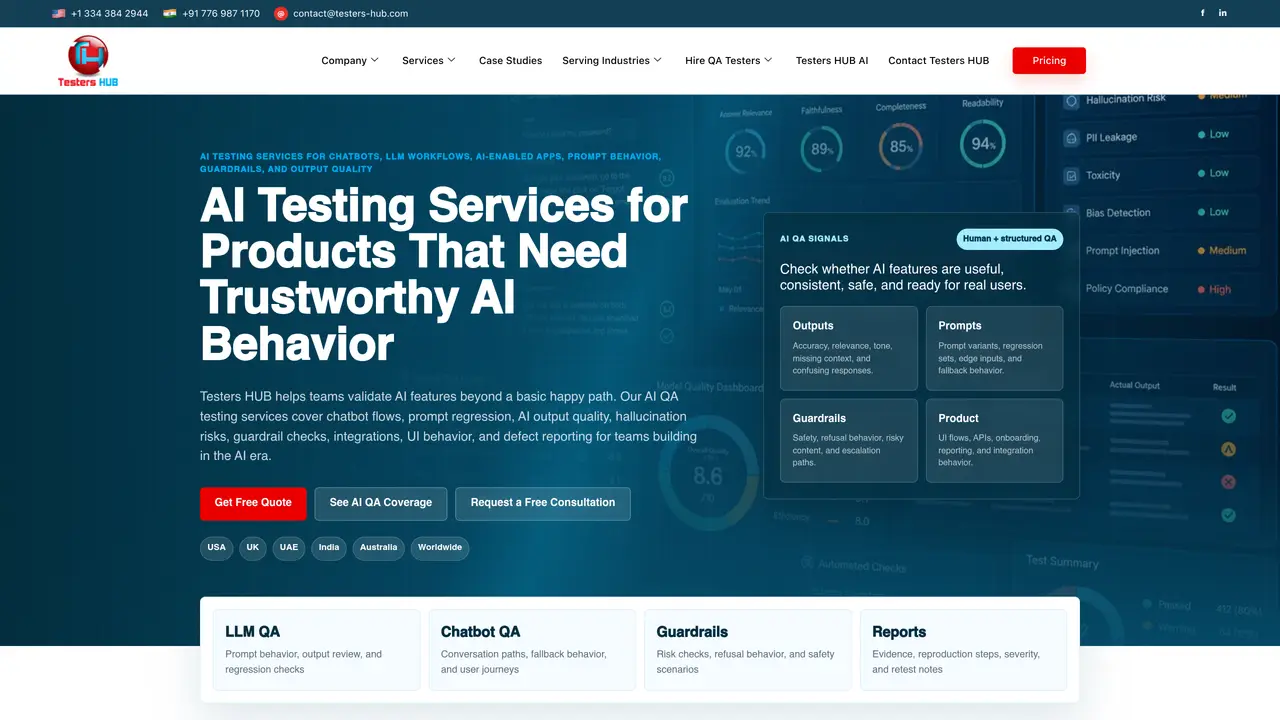
AI Testing Services specializes in quality assurance for AI-enabled products, focusing on validating chatbot flows, prompt behavior, LLM outputs, guardrail effectiveness, and integration points. The service is designed for teams developing AI features who require thorough reliability, safety, and user readiness assessments beyond basic automated testing. It combines structured test scenarios with human judgment to uncover issues that purely automated checks might miss, such as hallucinations, inconsistent outputs, or risky refusal behaviors. Testing encompasses prompt variants, conversation paths, API integrations, UI flows, and edge cases, with findings delivered as evidence-based reports that include reproduction steps and severity ratings. The process begins by defining expected behaviors based on user intents, acceptable outputs, and product goals, followed by executing structured AI scenarios and reporting practical risks. This approach ensures that AI systems behave as intended in real-world user journeys while addressing potential safety and usability concerns.
Key features
- Chatbot conversation path testing
- Prompt variant and regression testing
- LLM output review and hallucination checks
- Guardrail safety and refusal behavior validation
- API and integration behavior verification
- UI flow and onboarding testing
- Edge case and fallback behavior evaluation
- Evidence-based reporting with severity ratings
Use cases
- Validating AI chatbot reliability for customer support
- Testing LLM outputs for accuracy and consistency in SaaS applications
- Ensuring guardrails prevent risky or unsafe AI responses in healthcare apps
Pros
- Covers chatbot flows, prompt regression, and LLM output quality
- Evaluates guardrails, safety scenarios, and refusal behavior
- Combines structured QA with human judgment for deeper insights
- Provides evidence-based reports with reproduction steps and severity ratings
- Supports integration testing for APIs, UI flows, and onboarding
Cons
- No pricing details available on the website
- No free tier or self-service option mentioned
- Requires contact for quotes and consultation
Frequently asked questions about AI Testing Services
What does AI Testing Services actually test?
AI Testing Services evaluates chatbot flows, prompt behavior, LLM outputs, guardrail effectiveness, UI flows, API integrations, and edge cases to ensure reliability, safety, and user readiness beyond basic happy-path testing.
Who should use AI Testing Services?
Teams building AI features, such as chatbots, LLM workflows, or AI-enabled applications, who need to validate trustworthy AI behavior, output quality, and integration points for real-world use.
How does the testing process work?
The process begins by defining expected behaviors based on user intents and product goals, then runs structured AI scenarios, and finally reports practical risks with evidence, reproduction steps, and severity ratings.
Does AI Testing Services provide human oversight?
Yes, the service combines structured test scenarios with human judgment to identify issues automated checks may miss, such as hallucinations, inconsistent outputs, or risky refusal behaviors.
What kind of reports does AI Testing Services deliver?
Findings are delivered as evidence-based reports including reproduction steps, severity ratings, and retest notes to help teams address identified issues effectively.
Can AI Testing Services test guardrails and safety mechanisms?
Yes, it includes guardrail checks for safety, refusal behavior, risky content, and escalation paths to ensure AI systems behave appropriately in various scenarios.