GitHub hosts HunyuanVideo, Tencent's open-source framework for large-scale video generation models, enabling AI-driven video creation.

bourdon
$29/mStarting price
0Popularity
About bourdon
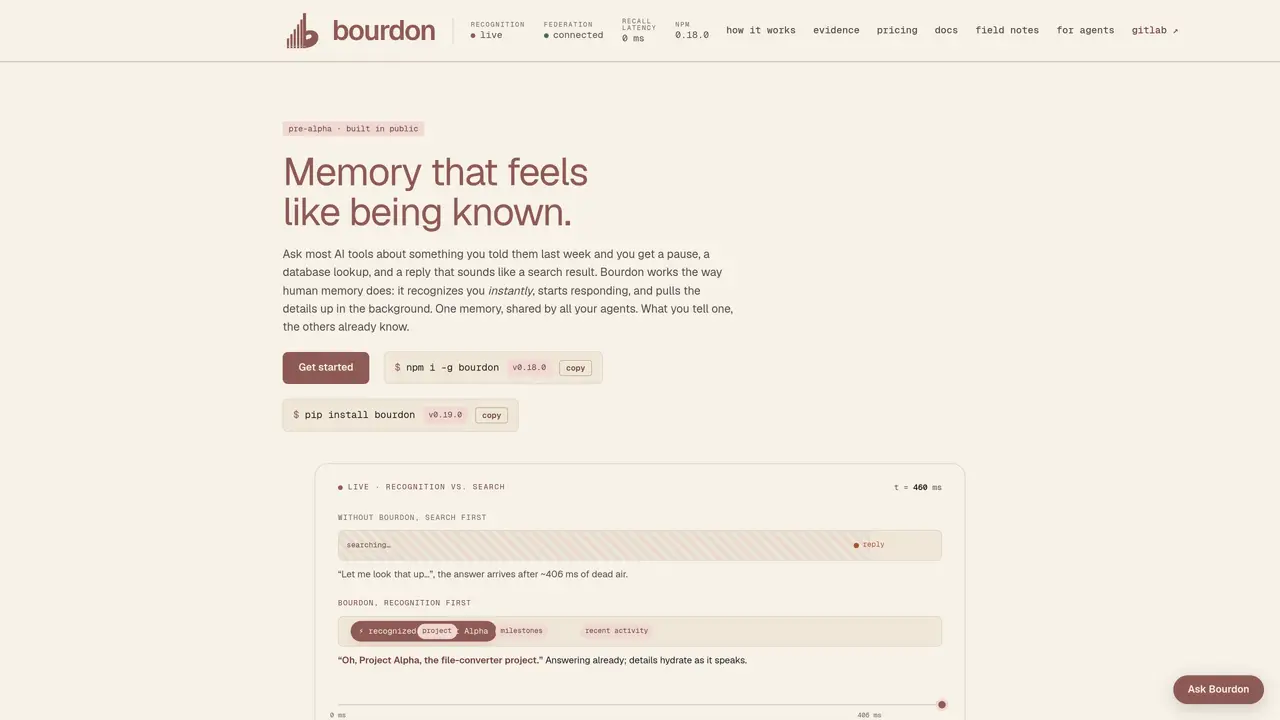
Bourdon is a memory layer designed for AI agents that prioritizes instant recognition over search-based retrieval. It records interactions and shares them across multiple agents such as Claude, Codex, Cursor, Copilot, and Devin, enabling consistent context without manual repetition. The system operates with near-zero latency by recognizing a user or context immediately and hydrating details in the background while responding. Memory is federated, meaning facts learned by one agent are available to others across different accounts and machines without additional configuration. The tool supports self-hosting with the full engine available under an open-source license, as well as managed hosting with private instances on dedicated hardware. It includes tiered memory storage, append-only audit trails, and per-agent token controls. Bourdon is positioned as a foundational component within a broader agent ecosystem, alongside routing and orchestration tools.
Key features
- Instant recognition of users and contexts
- Cross-agent memory federation
- Tiered memory stack (L0 to L6)
- Append-only audit logging
- Per-agent token and trust tier controls
- Self-hostable engine with open-source license
- Private managed instances with encrypted storage
- Configurable adapters for multiple AI agents
Use cases
- Unified memory for multi-agent workflows
- Cross-account knowledge sharing between AI tools
- Real-time context retention in agent conversations
Pros
- Recognition-first retrieval reduces response latency to near zero
- Federated memory shared across multiple agents and accounts
- Self-hosting option with full engine capability available
- Append-only audit logs for tracking memory changes
- Tiered memory stack for efficient storage and retrieval
Cons
- Pre-alpha software with limited public availability
- No support for all major AI agents (Gemini and Hermes adapters in development)
- Managed hosting limited to solo or small team plans
- No free tier for managed hosting
Frequently asked questions about bourdon
What is Bourdon and how does it work?
Bourdon is a memory layer for AI agents that prioritizes instant recognition over search-based retrieval. It records interactions and shares them across multiple agents, enabling consistent context without manual repetition. The system operates with near-zero latency by recognizing a user or context immediately and hydrating details in the background while responding.
Who is Bourdon designed for?
Bourdon is designed for users and teams working with AI agents such as Claude, Codex, Cursor, Copilot, and Devin. It is particularly useful for those who need seamless, shared memory across multiple agents and machines without additional configuration.
How does Bourdon differ from traditional AI memory systems?
Unlike traditional AI memory systems that rely on search-based retrieval, Bourdon uses recognition-first memory. It mimics human memory by recognizing a user instantly and pulling details in the background while responding, reducing latency and eliminating pauses for retrieval.
Can Bourdon be self-hosted, and what does that include?
Yes, Bourdon can be self-hosted, and the full recognition-first engine is available under an open-source license. Self-hosting includes the entire engine with cross-agent federation, tiered memory storage, append-only audit trails, and per-agent token controls, with no features held back.
What are the pricing models for Bourdon?
Bourdon offers self-hosting for free, with the option to upgrade to managed hosting for private instances on dedicated hardware. Managed hosting includes tiered pricing based on usage, such as solo or team plans, with operations-focused billing rather than feature-based pricing.
Does Bourdon support integrations with other AI agents?
Yes, Bourdon supports integrations with multiple AI agents, including Claude, Codex, Cursor, Copilot, and Devin. Adapters for additional agents like Gemini and Hermes are in development, and users can join their own agents with minimal configuration.