GitHub hosts HunyuanVideo, Tencent's open-source framework for large-scale video generation models, enabling AI-driven video creation.

Deformable Convolutional Network (DCN)
$0.07Starting price
0Popularity
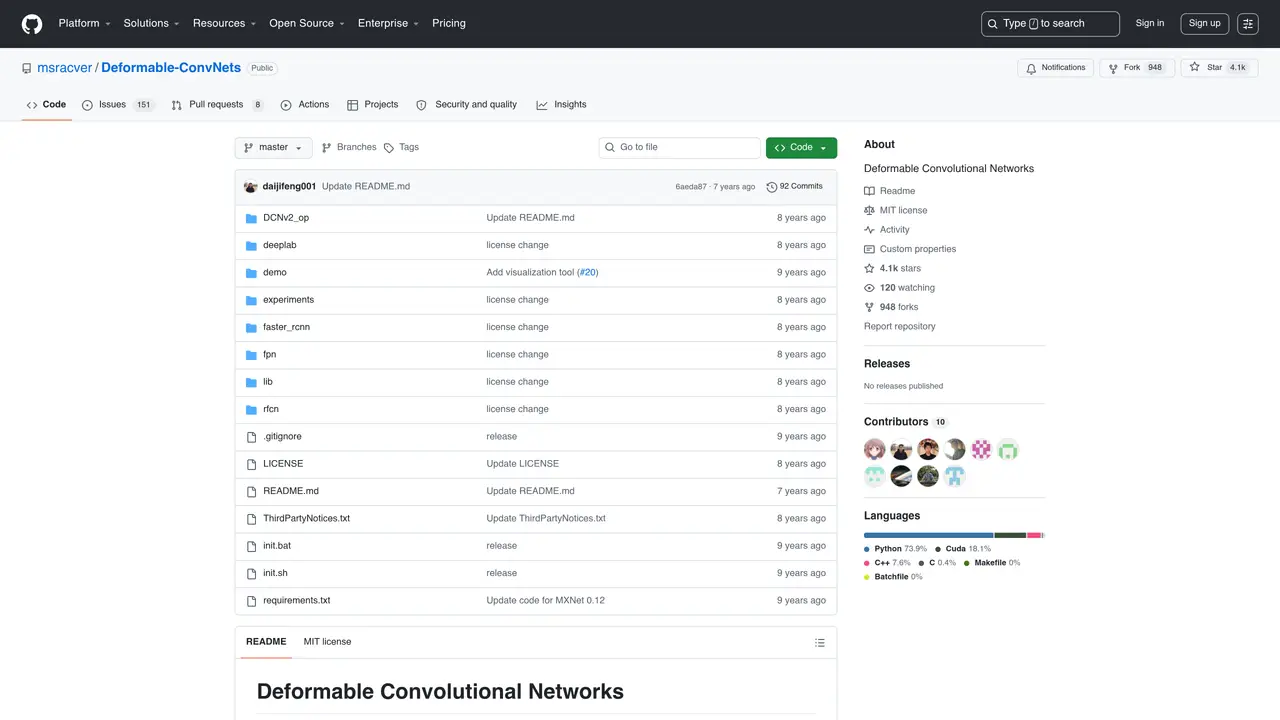
About Deformable Convolutional Network (DCN)
Deformable Convolutional Network (DCN) is a powerful deep learning tool that provides state-of-the-art performance for object detection and semantic segmentation tasks. DCN is designed to be fast and efficient, with a unique deformable convolutional layer that allows for more flexible convolutional operations. This layer enables the network to learn more complex feature representations, resulting in improved accuracy and performance. DCN also incorporates deformable RoI-Pooling, which enables more precise object detection and segmentation. With its robust features and performance, DCN is an ideal choice for any task requiring accurate object detection and semantic segmentation. DCN is designed to be easy to use and highly customizable, allowing users to quickly and easily adjust parameters to suit their specific needs. Additionally, DCN supports multiple GPUs, allowing users to scale up their workloads with ease.
GitHub, Inc.
San Francisco, California, US · Founded 2008
- Founders
- Tom Preston-Werner, Chris Wanstrath, PJ Hyett, Scott Chacon
- Founded
- 2008
- Headquarters
- San Francisco, California, US
- Legal status
- Subsidiary of Microsoft (NASDAQ: MSFT)
Key features
- State-of-the-art performance for object detection and semantic segmentation tasks
- Unique deformable convolutional layer for flexible convolutional operations
- Deformable RoI-Pooling for precise object detection and segmentation
- Easy to use and highly customizable
- Supports multiple GPUs for scaling up workloads
Use cases
- Detect and segment objects in images quickly and accurately
- Easily adjust parameters to fit specific needs
- Scale up workloads with multiple GPUs
Pros
- Improves accuracy in object detection and semantic segmentation tasks by enabling flexible convolutional operations
- Includes deformable RoI-Pooling for more precise region-based feature extraction
- Supports multiple GPUs for scalable workloads
- Provides updated deformable convolution operators to address boundary sampling issues
- Offers efficient performance improvements, particularly at large image batch sizes
Cons
- Requires familiarity with deep learning frameworks like MXNet or PyTorch for implementation
- May produce slightly lower accuracy compared to original models due to platform differences
- Limited to specific use cases in computer vision, primarily object detection and segmentation
Frequently asked questions about Deformable Convolutional Network (DCN)
What is Deformable Convolutional Network (DCN) and what does it do?
Deformable Convolutional Network (DCN) is a deep learning framework designed to enhance object detection and semantic segmentation tasks by introducing deformable convolutional layers. These layers allow the network to adaptively adjust its receptive field, improving feature representation and accuracy.
Who is DCN suitable for?
DCN is suitable for researchers and practitioners in computer vision who require high-accuracy object detection and semantic segmentation. It is particularly useful for those working with complex visual tasks where standard convolutional networks may fall short.
How does DCN improve over standard convolutional networks?
DCN introduces deformable convolutional layers that enable the network to learn more flexible and adaptive feature representations. This adaptability allows the network to better handle variations in object shapes and scales, leading to improved performance in detection and segmentation tasks.
Does DCN support multiple GPUs?
Yes, the implementation supports multi-GPU training, enabling users to scale their workloads for faster processing and larger datasets.
What are the key components of DCN?
The key components include deformable convolutional layers and deformable RoI-Pooling, which together enable more precise and flexible feature extraction and region-of-interest processing.
How can I get started with DCN?
To get started, users can clone the official GitHub repository, which provides the implementation, pre-trained models, and training/testing code. The repository includes detailed instructions and examples to help users reproduce results and integrate DCN into their workflows.