GitHub hosts HunyuanVideo, Tencent's open-source framework for large-scale video generation models, enabling AI-driven video creation.

Flow AI
FreeStarting price
64KMonthly visits
30Popularity
About Flow AI
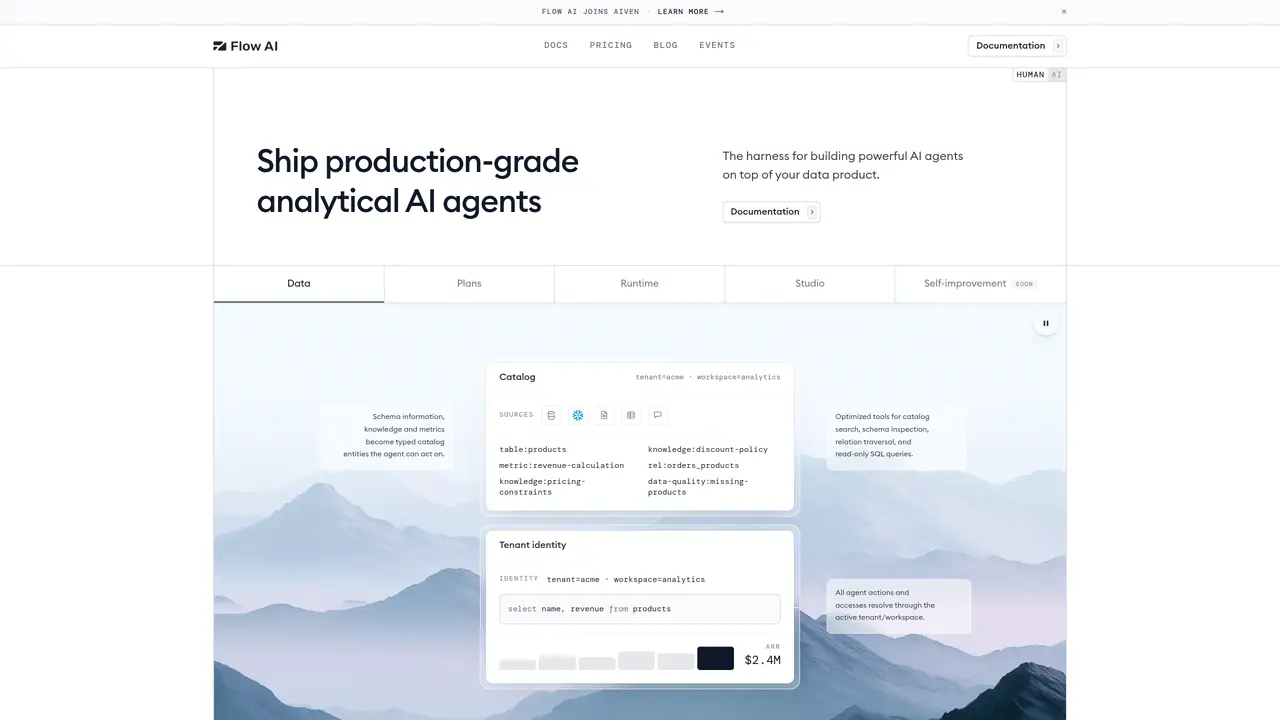
Flow AI provides an API and web infrastructure platform designed for B2B SaaS product teams seeking to embed customer-facing analytical AI agents into their application UI. The platform features a schema-aware semantic data layer that transforms complex tables, relationships, constraints, and documentation into governed knowledge agents can query and interpret reliably. It supports deterministic, reviewable reasoning to produce transparent plans for data operations, allowing teams to edit, constrain, or approve steps before execution. Flow AI also offers validated generative UI components, including charts, tables, comparisons, KPIs, and controls, which constrain outputs to safe, renderable structures suitable for embedding beyond chat interfaces. The enterprise runtime and execution layer supports multiple models (OpenAI, Anthropic, Gemini, Llama, Mistral, Qwen, and more) and offers deployment flexibility across AWS, Azure, GCP, and on-premise environments, including data residency options in the EU or US. The platform emphasizes production-grade analytics agents by combining schema and rule grounding, deterministic data operations, and UI validation to handle real multi-tenant SaaS data models and generate visual insights that align with a product’s existing layout and design system, all without vendor lock-in.
Key features
- Schema-aware semantic data layer for reliable agent queries
- Deterministic, reviewable reasoning with step-by-step transparency
- Validated generative UI components (charts, tables, KPIs, controls)
- Multi-model support (OpenAI, Anthropic, Gemini, Llama, Mistral, Qwen, and more)
- Deployment across AWS, Azure, GCP, on-premise, and data residency options
- Enterprise-grade runtime and execution layer
- Zero lock-in deployment control
- Integration with structured data, rules, and customer context
- Governed knowledge representation for agents
- Production-ready analytics agents for multi-tenant SaaS applications
Use cases
- Embedding analytical AI agents into SaaS application UIs
- Generating safe, visual insights from complex datasets
- Building customer-facing AI-powered analytics tools
Pros
- Schema-aware semantic data layer transforms complex tables, relationships, and documentation into governed knowledge agents can reliably query
- Supports deterministic, reviewable reasoning with step-by-step plans that can be edited, constrained, or approved before execution
- Validated generative UI components (charts, tables, KPIs) constrain outputs to safe, renderable structures for embedding beyond chat interfaces
- Enterprise runtime supports multiple models (OpenAI, Anthropic, Gemini, Llama, Mistral, Qwen) with deployment flexibility across AWS, Azure, GCP, and on-premise environments
- Self-improvement loop enables agents to learn from traces, evals, and failures, converting mistakes into test cases and improving over time
Cons
- Requires integration into existing Python or Node applications, adding complexity to deployment and maintenance
- Schema-aware grounding may introduce overhead when handling highly dynamic or rapidly changing data schemas
- Deterministic planning and approval workflows can slow down real-time interactions compared to open-ended agent loops
Frequently asked questions about Flow AI
What is Flow AI?
Flow AI is a platform designed to help B2B SaaS product teams embed customer-facing analytical AI agents into their applications. It provides a schema-aware semantic data layer, deterministic reasoning, and validated generative UI components for reliable and transparent AI-driven data operations.
Who is Flow AI suitable for?
The platform is tailored for engineering teams in B2B SaaS companies that need to integrate AI agents capable of handling complex, multi-tenant data models while maintaining production-grade reliability and compliance.
How does Flow AI handle data governance and permissions?
Flow AI enforces tenant-specific data access through a catalog system that resolves all agent actions and queries within the active tenant or workspace, ensuring data isolation and controlled execution of actions.
Can Flow AI integrate with existing data infrastructure?
Yes, Flow AI supports ingestion from various data sources and integrates with existing data models, metrics, and business logic, transforming them into structured catalog entities that agents can reliably query and act upon.
Does Flow AI support multiple AI models?
The platform supports multiple AI models, including OpenAI, Anthropic, Gemini, Llama, Mistral, Qwen, and others, allowing teams to choose the best model for their specific use cases.
How can I get started with Flow AI?
Developers can start by integrating the Flow AI runtime into their Python or Node.js applications, configuring the data catalog, and using the Studio to design, test, and deploy AI agents with transparent reasoning and execution plans.
Flow AI Website Engagement
Last Update: 9 days ago
Total Monthly Visits
0
Bounce Rate
0%
Visit Duration (avg)
0.00s
Pages Per Visit
0
Country Rank
0
India
Global Rank
0
Category Rank
#0
Programming & Developer Software
Monthly Traffic
Traffic Sources
Traffic Share By Country
- United States10.9%
- Uzbekistan8.5%
- India6.9%
- Pakistan6.4%
- United Kingdom6.3%