GitHub hosts HunyuanVideo, Tencent's open-source framework for large-scale video generation models, enabling AI-driven video creation.

GloVe
$1Starting price
0Popularity
About GloVe
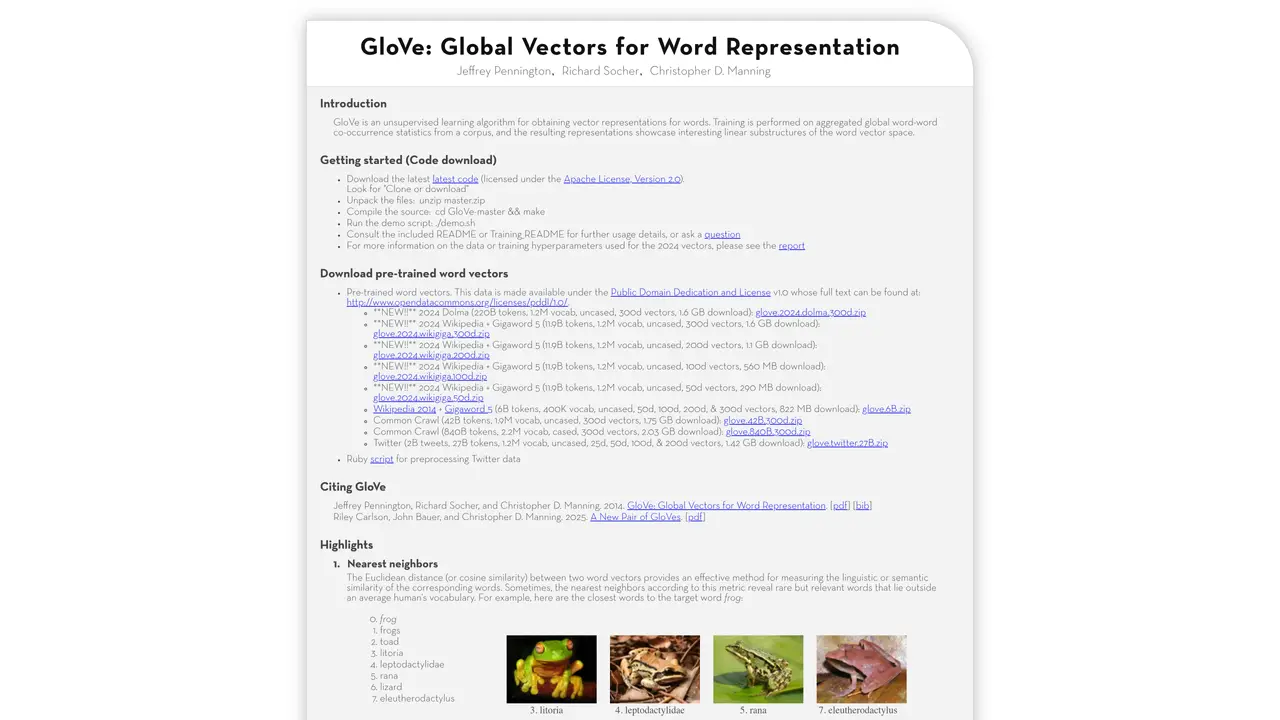
GloVe is an unsupervised learning algorithm developed at Stanford University designed to create word vectors, or numerical representations of words, from large text corpora. These word embeddings capture semantic relationships between words and concepts, enabling analysis of context and meaning within text. The tool is widely used to identify topics and themes, measure word similarity, and build predictive models for natural language processing tasks. GloVe is particularly effective for uncovering hidden patterns in unstructured text data, making it valuable for applications such as sentiment analysis, machine translation, and document classification. By converting words into vectors, GloVe transforms qualitative text data into quantitative formats that machine learning models can process efficiently. Its approach balances global and local statistical information from text to produce meaningful word representations. Researchers and developers use GloVe to enhance the performance of NLP systems by providing robust, context-aware word embeddings.
Key features
- Generates word embeddings from large text corpora
- Captures semantic relationships between words
- Unsupervised learning algorithm
- Produces numerical representations of words
- Balances global and local statistical information
- Supports sentiment analysis and machine translation
- Enables topic and theme identification
- Measures word similarity and context
- Converts qualitative text into quantitative data
Use cases
- Building predictive models for NLP tasks
- Analyzing large volumes of text to uncover hidden patterns
- Enhancing sentiment analysis and machine translation systems
Pros
- Produces word embeddings that capture linear substructures in vector space, revealing nuanced semantic relationships
- Trained on global word-word co-occurrence statistics, balancing both local and global context
- Available with pre-trained vectors for multiple corpora and dimensionalities (e.g., Wikipedia, Common Crawl, Twitter)
- Open-source implementation with Apache 2.0 license for code and public domain for pre-trained vectors
- Demonstrates effectiveness in capturing analogical relationships through vector arithmetic
Cons
- Requires significant computational resources for training on large corpora due to co-occurrence matrix construction
- Pre-trained vectors are static and may not adapt to domain-specific terminology without fine-tuning
- Performance depends heavily on the quality and representativeness of the training corpus
Frequently asked questions about GloVe
What is GloVe and what does it do?
GloVe is an unsupervised algorithm that generates dense vector representations for words by analyzing global word-word co-occurrence statistics from a text corpus. These word embeddings capture semantic relationships and enable quantitative analysis of word meaning and context.
Who should use GloVe?
GloVe is designed for researchers, data scientists, and developers working on natural language processing tasks such as sentiment analysis, document classification, or machine translation who require robust word embeddings for downstream modeling.
How do I get started with GloVe?
Users can download the open-source code from the Stanford NLP website, compile it, and run the provided demo script. Pre-trained word vectors are also available for immediate use in various dimensionalities and corpora.
What are the licensing terms for GloVe?
The GloVe source code is licensed under the Apache License 2.0, while the pre-trained word vectors are released under the Public Domain Dedication and License v1.0, allowing unrestricted use and modification.
Can GloVe capture analogical relationships between words?
Yes, GloVe is designed so that vector differences between word pairs (e.g., king - queen) reflect meaningful semantic relationships, enabling analogical reasoning tasks such as completing word analogies.
Are there pre-trained word vectors available for GloVe?
Yes, pre-trained vectors are provided for multiple corpora including Wikipedia, Common Crawl, and Twitter, with options for different vector dimensionalities (e.g., 50d, 100d, 200d, 300d).