GitHub hosts HunyuanVideo, Tencent's open-source framework for large-scale video generation models, enabling AI-driven video creation.

SBERT
$0.07Starting price
0Popularity
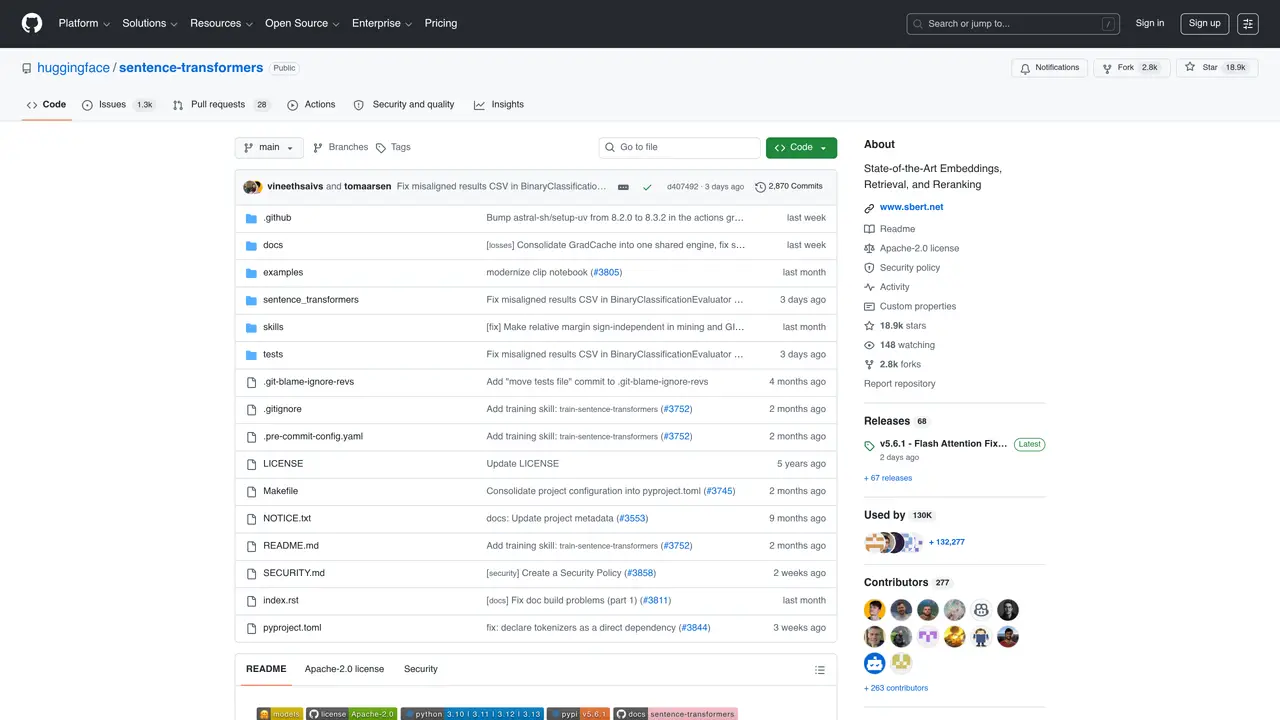
About SBERT
SBERT, or Sentence-BERT, is a modification of the BERT network that uses siamese and triplet network structures to derive semantically meaningful sentence embeddings. These embeddings can be compared using cosine-similarity to measure the semantic similarity between sentences, enabling tasks such as semantic search, clustering, and paraphrase detection. The tool is designed to transform sentences into dense vector representations that capture their meaning, making it easier to perform downstream NLP tasks with high accuracy. SBERT is particularly useful for developers and researchers working with text data who require efficient and scalable solutions for semantic similarity tasks. It supports cross-lingual transfer, allowing users to compare and contrast sentences across different languages without requiring language-specific fine-tuning. This makes it a versatile tool for multilingual applications, including cross-lingual information retrieval and document clustering. The framework is open-source and integrates seamlessly with popular deep learning libraries, providing flexibility for customization and deployment in various research and production environments.
GitHub, Inc.
San Francisco, California, US · Founded 2008
- Founders
- Tom Preston-Werner, Chris Wanstrath, PJ Hyett, Scott Chacon
- Founded
- 2008
- Headquarters
- San Francisco, California, US
- Legal status
- Subsidiary of Microsoft (NASDAQ: MSFT)
Key features
- Automate sentiment analysis
- Document classification
- Cross-lingual pattern identification
- Natural language understanding (NLU)
- Deep learning models
- Text-based data prediction and classification
Use cases
- Automate sentiment analysis of customer reviews
- Automatically classify documents into categories
- Identify and translate cross-lingual patterns
Pros
- Provides state-of-the-art sentence embeddings for semantic search, similarity, and retrieval tasks
- Supports multiple model types including Sentence Transformers, Cross-Encoders, Sparse Encoders, and Multi-Vector Encoders
- Offers over 15,000 pre-trained models optimized for various benchmarks like MTEB
- Enables custom model training and fine-tuning for domain-specific applications
- Integrates seamlessly with Hugging Face for easy model access and deployment
Cons
- Requires familiarity with Python and deep learning frameworks like PyTorch
- High computational resource demands for training custom models
- Limited built-in support for real-time processing in low-resource environments
Frequently asked questions about SBERT
What is SBERT and what does it do?
SBERT, or Sentence-BERT, is a framework designed to compute embeddings for sentences, paragraphs, and images using state-of-the-art deep learning models. It enables tasks such as semantic search, semantic textual similarity, and paraphrase mining by transforming text into meaningful vector representations.
Who should use SBERT?
SBERT is suitable for developers, researchers, and data scientists working with natural language processing tasks. It is particularly useful for those needing to analyze text, compare sentences, or build retrieval and reranking systems.
How does SBERT work?
SBERT uses pre-trained models to generate embeddings for input text. These embeddings can then be used to compute similarity scores between texts, enabling applications like semantic search or classification. Users can also fine-tune models for custom use cases.
What types of models does SBERT support?
SBERT supports Sentence Transformer models for embeddings, Cross-Encoder models for reranking, Sparse Encoder models for sparse embeddings, and Multi-Vector Encoder models for token-level embeddings. Over 15,000 pre-trained models are available on Hugging Face.
Can I fine-tune SBERT models for my specific needs?
Yes, SBERT allows users to train or fine-tune their own embedding, reranker, sparse encoder, or multi-vector encoder models. This flexibility enables customization for specific applications and datasets.
How do I get started with SBERT?
To get started, install the library using pip, then load a pre-trained model and encode your text to generate embeddings. The framework provides quickstart guides and documentation for embedding, reranking, and training models.