GitHub hosts HunyuanVideo, Tencent's open-source framework for large-scale video generation models, enabling AI-driven video creation.

Google AutoML Vision
0Popularity
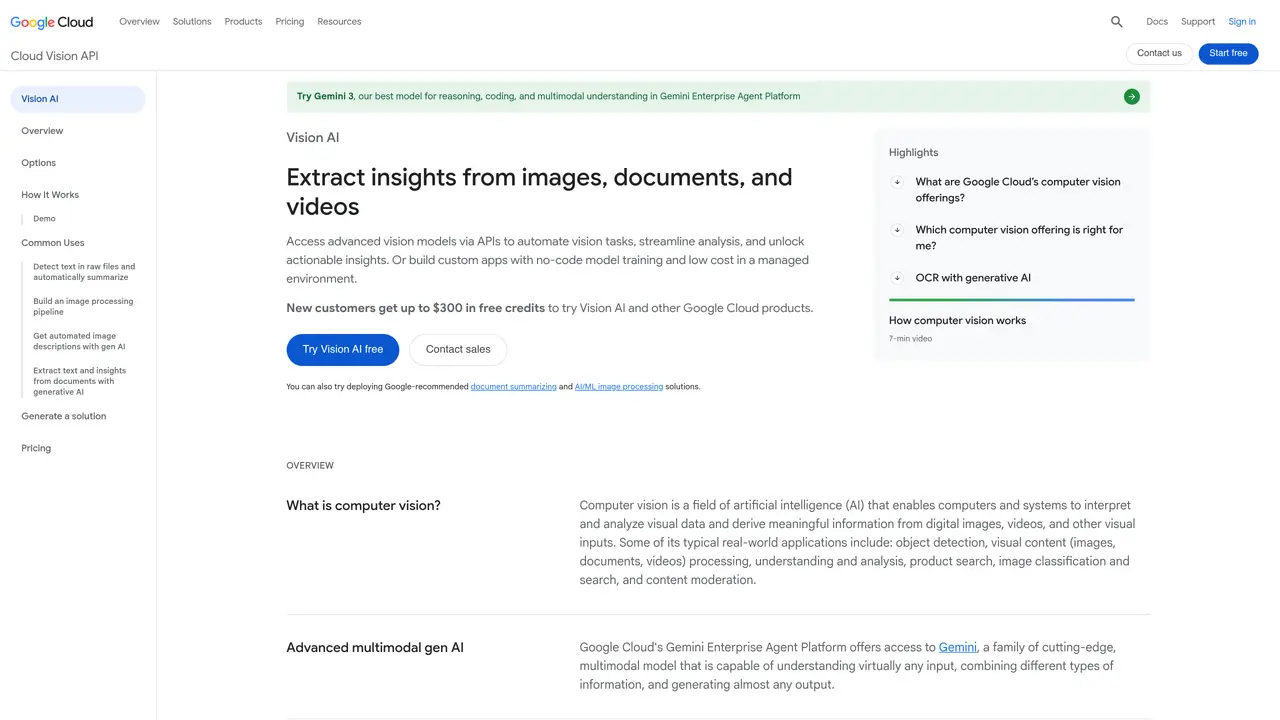
About Google AutoML Vision
Google AutoML Vision is an advanced machine learning tool that helps businesses of all sizes automate the process of image recognition. With it, users can quickly and accurately create custom machine learning models for a variety of tasks, such as object detection, facial recognition, and optical character recognition. By leveraging the power of deep learning, Google AutoML Vision allows businesses to train and deploy models in a fraction of the time it takes to do so manually. This service also offers a wide range of features that make it easy to use, such as intuitive drag-and-drop interfaces, powerful APIs, and real-time insights. All of these features come together to provide businesses with a powerful and efficient tool to help them quickly process and analyze images and videos. With Google AutoML Vision, businesses can gain valuable insights, improve their products and services, and stay ahead of the competition.
Key features
- Automates image recognition
- Creates custom machine learning models
- Leverages deep learning for model training and deployment
- Intuitive drag-and-drop interfaces
- Powerful APIs
- Real-time insights
Use cases
- Automate image recognition process
- Create custom machine learning models for object detection, facial recognition, and optical character recognition
- Train and deploy models in a fraction of the time it takes to do so manually
Pros
- Enables custom model training without requiring deep machine learning expertise
- Supports a wide range of vision tasks including object detection, classification, and OCR
- Integrates seamlessly with Google Cloud services and APIs
- Provides pre-trained models for common use cases to accelerate deployment
- Offers scalable infrastructure for handling large datasets and high-volume processing
Cons
- Requires a Google Cloud account and associated costs for usage
- May involve a learning curve for users unfamiliar with cloud-based ML workflows
- Custom model training can be time-consuming depending on dataset size and complexity
Frequently asked questions about Google AutoML Vision
What is Google AutoML Vision used for?
Google AutoML Vision is a machine learning tool designed to help businesses automate image recognition tasks. It enables users to create custom models for tasks such as object detection, facial recognition, and optical character recognition without requiring deep expertise in machine learning.
Who should use Google AutoML Vision?
The tool is suitable for businesses of all sizes, including developers, data scientists, and non-technical users who need to integrate advanced image analysis capabilities into their applications or workflows.
How does Google AutoML Vision work?
Users upload labeled images to train custom models, which the platform then uses to generate and deploy machine learning models. The process involves uploading data, training the model, and deploying it via APIs for real-time or batch predictions.
Does Google AutoML Vision integrate with other tools?
Yes, it integrates with Google Cloud services and can be accessed via APIs, allowing users to incorporate image recognition into existing applications, workflows, or other cloud-based systems.
What are the limitations of Google AutoML Vision?
The tool requires a dataset of labeled images for training, which may be time-consuming to prepare. Additionally, custom models may have performance limitations depending on the quality and diversity of the training data provided.
How can I get started with Google AutoML Vision?
To get started, users need a Google Cloud account and can access AutoML Vision through the Google Cloud Console. The platform provides documentation and guides to help users upload data, train models, and deploy them for their specific use cases.