GitHub hosts HunyuanVideo, Tencent's open-source framework for large-scale video generation models, enabling AI-driven video creation.

Gradio
196KMonthly visits
38Popularity
About Gradio
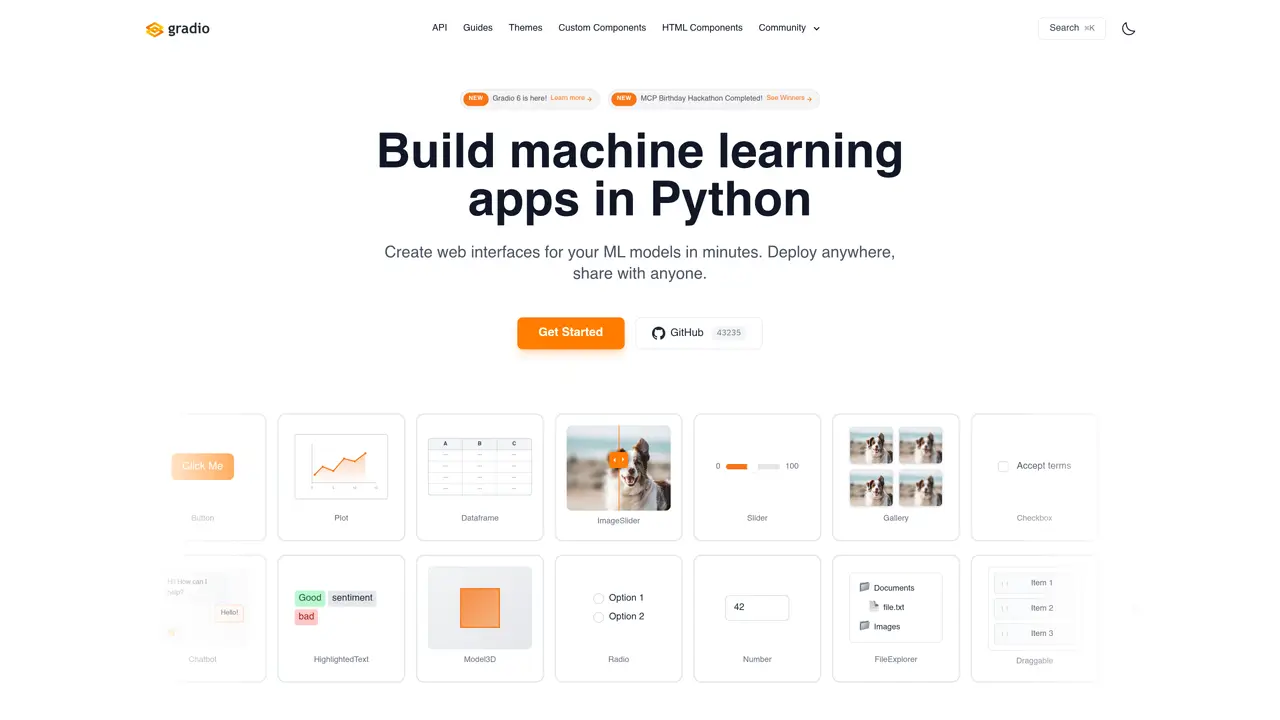
Gradio is an open-source Python library designed to help developers quickly build interactive web interfaces for machine learning models. It enables users to create customizable UIs with minimal code, allowing models to be demoed, tested, and shared directly from a browser without requiring frontend development expertise. The tool supports a wide range of input and output components, including text, images, audio, and video, making it versatile for various ML applications such as chatbots, image classifiers, and audio processing systems. Gradio simplifies collaboration by providing shareable links for models, allowing teams or the public to interact with applications in real time. It integrates seamlessly with popular ML frameworks like TensorFlow, PyTorch, and Hugging Face, and can be deployed locally or on cloud platforms. The library is optimized for speed and ease of use, enabling developers to prototype and iterate on ML projects efficiently while maintaining flexibility for customization.
Key features
- Quickly and easily demo ML models
- Interact with ML models from any device
- Build powerful ML apps in minutes
- User-friendly design
- Fast and easy installation
- Intuitive web interface
Use cases
- Demo ML models to colleagues or the public
- Collaborate with others on ML projects
- Build and share ML apps quickly and easily
Pros
- Enables rapid prototyping of machine learning interfaces with minimal code
- Supports a wide range of input/output components including images, audio, video, 3D models, and dataframes
- Offers seamless deployment options, including free hosting on Hugging Face Spaces
- Provides instant sharing capabilities via public links for local demos
- Eliminates the need for frontend development expertise like JavaScript or CSS
Cons
- Limited customization options for advanced frontend styling compared to traditional web frameworks
- Dependency on Python ecosystem may restrict users unfamiliar with the language
- Hosting on external platforms like Hugging Face Spaces may introduce latency or downtime
Frequently asked questions about Gradio
What is Gradio and what does it do?
Gradio is an open-source Python library designed to quickly create web interfaces for machine learning models. It allows developers to build interactive demos, prototypes, and production-ready apps with minimal code, handling the frontend so users can focus on model development.
Who is Gradio suitable for?
Gradio is ideal for developers, researchers, and data scientists who need to deploy machine learning models as interactive web apps without requiring frontend expertise. It is also useful for teams collaborating on ML projects or sharing demos with clients and colleagues.
How do I get started with Gradio?
Getting started with Gradio is straightforward. Install it via pip, write a few lines of Python to define your model interface, and launch the app with a single command. No JavaScript, CSS, or frontend experience is required.
Can Gradio handle different types of data inputs and outputs?
Yes, Gradio supports a wide range of input and output components, including text, images, audio, video, 3D models, dataframes, and more. It provides over 40 built-in components to accommodate various data types.
How can I share my Gradio app with others?
Gradio offers two primary ways to share apps. You can generate a public link to run your app locally, which is useful for quick demonstrations, or deploy it permanently to platforms like Hugging Face Spaces for always-online, shareable access.
Does Gradio integrate with other tools or platforms?
Gradio integrates seamlessly with popular ML frameworks and platforms. It can be deployed on Hugging Face Spaces for hosting, and its Python-based interface allows easy integration with libraries like TensorFlow, PyTorch, and others.
Gradio Website Engagement
Last Update: 9 days ago
Total Monthly Visits
0
Bounce Rate
0%
Visit Duration (avg)
0.00s
Pages Per Visit
0
Country Rank
0
United States
Global Rank
0
Category Rank
#0
Computers Electronics & Technology
Monthly Traffic
Traffic Sources
Traffic Share By Country
- United States16.9%
- China10.4%
- Germany8.9%
- India7.2%
- Vietnam4.4%