

Scales efficient language processing with open-source accessibility.
357M visits/mo+1%#2 Coding & Development
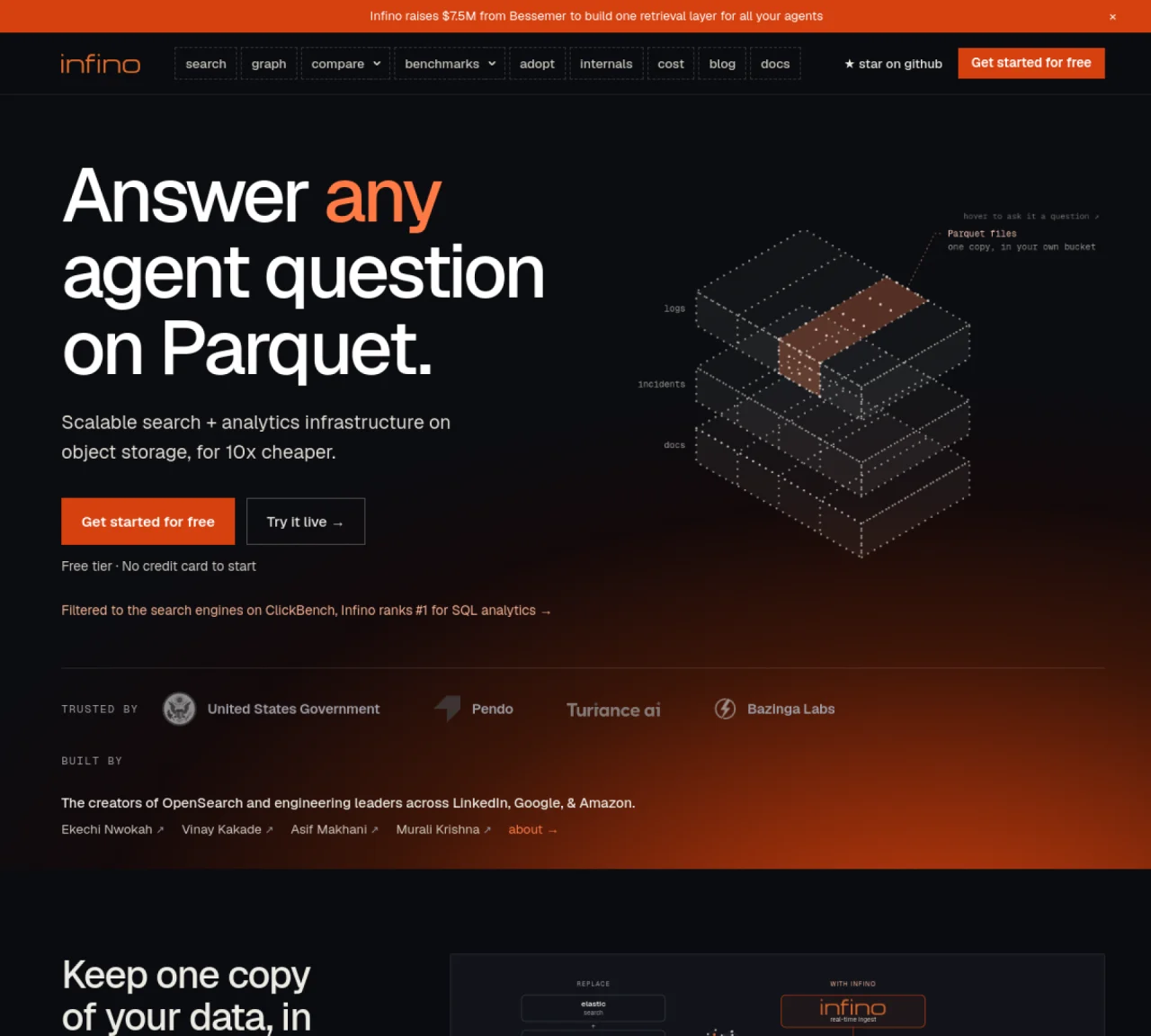
Infino provides a single retrieval layer that combines full-text, vector, and graph search capabilities on Parquet files stored in object storage. It enables agents to express complex queries in a single SQL statement, integrating keyword, semantic, and graph-based retrieval. The system supports hybrid search by combining multiple retrieval modes to improve accuracy. Data is stored in Parquet format, allowing for scalable and cost-effective analytics without requiring separate databases for different search types. Infino is designed for use cases involving large-scale logs, events, or structured datasets where retrieval speed and cost efficiency are critical. It is built to handle both small and large document sizes efficiently, with pricing based on storage, write tokens, read tokens, and returned bytes.
Infino AI provides a single retrieval layer that combines full-text, vector, and graph search capabilities on Parquet files stored in object storage. It allows agents to express complex queries in a single SQL statement, integrating keyword, semantic, and graph-based retrieval for improved accuracy and efficiency.
Infino AI is designed for use cases involving large-scale logs, events, or structured datasets where retrieval speed and cost efficiency are critical. It suits teams needing scalable search and analytics infrastructure on object storage, such as government agencies, enterprises, and engineering teams.
Infino AI's pricing is based on storage, write tokens, read tokens, and returned bytes. The cost model measures ingest work with write tokens, query work with read tokens, and charges for the volume of data returned. There is an account minimum, and costs scale with usage.
Yes, Infino AI can replace Elasticsearch, vector databases like Qdrant or Pinecone, graph databases like Neo4j, and analytics warehouses like Snowflake or Databricks. It consolidates these functions into a single system operating on Parquet files in object storage.
Infino AI supports real-time ingest of Parquet files from object storage systems like S3, GCS, and Azure Blob. It also integrates with table formats such as Iceberg and Hudi, and allows SQL-based hybrid search combining keyword, semantic, and graph retrieval methods.
Users can get started with Infino AI by signing up for a free tier, which does not require a credit card. The platform offers live demos and documentation to guide integration and setup, including replacing existing search and database tools with Infino's unified retrieval layer.
infino.ai · third-party estimates from Similarweb
Last 3 months · grows by one month every month
Share of visits by channel
Share of visits · estimated visits
Coding & Development · Sep 2026
Traffic figures are third-party estimates, good for scale and trends; they can differ from a company's own numbers. Updated monthly.
We use essential cookies to run aitoolnavio™, and optional cookies to analyze traffic and measure our marketing. You choose what we use — optional cookies stay off unless you turn them on. See our Privacy Policy.
One short email a week: fresh tools worth trying, honest takes and the updates that actually matter. No spam, unsubscribe any time.
Scales efficient language processing with open-source accessibility.
Collaboration and version control platform for software development and AI model hosting.
Tesla’s AI stack powers Full Self-Driving, Optimus humanoid robots, and real-world autonomy with neural networks, custom hardware, and Dojo-scale training.
Integrates AI into Airtable to analyze data, summarize insights, draft content, and automate workflows without prior AI experience.
AI-powered website builder that generates a professional site in under a minute and includes tools for content, SEO, and analytics.
Unified platform to access and switch between hundreds of AI models like ChatGPT, Claude, and Gemini via a single API.
xAI builds Grok frontier AI models for reasoning, coding, voice, images, video, enterprise workflows, and developer APIs.
Meta AI enhances machine learning, NLP, and computer vision capabilities.
Crowdsourced platform for blind, side-by-side AI model comparisons with a public leaderboard.
Customize, deploy, and control AI models securely.
Independent benchmarks comparing AI models on quality, speed, and cost across multiple capabilities.
Chat, build, and explore with open AI models.
Matched on what this tool does — grouped by the job you would be replacing.
matches Full-text search on Parquet files · Vector search with embeddings · Graph search for linked data relationships
Search, analyze, and visualize large datasets for valuable insights with minimal setup.
Column-oriented OLAP database for real-time analytics at scale
Vector and full-text search database built on object storage
Search, automate data mining & analytics, gain competitive edge with AI.