GitHub hosts HunyuanVideo, Tencent's open-source framework for large-scale video generation models, enabling AI-driven video creation.

Jarvis/HuggingGPT
$0.07Starting price
0Popularity
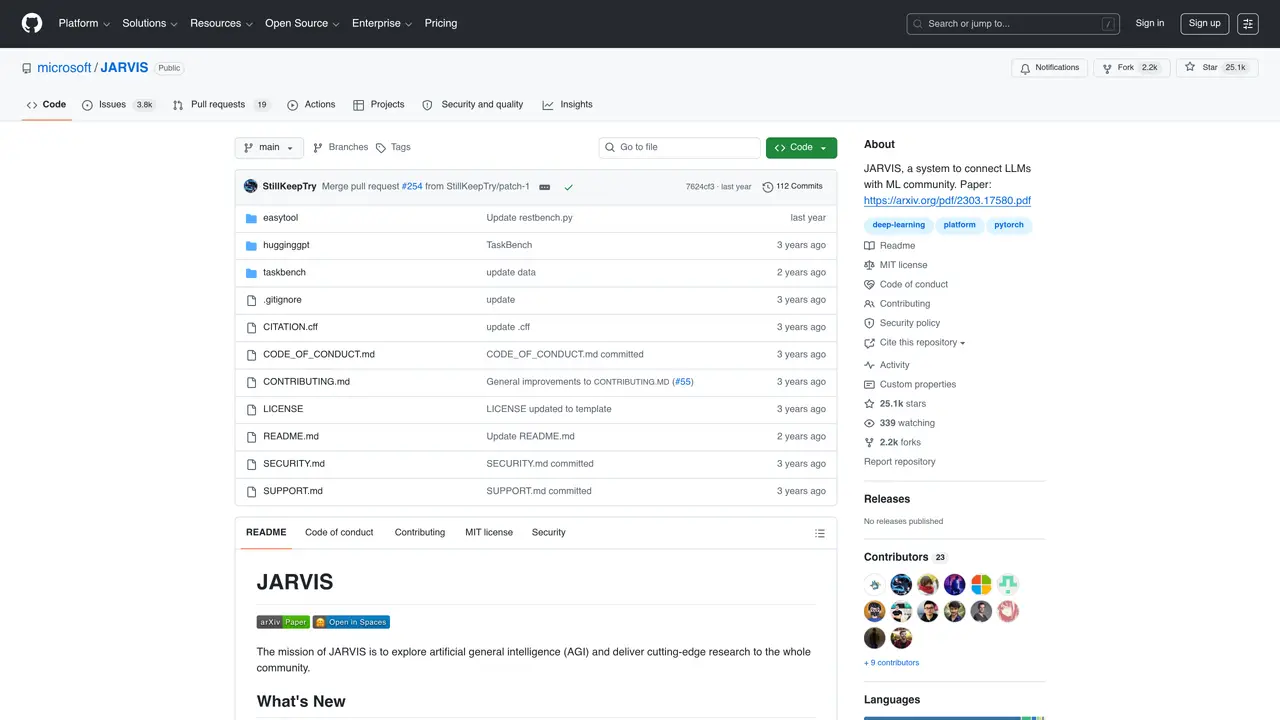
About Jarvis/HuggingGPT
JARVIS, developed by Microsoft, serves as a bridge between Language Model Managers (LLMs) and the broader machine learning (ML) community. The platform enables LLMs to publish their models and receive structured feedback from ML experts, fostering collaboration and knowledge exchange. It allows ML practitioners to efficiently search for existing language models, explore their applications, and gain insights into their performance and usage patterns. JARVIS is designed to streamline the process of model sharing and evaluation, making it easier for researchers and developers to contribute to and benefit from collective advancements in ML. The platform features an intuitive interface that simplifies model uploads for LLMs and model discovery for ML experts. By facilitating transparent communication and feedback loops, JARVIS aims to accelerate innovation in language model development and deployment. It also supports the dissemination of cutting-edge research, ensuring that users stay informed about the latest trends and breakthroughs in the field.
GitHub, Inc.
San Francisco, California, US · Founded 2008
- Founders
- Tom Preston-Werner, Chris Wanstrath, PJ Hyett, Scott Chacon
- Founded
- 2008
- Headquarters
- San Francisco, California, US
- Legal status
- Subsidiary of Microsoft (NASDAQ: MSFT)
Key features
- Publish language models
- Receive feedback from the ML community
- Search for existing language models
- Access models and gain insights
- Stay updated with ML research and development
- Intuitive user interface
Use cases
- Language Model Managers (LLMs) can publish their models and receive feedback.
- ML experts can easily search for existing language models and see how they are being used in various applications.
- Researchers and developers can stay up-to-date with the latest advancements in ML research and development.
Pros
- Enables collaboration between LLMs and expert models from Hugging Face Hub for solving complex AI tasks
- Supports task planning, model selection, execution, and response generation through a structured workflow
- Provides multiple deployment modes including CLI, Gradio demo, and web API for accessibility
- Includes lightweight configurations for easier local deployment and testing
- Facilitates research and development in AI by integrating cutting-edge models and tools
Cons
- Requires significant system resources for full deployment, including high VRAM and disk space
- May involve complex setup and configuration for optimal performance
- Dependent on external models and services, which could introduce latency or compatibility issues
Frequently asked questions about Jarvis/HuggingGPT
What is JARVIS and how does it work?
JARVIS is a system developed by Microsoft that connects large language models (LLMs) with the machine learning community. It enables LLMs to collaborate with expert models hosted on Hugging Face Hub to solve complex AI tasks through a four-stage workflow: task planning, model selection, task execution, and response generation.
Who is JARVIS designed for?
JARVIS is designed for researchers, developers, and users interested in leveraging LLMs and expert AI models to solve tasks collaboratively. It is particularly useful for those exploring task automation, model integration, and AI system collaboration.
What are the system requirements for running JARVIS?
JARVIS has two configuration modes: default (recommended) and minimal (lite). The default mode requires Ubuntu 16.04 LTS, at least 24GB VRAM, 16GB RAM, and over 284GB disk space, while the minimal mode has no additional requirements beyond Ubuntu 16.04 LTS.
Does JARVIS support cloud-based LLMs like GPT-4?
Yes, JARVIS supports cloud-based LLMs, including OpenAI services on Azure and the GPT-4 model, allowing users to integrate these models into the system for task planning and response generation.
How can I get started with JARVIS?
To get started, users can clone the JARVIS repository from GitHub, configure the system using provided YAML files (e.g., config.default.yaml or config.lite.yaml), and run the system in CLI mode or deploy it locally. A Gradio demo and web API are also available for easier access.
What are EasyTool and TaskBench in the context of JARVIS?
EasyTool is a component released by JARVIS to simplify tool usage for LLMs, while TaskBench is a benchmarking tool for evaluating the task automation capabilities of LLMs. Both are designed to enhance the functionality and assessment of JARVIS.