GitHub hosts HunyuanVideo, Tencent's open-source framework for large-scale video generation models, enabling AI-driven video creation.

Keras Tool
$1Starting price
0Popularity
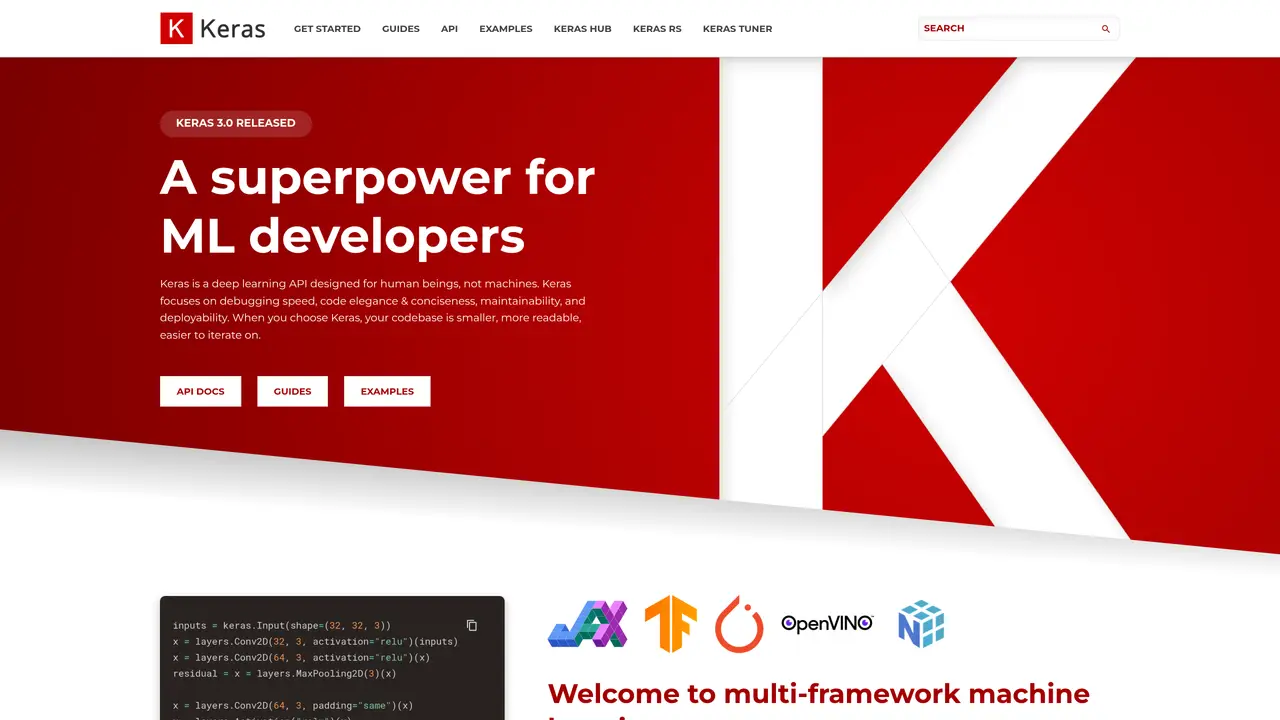
About Keras Tool
Keras is an open-source deep learning library designed to simplify the creation, training, and deployment of neural networks. It provides a high-level API that allows developers to quickly prototype and build powerful machine learning solutions with fewer lines of code. The tool supports a wide range of neural network architectures, including convolutional, recurrent, and generative models, making it versatile for various applications. Keras is optimized for both CPU and GPU computing, enabling users to leverage the speed and scalability of modern hardware. Its intuitive API makes deep learning more accessible to developers, while advanced features allow for the construction of complex models. Users can easily add layers, configure learning parameters, and define input and output data structures. Keras is widely used for tasks such as image recognition, natural language processing, and generative AI.
Key features
- High-level API for rapid model development
- Supports convolutional, recurrent, and generative neural networks
- Optimized for both CPU and GPU computing
- Intuitive layer addition and configuration
- Open-source and freely available
- Cross-platform compatibility
- Integration with TensorFlow backend
- Pre-built layers and utilities for common tasks
Use cases
- Prototyping and deploying deep learning models
- Image recognition and computer vision tasks
- Natural language processing and text generation
Pros
- Human-centered API design emphasizing code readability, debugging speed, and maintainability
- Multi-backend support enabling seamless model development across TensorFlow, JAX, and PyTorch
- Built-in methods for training, evaluation, and deployment with minimal boilerplate
- Access to pretrained models via KerasHub for rapid prototyping and inference
- Strong integration with scientific and industry organizations, including CERN, NASA, and Waymo
Cons
- May abstract away low-level optimizations, limiting fine-grained control for advanced users
- Requires familiarity with deep learning concepts to fully leverage its capabilities
- Dependency on backend frameworks (TensorFlow, JAX, PyTorch) for execution
Frequently asked questions about Keras Tool
What is Keras and who is it designed for?
Keras is a deep learning API designed for human beings, prioritizing code elegance, debugging speed, and maintainability. It is intended for developers, researchers, and practitioners who want to build, train, and deploy neural networks efficiently with fewer lines of code.
How does Keras work across different frameworks?
Keras uses a multi-backend approach, allowing models to be built and executed seamlessly across TensorFlow, JAX, and PyTorch. This flexibility enables users to leverage the strengths of each ecosystem without rewriting core logic.
What types of models can be built with Keras?
Keras supports a wide range of neural network architectures, including convolutional, recurrent, generative, and transformer models. It is suitable for tasks such as image recognition, natural language processing, and generative AI.
Does Keras provide pretrained models?
Yes, KerasHub offers a collection of pretrained model architectures with checkpoints available on Kaggle Models. These models can be used for both training and inference across TensorFlow, JAX, and PyTorch backends.
How do I get started with Keras?
Users can begin with the Keras quickstart guides, which provide step-by-step examples for building, training, and deploying models. The official documentation includes developer guides, API references, and code examples for various use cases.
Can Keras models be deployed in production environments?
Yes, Keras models are designed for deployability, with support for exporting to multiple frameworks and platforms. The library emphasizes maintainable and scalable code, making it suitable for both research and production use.