GitHub hosts HunyuanVideo, Tencent's open-source framework for large-scale video generation models, enabling AI-driven video creation.

PyTorch
$0.07Starting price
0Popularity
About PyTorch
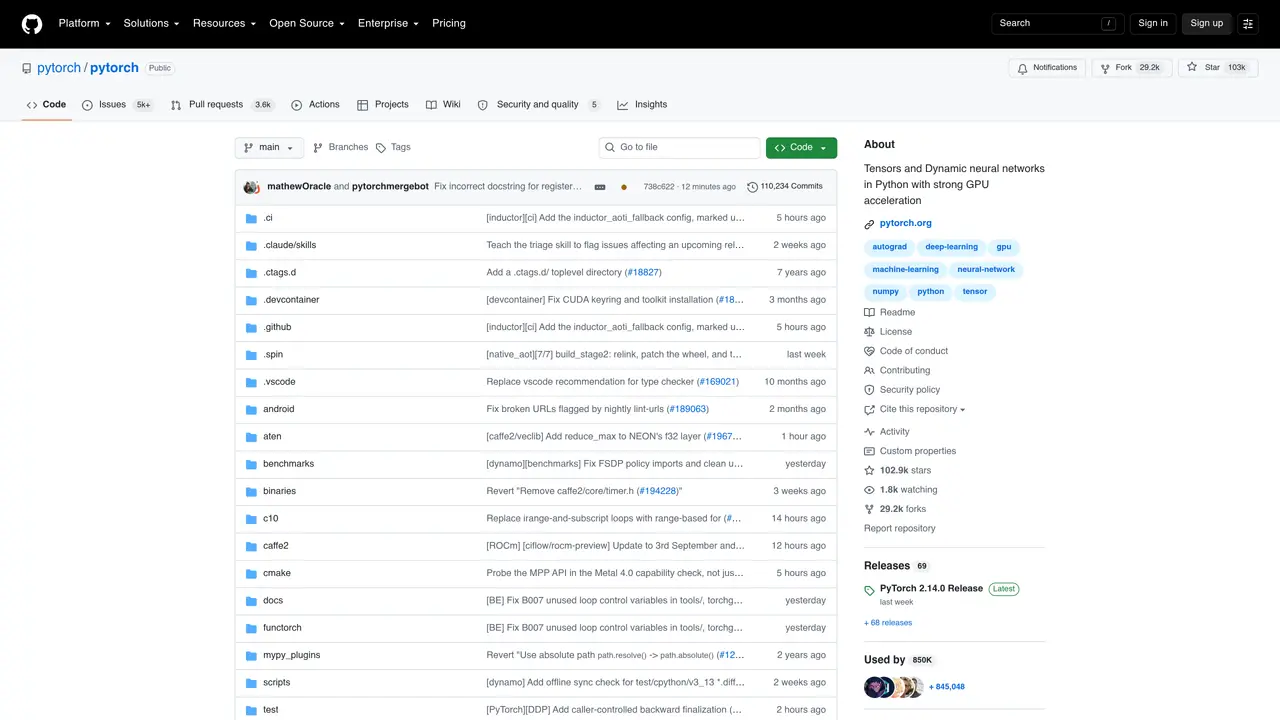
PyTorch is an open-source deep learning framework designed for tensor computation, automatic differentiation, and neural network development in Python. It supports mature CPU, GPU, CUDA, ROCm, and Intel GPU environments, making it suitable for both research and production workloads. Developers can define network behavior imperatively, run training loops, and inspect gradients through autograd, enabling experimentation and debugging close to standard scientific Python. The framework is particularly useful for experimental architectures, computer vision, language modeling, scientific computing, and recommendation systems where fast iteration and clear stack traces are essential. PyTorch integrates acceleration libraries and custom memory allocators to improve performance and memory efficiency during large model training. Its extension APIs allow teams to implement custom layers or tensor integrations in Python or C++, maintaining proximity to the core framework. The tensor library supports broad mathematical, indexing, linear algebra, and reduction operations for scientific workloads, while tape-based autograd records differentiable operations dynamically for flexible neural network structures.
GitHub, Inc.
San Francisco, California, US · Founded 2008
- Founders
- Tom Preston-Werner, Chris Wanstrath, PJ Hyett, Scott Chacon
- Founded
- 2008
- Headquarters
- San Francisco, California, US
- Legal status
- Subsidiary of Microsoft (NASDAQ: MSFT)
Key features
- Open-source deep learning framework
- Tensor computation with CPU, GPU, CUDA, ROCm, and Intel GPU support
- Automatic differentiation via autograd
- Imperative Python model code for dynamic execution
- Custom operator and layer extensions in Python or C++
- Integration with acceleration libraries and memory allocators
- Dynamic computation graphs for flexible architecture prototyping
- Prebuilt binaries and Docker images for GPU-enabled environments
- Source builds for specialized hardware configurations
- Distributed training and inference support
Use cases
- Prototyping experimental neural network architectures
- Training and deploying computer vision or language models
- Building custom operators or layers for specialized research
Pros
- Open-source and widely adopted deep learning framework with strong community support
- Provides tensor computation with GPU acceleration for efficient numerical operations
- Supports dynamic neural networks through tape-based autograd for flexible model development
- Integrates seamlessly with Python ecosystems like NumPy, SciPy, and Cython
- Offers cross-platform compatibility including CPU, GPU, CUDA, ROCm, and Intel GPU environments
Cons
- Requires familiarity with Python and deep learning concepts for effective use
- Large-scale model training may demand significant computational resources
- Complexity in building from source for custom configurations or unsupported hardware
Frequently asked questions about PyTorch
What is PyTorch primarily used for?
PyTorch is primarily used for tensor computation with GPU acceleration and building deep neural networks through its autograd system. It supports research and production workloads in areas like computer vision, language modeling, and scientific computing.
Who should use PyTorch?
PyTorch is suitable for developers, researchers, and data scientists working on machine learning projects, particularly those requiring dynamic neural networks, fast iteration, and integration with Python-based scientific computing tools.
Does PyTorch support custom hardware or extensions?
Yes, PyTorch allows teams to implement custom layers or tensor integrations in Python or C++ through its extension APIs. It also supports custom memory allocators and acceleration libraries for performance optimization.
How do I get started with PyTorch?
Getting started involves installing PyTorch via pre-built binaries or from source, depending on the hardware and use case. The official documentation provides installation guides, tutorials, and resources for building and deploying models.
Can PyTorch integrate with other deep learning frameworks?
PyTorch can be extended using Python packages like NumPy and SciPy, and it supports interoperability with other frameworks through tools like TorchScript for model serialization and optimization.
What are the system requirements for PyTorch?
PyTorch supports a range of hardware including CPUs, GPUs (NVIDIA CUDA, AMD ROCm, Intel GPU), and platforms like NVIDIA Jetson. Specific requirements depend on the installation method and intended use case.