GitHub hosts HunyuanVideo, Tencent's open-source framework for large-scale video generation models, enabling AI-driven video creation.

MarcoFLY Framework
FreeStarting price
0Popularity
About MarcoFLY Framework
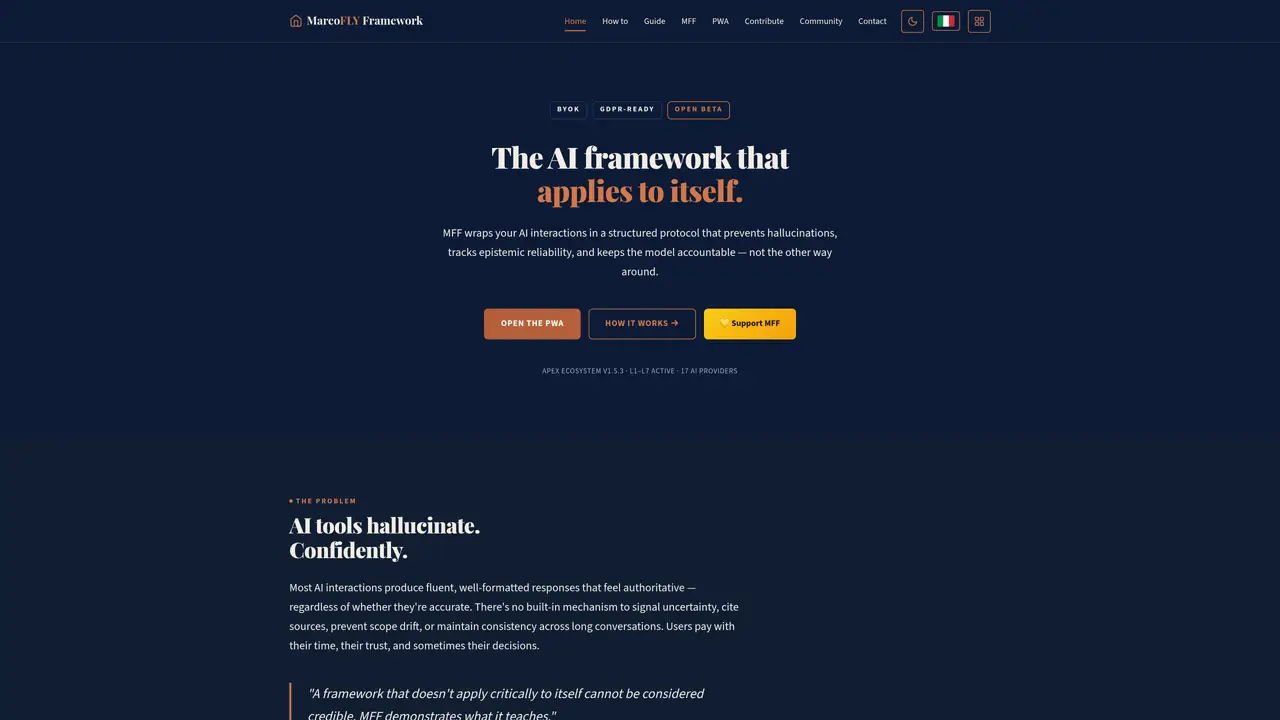
The MarcoFLY Framework (MFF) is a structured protocol designed to discipline AI model behavior during interactions. It introduces a reliability classification system where each AI response is assigned an epistemic label—such as Certain, Probable, Maybe, Depends, Unknown, or Cannot—indicating the confidence level and source status of the output. The framework operates as a text document that users paste into AI chat interfaces, functioning across multiple platforms including Claude, ChatGPT, and Gemini without requiring installation or configuration. MFF implements seven modular protection layers (L1–L7) that address hallucination prevention, scope drift, consistency maintenance, and long-session degradation. It supports Bring Your Own Key (BYOK) encryption for API keys and aligns with the NIST AI Risk Management Framework for responsible AI practices. The system also includes real-time streaming, web search integration, and peer review capabilities, with sessions stored securely and user-deletable.
Key features
- Epistemic reliability labeling (Certain, Probable, Maybe, Depends, Unknown, Cannot)
- Seven modular protection layers (L1–L7)
- Cross-provider AI validation (17 providers)
- Real-time streaming and web search integration
- BYOK encryption for API keys
- Session traceability and user-deletable data
- Peer review and open science validation
- Mobile-first PWA interface
Use cases
- Preventing hallucinations in technical architecture decisions
- Ensuring scientific rigor in research outputs
- Supporting legal and medical compliance with traceable AI outputs
Pros
- Structured epistemic labeling for every AI response
- Seven modular protection layers (L1–L7)
- Cross-provider compatibility without plugins
- BYOK encryption for API keys
- NIST-RMF alignment for responsible AI
Cons
- No free tier or open-source availability
- Requires manual pasting of protocol into chat interfaces
- Limited to text-based interaction (no native voice or image input)
- Beta status with potential instability
Frequently asked questions about MarcoFLY Framework
What is the MarcoFLY Framework (MFF) and what problem does it solve?
MFF is a structured protocol that disciplines AI model behavior by assigning epistemic labels to responses, preventing hallucinations and maintaining consistency. It addresses the issue of AI tools producing fluent but unreliable outputs without built-in mechanisms for uncertainty signaling or source verification.
Who is the MarcoFLY Framework designed for?
MFF is designed for IT professionals, researchers, legal and medical practitioners, managers, educators, and public administrators who require rigorous, traceable AI outputs for critical decision-making or compliance purposes.
How does the MarcoFLY Framework work across different AI platforms?
MFF operates as a text document that users paste into AI chat interfaces, functioning across platforms like Claude, ChatGPT, and Gemini without requiring installation or configuration. It acts as a structured interaction layer rather than a plugin or API wrapper.
Does the MarcoFLY Framework require any installation or configuration?
No, MFF is a prompt-based framework that requires no installation or configuration. Users simply paste the provided text document into their AI chat interface to activate the protocol.
What are the epistemic labels used in the MarcoFLY Framework?
MFF uses six epistemic labels—Certain, Probable, Maybe, Depends, Unknown, and Cannot—to indicate the confidence level and source status of each AI response, ensuring structural honesty and traceability.
How does the MarcoFLY Framework handle API keys and data privacy?
MFF supports Bring Your Own Key (BYOK) encryption, where API keys are AES-256-GCM encrypted server-side and never exposed to the browser or model. Sessions are stored securely and can be deleted by the user at any time.