GitHub hosts HunyuanVideo, Tencent's open-source framework for large-scale video generation models, enabling AI-driven video creation.

MCP2Skill
$9Starting price
0Popularity
About MCP2Skill
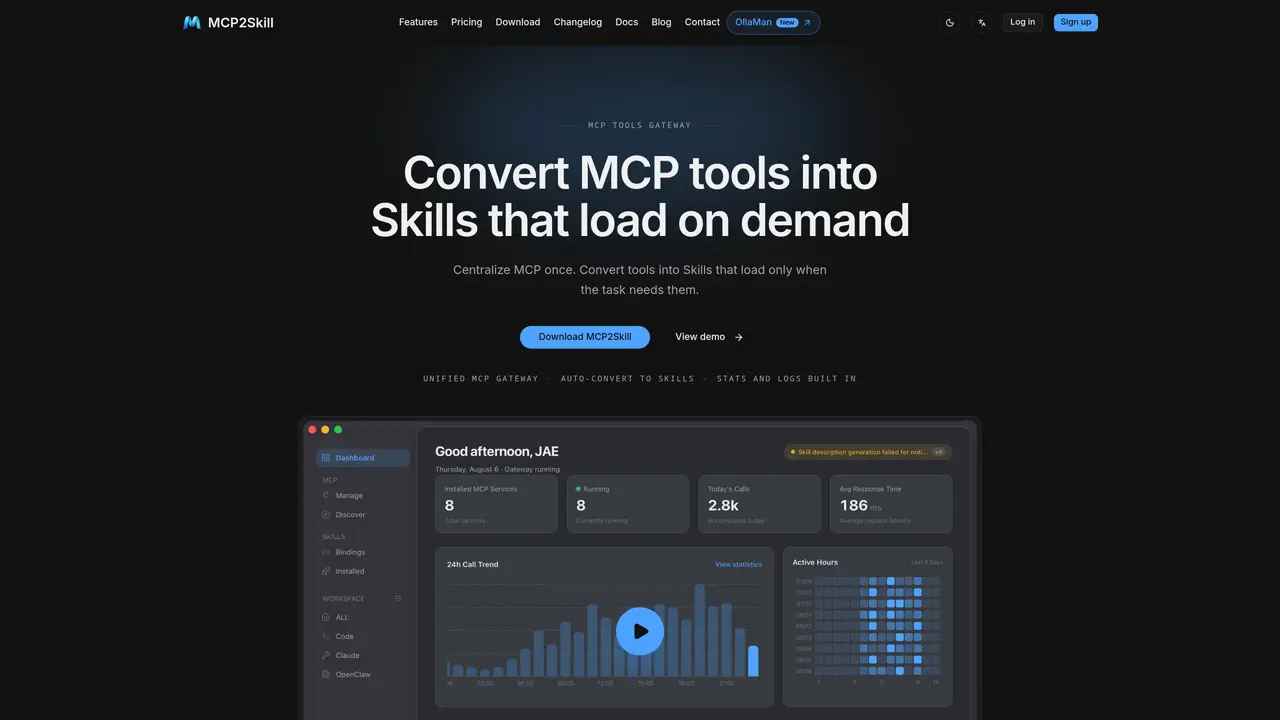
MCP2Skill centralizes Model Context Protocol tools into reusable Skills that load only when required. It provides a unified gateway for MCP services, converting raw tool schemas into structured Skill definitions with progressive disclosure. Users define capability boundaries at the workspace level, generating SKILL.md files that include instructions and scripts for high-value tasks. The tool supports auto-conversion of MCP services into Skills, with built-in statistics and logs for observability. It works across multiple AI clients including Claude Code, Claude Desktop, Cursor, Codex, and Gemini CLI. MCP2Skill aims to reduce token usage by keeping only minimal tool descriptions in context while loading full implementations on demand.
Key features
- Unified MCP gateway for centralized management
- Auto-conversion of MCP tools into Skills
- Progressive disclosure of tool schemas
- Built-in statistics and logs
- Workspace-level tool filtering
- SKILL.md generation with instructions and scripts
- Cross-client compatibility with major AI tools
- Preview generation before export or installation
Use cases
- Converting high-value MCP workflows into reusable Skills
- Centralizing MCP services for multiple AI clients
- Validating MCP setups before scaling infrastructure
Pros
- Reduces resident context by up to 90%
- Centralizes MCP setup in one gateway endpoint
- Provides built-in statistics and logs for observability
- Supports progressive disclosure of tool capabilities
- Works with multiple AI clients and MCP servers
Cons
- Free plan has limited services and workspaces
- No advanced observability views in free tier
- Lifetime plan requires one-time purchase
- Requires existing MCP infrastructure
Frequently asked questions about MCP2Skill
What is MCP2Skill and what does it do?
MCP2Skill converts Model Context Protocol (MCP) tools into reusable Skills that load only when required, reducing token usage and MCP tool overload. It provides a unified gateway for MCP services, auto-converting raw tool schemas into structured Skill definitions with progressive disclosure.
Who is MCP2Skill designed for?
MCP2Skill is designed for developers and teams using MCP-enabled AI clients such as Claude Code, Claude Desktop, Cursor, Codex, and Gemini CLI. It suits users looking to centralize MCP tools, reduce token usage, and improve observability in their workflows.
How does MCP2Skill reduce token usage?
MCP2Skill reduces token usage by keeping only a one-line description of each Skill resident in the context window, while loading the full SKILL.md and scripts only when invoked. This contrasts with raw tool schemas, which remain resident on every request.
What pricing models does MCP2Skill offer?
MCP2Skill offers a free plan for validating MCP setups and a Lifetime plan for long-term use. The free plan includes limited services and workspaces, while the Lifetime plan unlocks all premium features and provides priority access to new releases.
Which AI clients and agents does MCP2Skill work with?
MCP2Skill works with multiple AI clients and agents, including Claude Code, Claude Desktop, Cursor, Codex, and Gemini CLI. It also supports any MCP client, providing a unified gateway for MCP services.
How can I get started with MCP2Skill?
To get started, download MCP2Skill and convert one MCP workflow into a Skill to validate the setup. The free plan allows users to manage a few MCP services, create limited workspaces, and generate starter Skills before upgrading if needed.