GitHub hosts HunyuanVideo, Tencent's open-source framework for large-scale video generation models, enabling AI-driven video creation.

Megatron-LM
$0.07Starting price
0Popularity
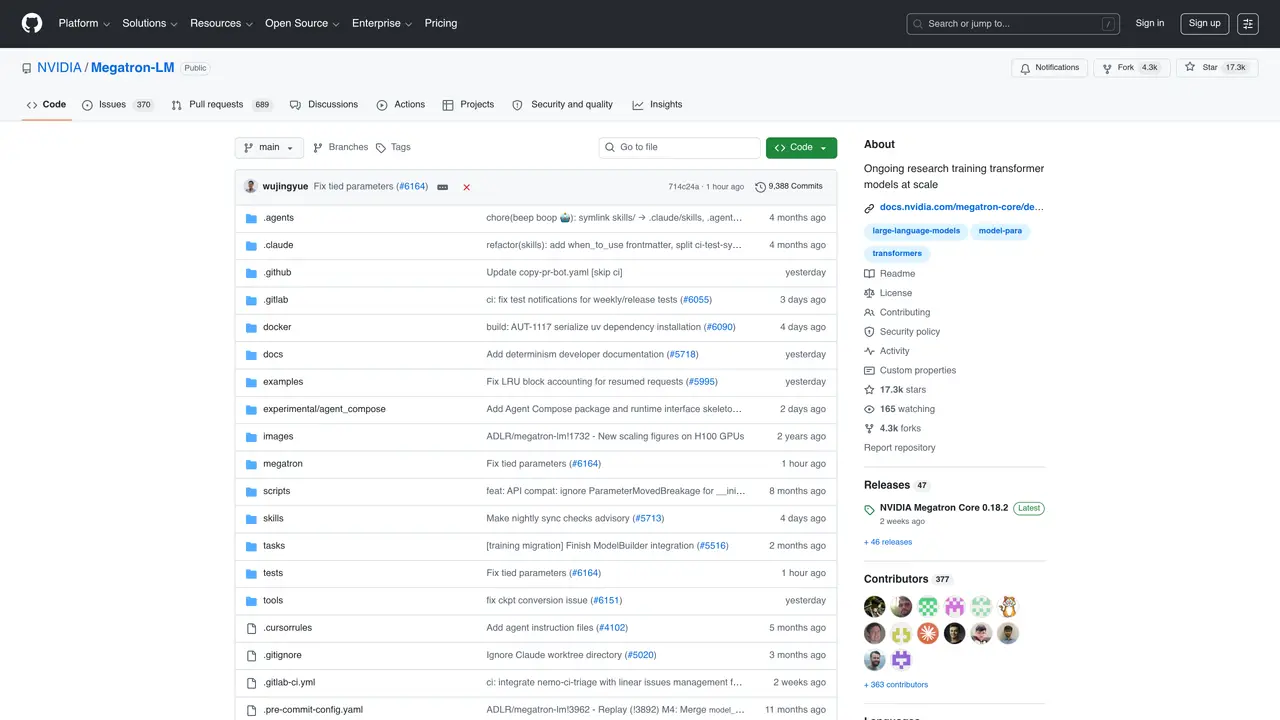
About Megatron-LM
Megatron-LM is an open source library from NVIDIA that enables developers to quickly and easily create large-scale natural language models. It is designed to reduce the time and effort needed to train and deploy these models, and to make them more accessible to all types of developers. With Megatron-LM, developers can scale their models up to over 8 billion parameters and achieve state-of-the-art performance with minimal effort. This library provides a toolkit of powerful features, including native support for TensorFlow, PyTorch, and JAX, as well as a wide range of pre-trained models for common tasks. Megatron-LM also offers various optimization techniques, such as adaptive learning rates, distributed data parallelism, and efficient memory usage, to help developers get the most out of their models. All of this makes Megatron-LM the ideal choice for anyone looking to create and deploy powerful natural language models quickly and easily.
GitHub, Inc.
San Francisco, California, US · Founded 2008
- Founders
- Tom Preston-Werner, Chris Wanstrath, PJ Hyett, Scott Chacon
- Founded
- 2008
- Headquarters
- San Francisco, California, US
- Legal status
- Subsidiary of Microsoft (NASDAQ: MSFT)
Key features
- Native support for TensorFlow, PyTorch, and JAX
- Scalable up to over 8 billion parameters
- Pre-trained models for common tasks
- Adaptive learning rates
- Distributed data parallelism
- Efficient memory usage
Use cases
- Creating large-scale natural language models for various applications
- Achieving state-of-the-art performance with minimal effort
- Scaling models up to over 8 billion parameters for complex tasks
Pros
- Open-source library from NVIDIA for training large-scale transformer models
- Supports multiple frameworks including TensorFlow, PyTorch, and JAX
- Offers advanced parallelism strategies such as tensor, pipeline, data, expert, and context parallelism
- Provides GPU-optimized building blocks and mixed precision training (FP16, BF16, FP8, FP4)
- Includes pre-trained model recipes and checkpoint conversion tools for production deployment
Cons
- Requires significant GPU resources and memory for large-scale training
- Steep learning curve for developers unfamiliar with distributed training concepts
- Building from source can be resource-intensive and may require manual configuration
Frequently asked questions about Megatron-LM
What is Megatron-LM and how does it differ from Megatron Core?
Megatron-LM is a reference implementation that includes Megatron Core along with pre-configured training scripts, designed for research teams and quick experimentation. Megatron Core, in contrast, is a composable library of GPU-optimized building blocks for custom training frameworks.
Who should use Megatron-LM?
Megatron-LM is suitable for research teams, developers learning distributed training, and those seeking quick experimentation with transformer models. Megatron Core is better suited for framework developers and ML engineers building custom training pipelines.
What parallelism strategies does Megatron-LM support?
Megatron-LM supports multiple parallelism strategies including Tensor Parallelism (TP), Pipeline Parallelism (PP), Data Parallelism (DP), Expert Parallelism (EP), and Context Parallelism (CP) to scale training across GPUs.
Does Megatron-LM support mixed precision training?
Yes, Megatron-LM supports mixed precision training with options including FP16, BF16, FP8, and FP4, enabling efficient training on GPUs.
How can I get started with Megatron-LM?
You can install Megatron-LM from PyPI using 'uv pip install megatron-core' or clone and install from source. The repository provides end-to-end training examples, installation guides, and documentation to help you begin training models.
Does Megatron-LM support model architectures beyond standard transformers?
Yes, Megatron-LM and Megatron Core support advanced architectures such as Mixture-of-Experts (MoE) models and hybrid architectures like Falcon-H1, which combines transformer and Mamba components.