GitHub hosts HunyuanVideo, Tencent's open-source framework for large-scale video generation models, enabling AI-driven video creation.

Megatron NLG
0Popularity
About Megatron NLG
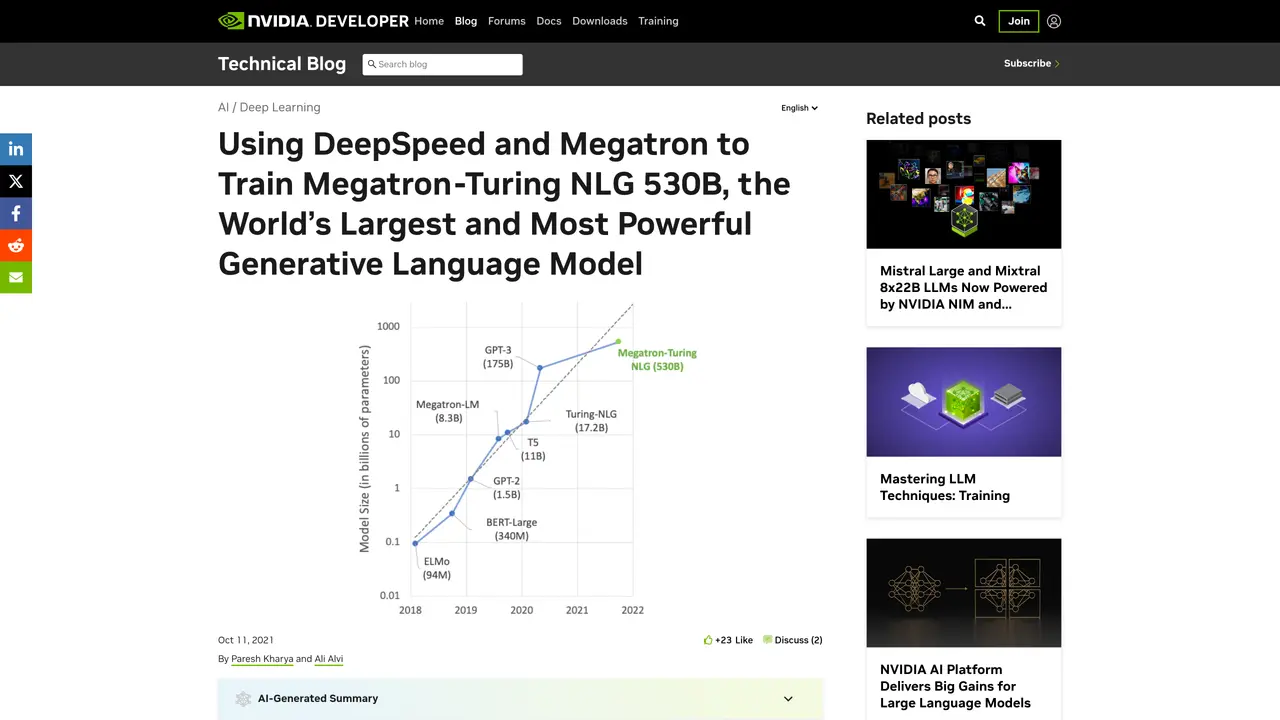
Megatron NLG is a state-of-the-art natural language generation (NLG) model developed by NVIDIA, recognized as one of the world’s largest and most powerful generative language models. Designed for developers and researchers, it enables the creation of advanced AI-driven natural language applications with high accuracy and efficiency. The model leverages a cutting-edge neural network architecture and deep learning algorithms, optimized for performance through GPU-accelerated training to deliver superior results. Megatron NLG supports a wide range of applications, including text summarization, dialogue generation, question answering, and creative content creation. Its architecture is built for scalability and flexibility, allowing users to handle diverse workloads with ease. Features such as easy-to-use APIs, optimized memory usage, and automatic scaling enhance usability and performance. The model is particularly suited for tasks requiring large-scale language understanding and generation, making it a robust solution for both research and production environments.
Nvidia
Santa Clara, United States · Founded 1993
- Founders
- Jensen Huang, Chris Malachowsky, Curtis Priem
- Founded
- 1993
- Headquarters
- Santa Clara, United States
- Legal status
- Public company
Key features
- Generate infinitely diverse and creative natural language content
- Create powerful AI-driven applications with superior performance
- Leverage Megatron NLG’s APIs, optimized memory usage and automatic scaling
Use cases
- Summarization
- Dialogue generation
- Question answering
Pros
- Largest monolithic transformer-based language model with 530 billion parameters
- Demonstrates unmatched accuracy across natural language tasks including completion prediction, reading comprehension, and commonsense reasoning
- Achieves state-of-the-art results on benchmarks such as LAMBADA, PiQA, HellaSwag, WiC, and ANLI
- Leverages advanced parallelism techniques (tensor-slicing, pipeline, and data parallelism) for efficient large-scale training
- Developed through collaboration between NVIDIA and Microsoft, combining cutting-edge GPU infrastructure with optimized distributed learning software
Cons
- Requires substantial computational resources, including thousands of NVIDIA A100 GPUs and high-speed networking
- Training and deployment complexity due to massive model size and distributed training requirements
Frequently asked questions about Megatron NLG
What is Megatron NLG and what does it do?
Megatron NLG is a 530-billion-parameter transformer-based language model developed jointly by NVIDIA and Microsoft. It specializes in natural language generation tasks such as completion prediction, reading comprehension, commonsense reasoning, and natural language inference.
Who should use Megatron NLG?
The tool is designed for developers and researchers working on large-scale natural language processing applications who require high accuracy and performance in tasks like summarization, dialogue generation, translation, and semantic search.
How does Megatron NLG achieve its performance?
Megatron NLG leverages a 3D parallelism system combining data, pipeline, and tensor-slicing parallelism, optimized for distributed training across thousands of NVIDIA A100 GPUs and high-speed InfiniBand networking.
What are the key technical innovations behind Megatron NLG?
The model uses a 105-layer transformer architecture, co-developed training recipes, and high-quality training corpora with hundreds of billions of tokens to improve optimization efficiency and stability during training.
What kind of hardware is required to run Megatron NLG?
Training and deploying Megatron NLG requires access to large-scale GPU clusters, such as NVIDIA Selene or Microsoft Azure NDv4, equipped with NVIDIA A100 Tensor Core GPUs and HDR InfiniBand networking for efficient distributed training.
Can Megatron NLG be used for zero-shot or few-shot learning tasks?
Yes, Megatron NLG demonstrates strong performance in zero-, one-, and few-shot learning settings, making it suitable for tasks where labeled data is limited or unavailable.