GitHub hosts HunyuanVideo, Tencent's open-source framework for large-scale video generation models, enabling AI-driven video creation.

Microsoft Cognitive Toolkit
$0.07Starting price
0Popularity
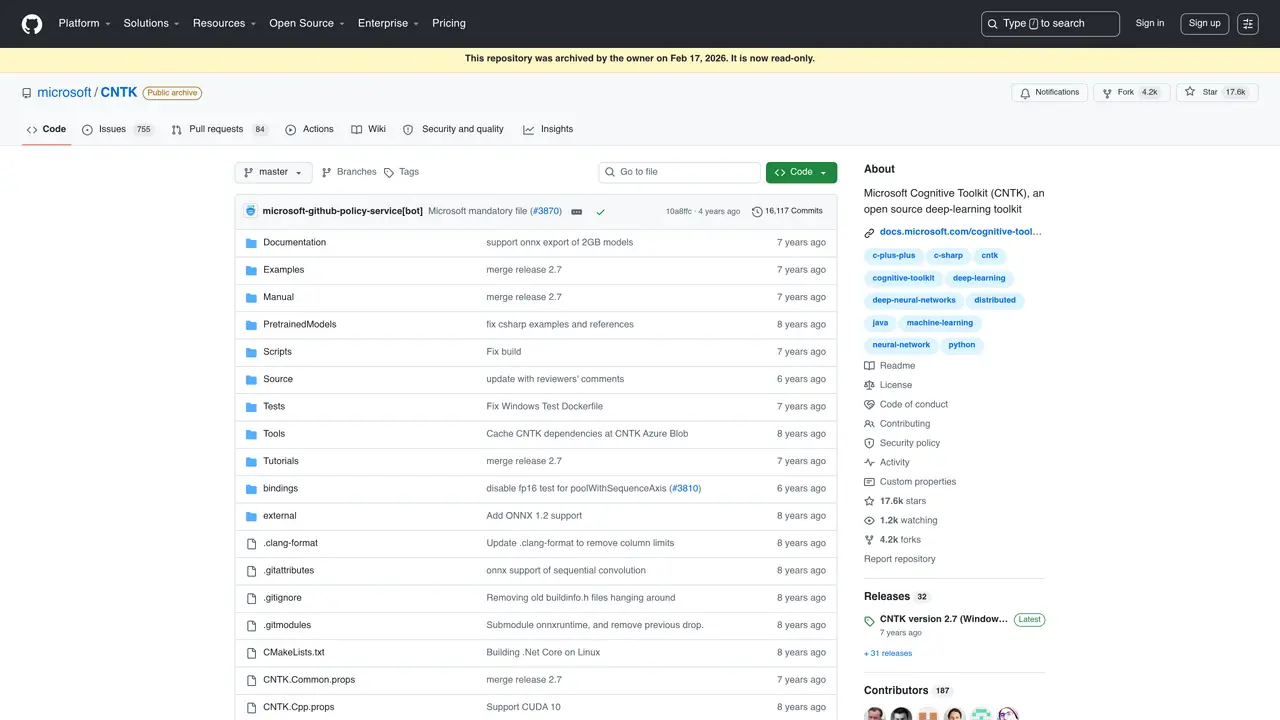
About Microsoft Cognitive Toolkit
Microsoft Cognitive Toolkit is an open-source deep learning framework that makes it easy to build, train, and deploy complex neural network models. It provides a powerful set of tools to simplify the development process and create cutting-edge models that can deliver accurate results. With its intuitive interface, Microsoft Cognitive Toolkit makes it easy to get started with deep learning, even for those with no prior experience. It features an array of powerful algorithms and tools, including gradient-based optimization techniques and state-of-the-art techniques for natural language processing and image recognition. Plus, its rich library of pre-trained models provides a great starting point for developers to create their own models. Microsoft Cognitive Toolkit is an effective and efficient tool for developers looking to build sophisticated deep learning applications quickly and easily.
GitHub, Inc.
San Francisco, California, US · Founded 2008
- Founders
- Tom Preston-Werner, Chris Wanstrath, PJ Hyett, Scott Chacon
- Founded
- 2008
- Headquarters
- San Francisco, California, US
- Legal status
- Subsidiary of Microsoft (NASDAQ: MSFT)
Key features
- Create accurate deep learning models quickly
- Simplify development process with intuitive interface
- Utilize powerful algorithms and tools
- Gradient-based optimization techniques
- State-of-the-art techniques for natural language processing and image recognition
- Rich library of pre-trained models
Use cases
- Building sophisticated deep learning applications quickly and easily
- Creating cutting-edge models that can deliver accurate results
- Developing complex neural network models with ease
Pros
- Unified deep learning toolkit representing neural networks as computational graphs
- Supports popular model types including feed-forward DNNs, CNNs, and RNNs/LSTMs
- Implements stochastic gradient descent with automatic differentiation and parallelization across GPUs and servers
- Open-source since 2015 with active community contributions and resources
- Provides full support for ONNX 1.4.1 for model interoperability and cross-platform inferencing
Cons
- Repository archived as of February 2026 with no new feature development planned
- Limited ongoing maintenance and updates post-2.7 release
- Complex setup process for development environments across Windows and Linux
- Declining ecosystem support compared to newer deep learning frameworks
Frequently asked questions about Microsoft Cognitive Toolkit
What is Microsoft Cognitive Toolkit (CNTK)?
Microsoft Cognitive Toolkit (CNTK) is an open-source deep learning toolkit that represents neural networks as a series of computational steps via a directed graph, enabling users to build and train models such as feed-forward DNNs, CNNs, and RNNs/LSTMs.
Who should use CNTK?
CNTK is designed for developers, researchers, and data scientists who need a flexible and scalable framework for building, training, and deploying deep learning models, particularly those working with complex neural architectures.
How does CNTK handle model training and deployment?
CNTK implements stochastic gradient descent with automatic differentiation and parallelization across multiple GPUs and servers, while supporting ONNX for cross-platform model deployment and interoperability.
Is CNTK still actively developed?
CNTK 2.7 is the last main release, with no plans for new feature development; however, minor bug fixes may be released on a case-by-case basis, and users are encouraged to transition to ONNX and ONNX Runtime for ongoing support.
What programming languages does CNTK support?
CNTK supports multiple programming languages, including Python, C++, C#, .NET, and Java, with dedicated APIs and documentation for each.
How can I get started with CNTK?
Users can install CNTK via Python-only, script-driven, or manual methods on Windows and Linux, or use Docker for containerized setups, and explore tutorials, examples, and documentation provided in the repository.