GitHub hosts HunyuanVideo, Tencent's open-source framework for large-scale video generation models, enabling AI-driven video creation.

ML
0Popularity
About ML
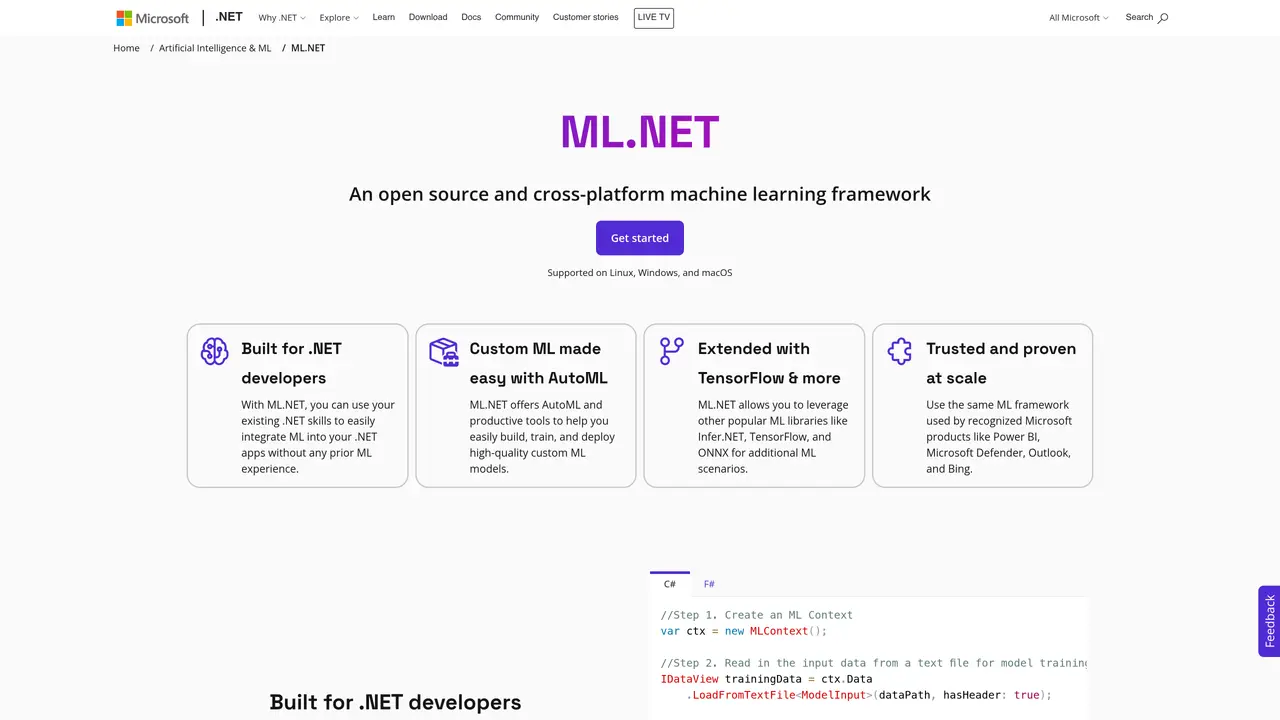
ML is a comprehensive, open-source machine learning framework for .NET developers. Using ML, developers can quickly create sophisticated models and use them to create applications that can make predictions and automate tasks. With ML, developers can easily integrate machine learning into their existing applications, allowing them to quickly add features such as voice recognition and natural language processing. By leveraging the power of ML, developers can create applications that are able to make smarter decisions and automate tasks, saving time and resources. ML makes machine learning accessible to all developers, regardless of their experience, by providing tools and libraries that are easy to use and understand. With ML, developers can experiment with different algorithms and models to find the best fit for their application, allowing them to create powerful and efficient applications. ML is the perfect solution for developers looking to create powerful applications that can make smarter decisions and automate tasks.
Microsoft
Redmond, United States · Founded 1975
- Founders
- Bill Gates, Paul Allen
- Founded
- 1975
- Headquarters
- Redmond, United States
- Legal status
- Public company
Key features
- Create sophisticated machine learning models
- Automate tasks and make predictions
- Add voice recognition and natural language processing
- Experiment with different algorithms and models
- Integrate machine learning into existing applications
- Make machine learning accessible to all developers
Use cases
- Creating powerful applications that can automate tasks and make predictions
- Adding voice recognition and natural language processing features to existing applications
- Experimenting with different algorithms and models to find the best fit for an application
Pros
- Open-source and cross-platform, supporting Windows, Linux, and macOS
- Integrates seamlessly with existing .NET applications and skills
- Offers AutoML tools like Model Builder and ML.NET CLI for simplified model creation
- Extensible to leverage other ML frameworks such as TensorFlow, ONNX, and Infer.NET
- Proven at scale with use in Microsoft products like Power BI, Outlook, and Bing
Cons
- Requires familiarity with .NET ecosystem, limiting accessibility for non-.NET developers
- AutoML tools may still require some technical understanding for optimal configuration
- Performance may vary depending on dataset size and complexity
Frequently asked questions about ML
What is ML.NET?
ML.NET is an open-source, cross-platform machine learning framework designed specifically for .NET developers. It enables integration of machine learning into .NET applications using familiar tools and languages like C# and F#.
Who should use ML.NET?
ML.NET is ideal for .NET developers who want to add machine learning capabilities to their applications without requiring prior machine learning experience. It is suitable for building web, mobile, desktop, games, and IoT applications.
How does ML.NET work?
ML.NET allows developers to create custom machine learning models by leveraging AutoML tools like Model Builder and ML.NET CLI. Users load their data, and the framework automates the model-building process, including training and deployment.
Can ML.NET integrate with other machine learning frameworks?
Yes, ML.NET is designed to be extensible and supports integration with popular frameworks such as TensorFlow, ONNX, and Infer.NET. This allows access to advanced scenarios like image classification and object detection.
What are the key features of ML.NET?
ML.NET offers AutoML for automated model building, support for multiple .NET languages, integration with existing .NET applications, and compatibility with Windows, Linux, and macOS. It also provides tools like Model Builder and ML.NET CLI for ease of use.
How do I get started with ML.NET?
To get started, visit the ML.NET documentation or GitHub repository for tutorials and sample code. Use Model Builder for a visual interface or the ML.NET CLI for command-line model creation. Both options guide users through loading data and building models.