GitHub hosts HunyuanVideo, Tencent's open-source framework for large-scale video generation models, enabling AI-driven video creation.

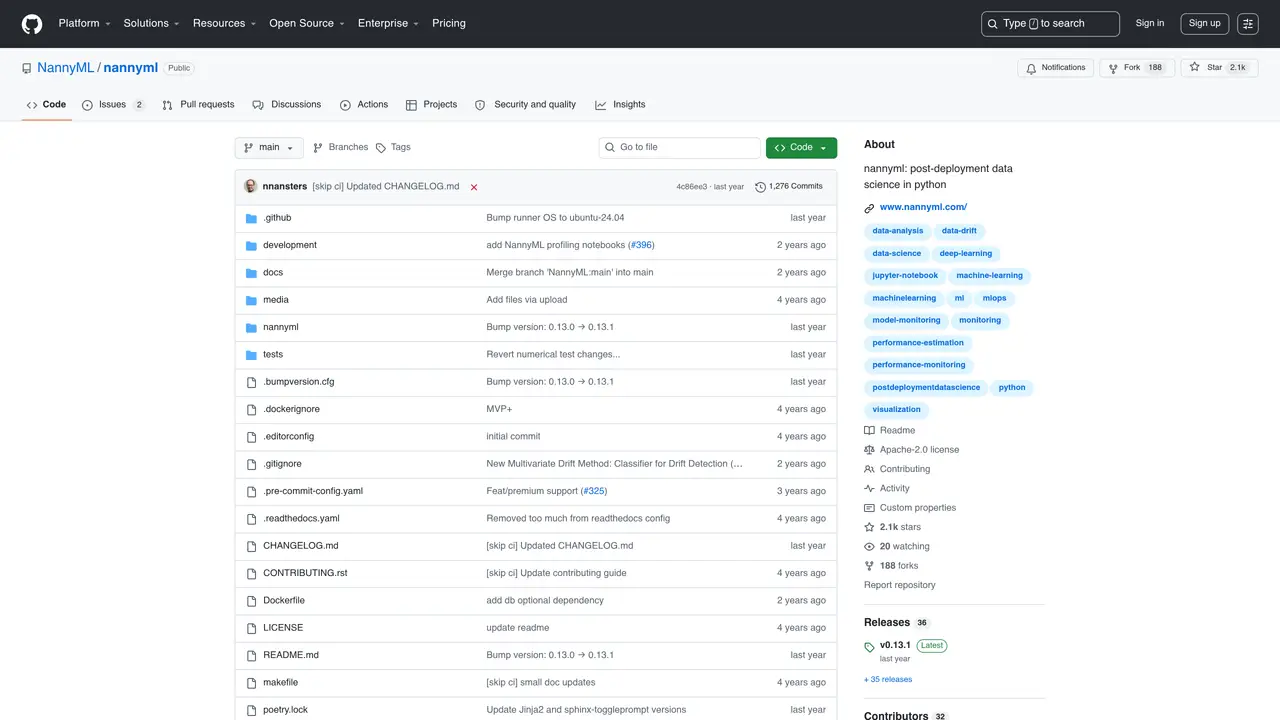
NannyML
$0.07Starting price
0Popularity
About NannyML
NannyML is a revolutionary machine learning platform designed to simplify the process of creating advanced models. It provides users with powerful tools to quickly and easily build complex machine learning models in an intuitive, user-friendly interface. NannyML focuses on helping users make the most of their data. It provides a comprehensive suite of features, such as automated feature selection, hyperparameter optimization, and data visualization. This helps users to quickly build models that can accurately predict outcomes with minimal effort. Furthermore, NannyML’s advanced algorithm selection capabilities enable users to identify the best algorithm for their data, further enhancing their model’s performance. For those new to machine learning, NannyML offers a wide range of tutorials, documentation, and support resources to get them up and running. All of this is easily accessible from the platform’s simple dashboard, making it easy for users to get the most out of their machine learning experience.
GitHub, Inc.
San Francisco, California, US · Founded 2008
- Founders
- Tom Preston-Werner, Chris Wanstrath, PJ Hyett, Scott Chacon
- Founded
- 2008
- Headquarters
- San Francisco, California, US
- Legal status
- Subsidiary of Microsoft (NASDAQ: MSFT)
Key features
- Automated feature selection
- Hyperparameter optimization
- Data visualization
- Model building
- Algorithm selection
- Tutorials and documentation for beginners
Use cases
- Building complex machine learning models with minimal effort
- Identifying the best algorithm for a given dataset
- Quickly selecting features and tuning hyperparameters for optimal model performance
Pros
- Open-source Python library with no proprietary dependencies
- Estimates post-deployment model performance without requiring target labels
- Detects data drift and links drift alerts to model performance changes
- Model-agnostic, supporting both classification and regression tabular use cases
- Provides interactive visualizations and an easy-to-use interface for data scientists
Cons
- Requires Python programming knowledge to implement and integrate
- Limited to tabular data, excluding non-tabular use cases like text or images
- Performance estimation relies on assumptions about data distribution shifts
- Community-driven development may result in slower updates compared to commercial alternatives
Frequently asked questions about NannyML
What does NannyML do?
NannyML is an open-source Python library that estimates post-deployment model performance without requiring target labels, detects data drift, and links drift alerts to changes in model performance. It supports both classification and regression tasks for tabular data.
Who is NannyML designed for?
NannyML is built for data scientists and machine learning practitioners who need to monitor and maintain the performance of deployed models. It is particularly useful for teams that lack real-time access to ground truth labels after deployment.
How does NannyML estimate model performance without target labels?
NannyML uses novel algorithms such as confidence-based performance estimation (CBPE) for classification and direct loss estimation (DLE) for regression to estimate performance metrics like ROC AUC or RMSE without needing actual outcomes.
What types of data drift detection does NannyML support?
NannyML detects multivariate data drift using a PCA-based data reconstruction approach. It helps identify shifts in data distribution that may impact model performance, reducing alert fatigue by focusing on meaningful changes.
Is NannyML model-agnostic?
Yes, NannyML is completely model-agnostic and supports all tabular use cases, meaning it can be applied to any machine learning model regardless of the underlying algorithm or framework.
How can I get started with NannyML?
Users can start with NannyML by exploring the provided resources such as 'NannyML 101' for beginners, reviewing the documentation, or joining the community Slack for support. The library can be installed via Python and integrated into existing workflows.