GitHub hosts HunyuanVideo, Tencent's open-source framework for large-scale video generation models, enabling AI-driven video creation.

opencodex
$0.07Starting price
0Popularity
About opencodex
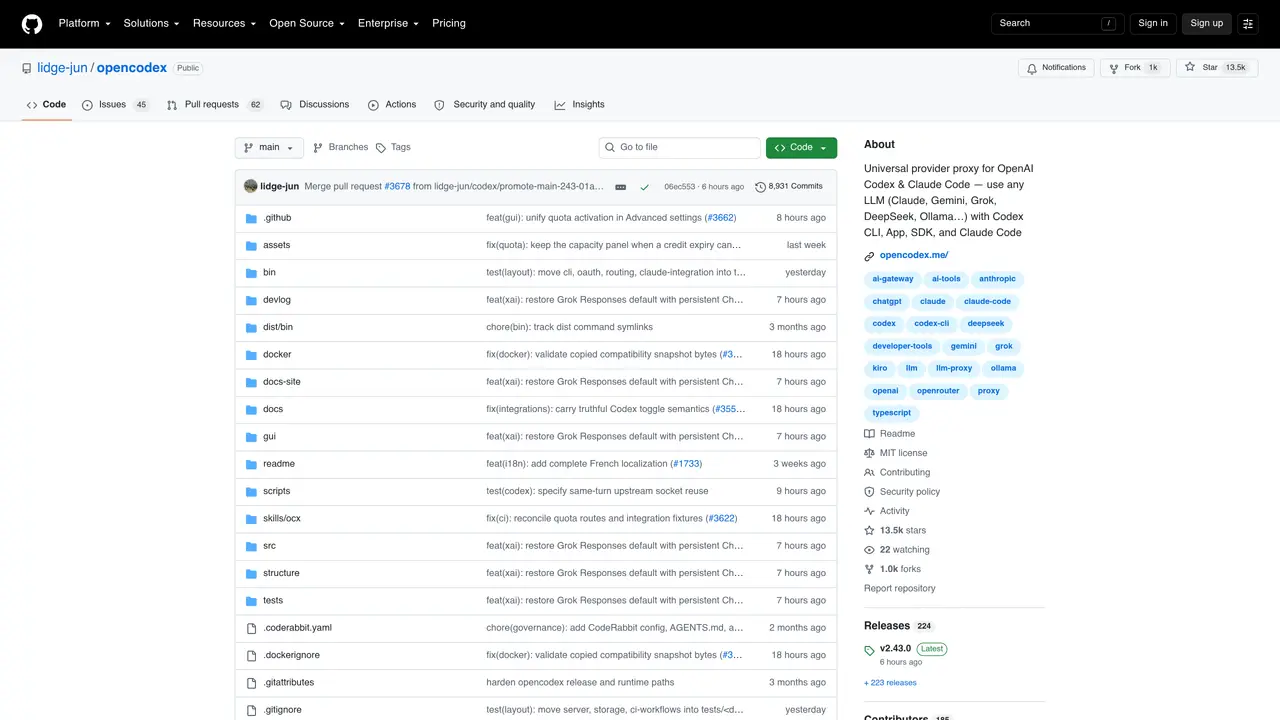
opencodex is a lightweight local proxy that translates OpenAI Codex’s Responses API into requests compatible with a wide range of LLM providers, including Claude, Gemini, Grok, DeepSeek, and Ollama. It supports Codex CLI, App, SDK, and Claude Code without requiring any changes to existing workflows. The proxy handles streaming, tool calls, reasoning tokens, and images across over 40 providers through five protocol adapters. It also manages ChatGPT account pools with features like quota tracking, session affinity, and automatic failover to ensure reliability. A web dashboard provides live request logs, provider management, and OAuth login support for streamlined oversight. The tool is designed for developers and teams who want to leverage multiple AI models seamlessly while maintaining their current workflows and tools.
GitHub, Inc.
San Francisco, California, US · Founded 2008
- Founders
- Tom Preston-Werner, Chris Wanstrath, PJ Hyett, Scott Chacon
- Founded
- 2008
- Headquarters
- San Francisco, California, US
- Legal status
- Subsidiary of Microsoft (NASDAQ: MSFT)
Key features
- Translates Codex Responses API to work with 40+ LLM providers
- Supports streaming, tool calls, reasoning tokens, and images
- Manages ChatGPT account pools with quota tracking and failover
- Five protocol adapters for broad provider compatibility
- Web dashboard for live request logs and provider management
- OAuth login support for secure access
- Session affinity and automatic failover for reliability
- No changes required to existing Codex or Claude Code workflows
- Open source and locally deployable
Use cases
- Unifying AI model usage across different providers without rewriting code
- Managing multiple ChatGPT accounts with quota tracking and failover
- Streamlining development workflows by integrating Codex and Claude Code with other LLMs
Pros
- Enables seamless switching between over 40 LLM providers without modifying existing workflows or tools
- Supports streaming, tool calls, reasoning tokens, and images across multiple providers
- Includes a web dashboard for live request logs, provider management, and OAuth login
- Manages ChatGPT account pools with quota tracking, session affinity, and automatic failover
- Lightweight local proxy that integrates with Codex CLI, App, SDK, and Claude Code
Cons
- Requires Node.js 18+ and Bun runtime for installation
- Complexity may increase for users unfamiliar with proxy setups or multi-provider management
- Dependency on local proxy setup may introduce latency in some workflows
Frequently asked questions about opencodex
What is opencodex and what does it do?
opencodex is a lightweight local proxy that translates OpenAI Codex’s Responses API into requests compatible with over 40 LLM providers, including Claude, Gemini, Grok, DeepSeek, and Ollama. It allows users to leverage multiple AI models seamlessly while maintaining their existing workflows.
Who is opencodex designed for?
The tool is designed for developers and teams who want to use multiple AI models without changing their current workflows or tools. It supports Codex CLI, App, SDK, and Claude Code, making it suitable for both individual developers and collaborative environments.
How does opencodex manage multiple LLM providers?
opencodex uses five protocol adapters to handle streaming, tool calls, reasoning tokens, and images across providers. It also includes a web dashboard for managing providers, monitoring requests, and configuring accounts.
Can opencodex manage multiple ChatGPT accounts?
Yes, opencodex can manage a ChatGPT account pool, allowing users to add accounts, track quotas, and route new sessions to the lowest-usage account while maintaining session affinity for existing threads.
What are the system requirements for installing opencodex?
opencodex requires Node.js 18+ and the Bun runtime for installation. It can be installed globally using npm or run via Docker Compose for containerized environments.
How do I get started with opencodex?
Users can install opencodex globally using npm, then start the proxy and dashboard with the command 'ocx start'. The web dashboard, accessible at localhost:10100, provides configuration options for providers and accounts.