GitHub hosts HunyuanVideo, Tencent's open-source framework for large-scale video generation models, enabling AI-driven video creation.
Plurality Network
0Popularity
About Plurality Network
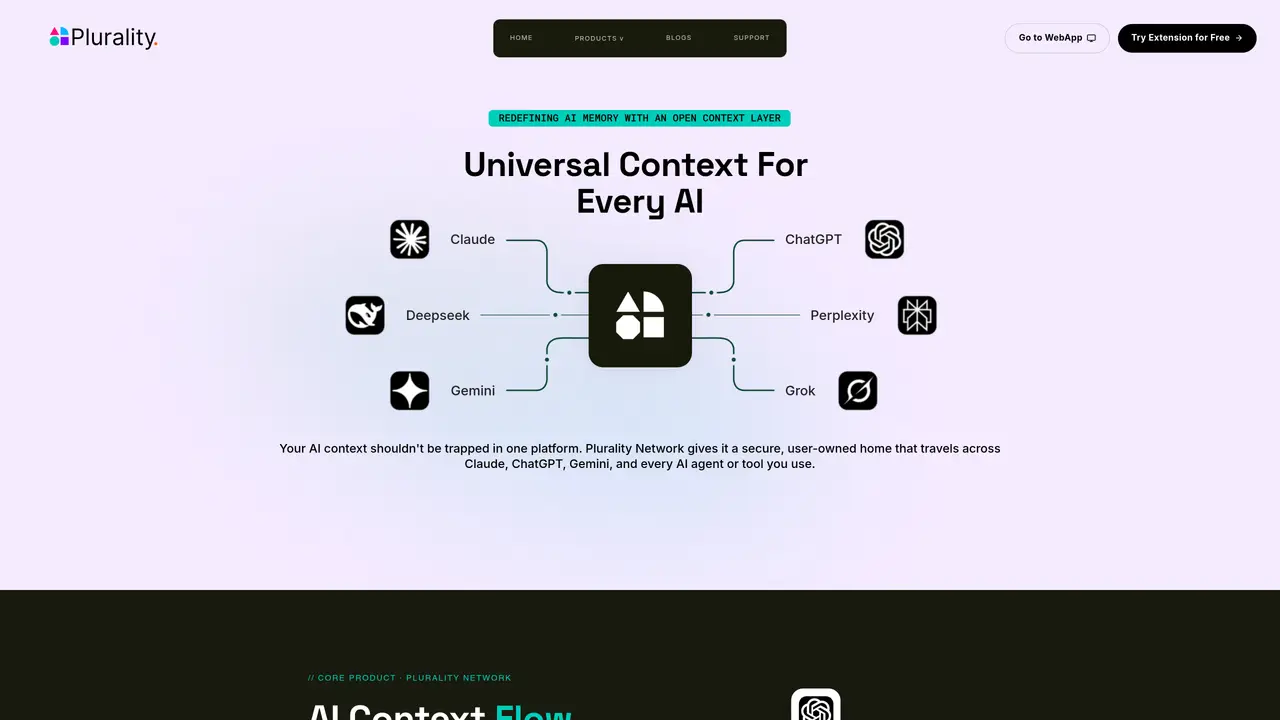
Plurality Network is an AI-powered, decentralized profile and context layer designed to eliminate AI ‘amnesia’ by preserving user memories, preferences, and smart profiles across multiple LLMs and web2/web3 applications. It uses AI to extract, organize, and serve contextual signals to agents and apps via SDKs and APIs, ensuring conversations and workflows remain personalized without repeated onboarding. Cryptographic controls and permissioned access allow users to maintain full control over their data, preventing unauthorized sharing or misuse. Developers can integrate Plurality Network to build context-aware, privacy-first experiences that adapt to individual users over time. The tool is particularly useful for anyone seeking to unify their digital identity while safeguarding personal information. By enabling persistent, cross-platform context, it reduces friction for both users and developers in AI-driven interactions. The decentralized architecture ensures scalability and resilience, making it suitable for applications ranging from personal assistants to enterprise workflows.
Key features
- Decentralized profile layer for persistent user memories
- Privacy-preserving cryptographic controls
- Cross-platform context sharing via SDKs/APIs
- Permissioned data access for users
- AI-driven extraction and organization of contextual signals
- Unified digital identity management
- Compatibility with web2 and web3 applications
- Eliminates repeated onboarding for AI interactions
- Permissionless integration for developers
Use cases
- Preserving personalized AI assistant interactions across different platforms
- Building privacy-first, context-aware applications for users
- Enabling developers to create adaptive, long-term user experiences
Pros
- Enables portable AI context across multiple platforms like ChatGPT, Claude, Gemini, Grok, and Perplexity
- Gives users full control over their data with cryptographic and permissioned access mechanisms
- Reduces repetitive onboarding by preserving preferences, writing styles, and project history
- Supports privacy-preserving identity infrastructure for Web3 applications via Oasis Sapphire
- Eliminates vendor lock-in by storing context independently of any single AI platform
Cons
- Requires users to set up and manage their context profiles, which may involve a learning curve
- Relies on browser extensions or MCP for integration, which may not cover all AI tools
- Privacy protections depend on user configuration and platform compliance
Frequently asked questions about Plurality Network
What is AI context management, and how does the Open Context Layer work?
The Open Context Layer is a user-controlled interoperable system that stores AI context—preferences, history, and identity—in a portable format. Any AI platform can access this layer, enabling seamless context management across tools without fragmentation.
Why is portable memory important for AI users?
Portable memory prevents data fragmentation by allowing users to carry their history, preferences, and workflows across AI systems. This ensures smoother, more personalized experiences without repeating context each time.
How does the context layer protect my privacy and data ownership?
The Open Context Layer uses Privacy by Design principles, including Multi-Party Compute and Trusted Execution Environments, to ensure users retain full control over who accesses their context and under what conditions.
How is the Open Context Layer different from existing AI memory solutions?
Unlike other solutions, the Open Context Layer acts as a credibly neutral settlement layer for vector embeddings, focused on contextual AI and fine-grained permissioning. It eliminates silos rather than masking them.
How do I get started with the Open Context Layer?
Users can sign up to create a portable context profile or integrate the system into their apps and agents using open APIs and SDKs. The process involves setting up a context profile and configuring access permissions.
Can I use my AI context across multiple platforms?
Yes. The Open Context Layer works across platforms such as ChatGPT, Claude, Gemini, Grok, Perplexity, and others, allowing users to maintain continuity and personalized responses regardless of the tool being used.